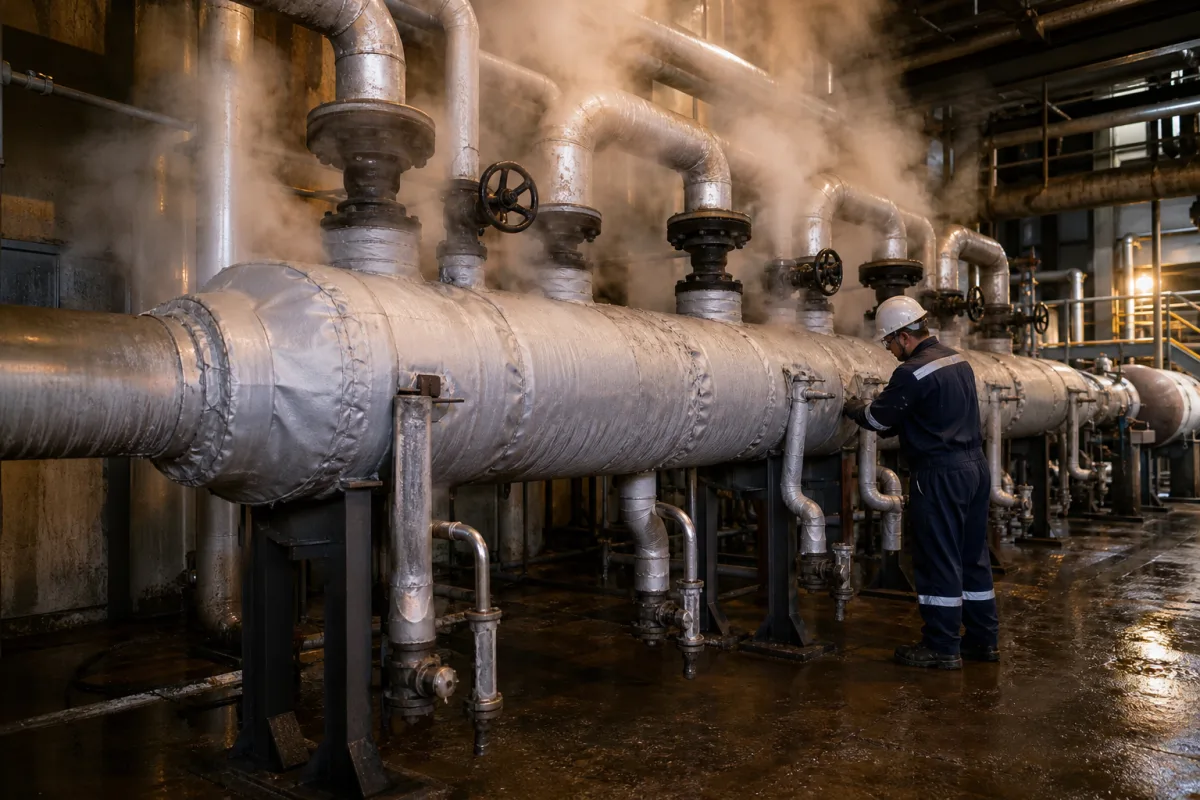
Steam header (process-area header that splits steam from a main or reducing station to two or more users)
The steam header of a process area · the manifold that takes steam from a main or a pressure-reducing station and splits it to users, sized at 10-15 m/s for the maximum incoming load, drained at its low end, branched from the top, vented at the terminal end, and built to drawings with a nozzle schedule
Where steam arrives in a process area, a header gathers it and splits it into branches for each machine or section, so each can be isolated from one place and the supply is buffered against swings in demand. The header is sized larger than the line feeding it, drained so that condensate never reaches the users, and built as a pressure part with a set of nozzles drawn for the plant. Specify the incoming maximum load, the users and their branch sizes, the drain and vent points, and the code and inspection the fabricator works to.
Steam headers that distribute steam within process areas and plant rooms, fed from a steam main or a pressure-reducing station: sizing, drainage, branch take-offs, terminal-end trapping and venting, accessories and fabrication to drawings. Boiler-house headers collecting steam from boilers are covered on the Steam distribution header (steam manifold) page; steam tracing manifolds on the Steam distribution manifold page; drain pockets on the Drip leg on a steam main page; traps on the Steam trap page. Boiler pressure-part headers (economizer, superheater, water-wall) are outside this page.
CNFX editorial research · Sources checked October 12, 2026 · 3 sources
Sizing the header on velocity at the maximum incoming load
Spirax Sarco states that "The distribution header diameter should be sized on a steam velocity of 10-15 m/s, for the maximum incoming steam load." [1] Forbes Marshall gives a header four purposes: isolating a boiler, section or equipment "from a single location", acting "as a buffer to cope with fluctuations in steam demand as the size of the header is greater than the size of the steam lines", leaving spare nozzles for future boilers, sections or equipment, and providing space for air and condensate to separate from the steam. [2]
Editorial calculation, with an assumed specific volume of about 0.46 m³/kg for saturated steam near 3 bar g (a steam-table value to be checked for the actual pressure): 2,000 kg/h is about 920 m³/h or 0.26 m³/s; at 12.5 m/s that needs about 0.021 m² of bore, an internal diameter near 160 mm. [1]
List each user with its peak steam demand and pressure, the incoming supply (main or reducing station), and spare nozzles wanted for later, so the header and branch sizes can be set on the maximum incoming load.
02
Draining, branching and venting the header
Spirax Sarco says "Steam headers should be drained in a similar way to steam mains, with a pocket suitably placed along the bottom of the manifold"; a slight fall towards the pocket helps, and "Headers longer than 5 m may benefit from a drain pocket at either end." Float traps suit fluctuating condensate loads; for headers close to boilers that may see carryover, thermodynamic traps with anti-air-binding discs are an alternative. [1]
Branches to process "should be taken from the top of the main", with a separator and trap set before the plant inlet on long or convoluted branches, and a trap set immediately before any temperature control valve. Where pipework downstream of a reducing valve could be shut off, "a trapping point should be provided to drain any condensate formed during this period", keeping the reducing valve from filling with water. Terminal ends collect air and are prone to waterhammer, so Spirax Sarco puts a trap and an air vent there on a tee. [1]
Forbes Marshall lists the accessories to fit on the header: air vent, drain trap, pressure and temperature gauge, and safety valve. [2]
Point on the header
What to fit
Source
Low point, along the bottom
Drain pocket and trap; pockets at both ends above 5 m
ORL Power fabricates steam header manifolds to "approved drawings, operating conditions, nozzle schedules and the agreed inspection scope", with material grade confirmed by project, code applicability confirmed at quotation, heat treatment where specified, and project-specific inspection and test plans. It notes that boiler headers and steam header manifolds "are not automatically interchangeable": a boiler header belongs to a boiler pressure-part circuit, while a steam header manifold distributes steam to users. [3]
Send the fabricator a drawing with the nozzle schedule (size, rating, orientation), design pressure and temperature, material, the construction code, and the inspection and test plan.
04
Process steam header details
Paste it into your enquiry below or into an email to a maker, then replace every bracket.
Supply: [main or reducing station; pressure; maximum incoming load]
Users: [list; peak demand; pressure]
Header: [diameter; length; spare nozzles]
Drainage: [pockets; traps; fall]
Venting: [terminal end air vent]
Accessories: [gauges; safety valve]
Construction: [code; material; nozzle schedule; ITP]
1 company lists this product among what they make. Company figures are quoted from each
company's own website; every card states where the relationship came from.
Suzhou Orl Power Engineering Co., Ltd.
Manufacturing site to be confirmed for the order
Fabricates steam header manifolds and boiler headers to approved drawings, nozzle schedules and project inspection plans.
Explore company information and manufacturing capabilities, then discuss the scope of your project with a relevant supplier.
Share this page
Compiled and source-reviewed by the CNFX editorial team.
Each manufacturer above links to the page on that company's own website where the product is listed, with the date we checked it. How we source and review
· Page last updated 13 October 2026
Buyer questions
How fast should steam move in a header?
Spirax Sarco sizes the distribution header diameter on 10-15 m/s at the maximum incoming steam load. [1]
Where are branches taken from?
From the top of the header or main, so they draw dry steam. [1]
What should be fitted on the header?
Forbes Marshall lists an air vent, drain trap, pressure and temperature gauge, and safety valve. [2]
Is a boiler header the same as a steam header manifold?
ORL says the terms are not automatically interchangeable; a boiler header is a boiler pressure part. [3]
Sources and what still needs a direct check
Sources checked 2026-10-12. Spirax Sarco publishes its steam trap selection guidance for mains, headers and reducing valves; Forbes Marshall publishes SteamPedia notes on headers; ORL Power describes its header fabrication.