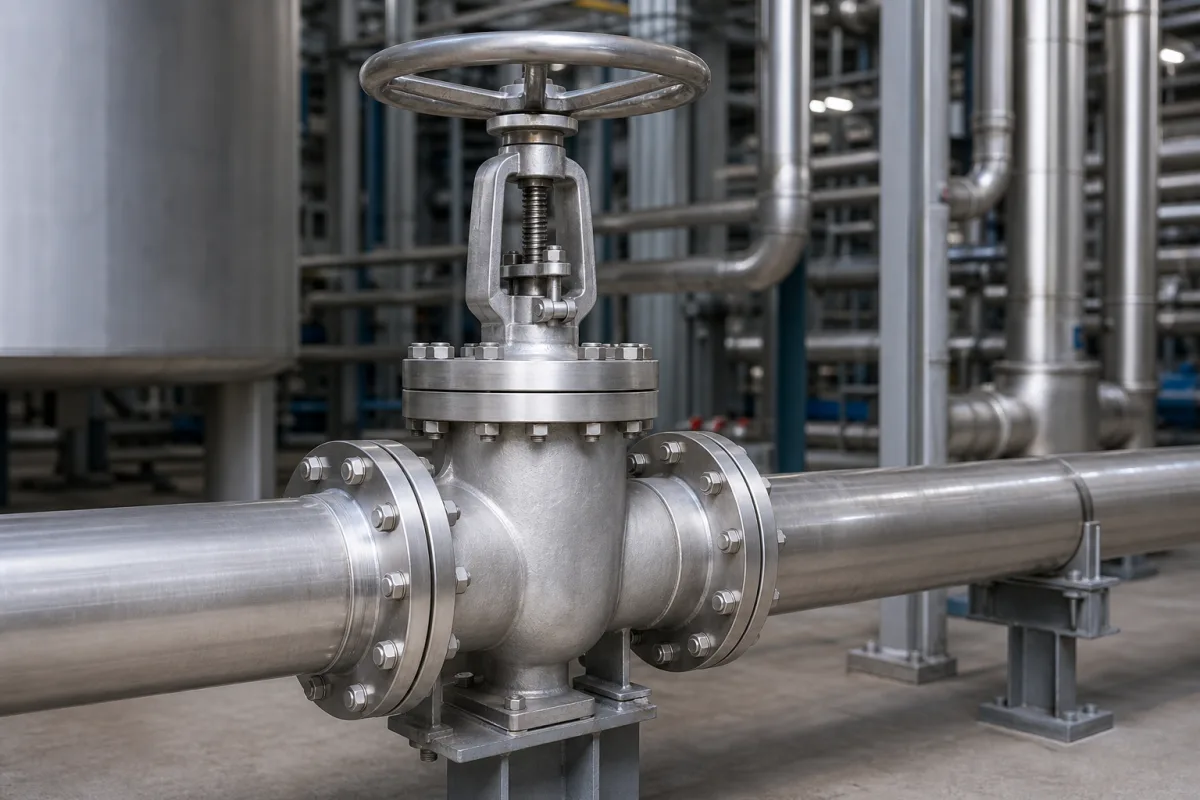
Valves that let people open up live chemical plant
The illustrated valve stands in a stainless process line beside a vessel: the kind of place where a fitter will one day need the line opened while the rest of the plant stays live. Whether one valve, two valves with a bleed, or a spade is enough is not a property of the valve; it comes from the hazard. The UK approach set out in HSE's HS(G)253, The safe isolation of plant and equipment, gives a table for it, and operators' procedures add what has to be proved before a valved isolation is relied on.
Covers isolation valves in the context of isolating chemical and process plant for maintenance: the HS(G)253 selection method and baseline isolation standards, positive, proved and non-proved isolation, double block and bleed and the proof of valve integrity, what makes a valve suitable for isolation duty, and blanks and spades. Gate valve wedge types, pressure locking and thermal binding are on Gate Valve (10249); seat-leakage test standards for valves are on the pages citing ISO 5208 and API 598.
CNFX editorial research · Sources checked October 13, 2026 · 3 sources
HSG253's baseline table: substance category against outcome factor
A presentation by an HSE specialist inspector on the key aspects of HS(G)253 sets out the selection tool of its appendix 6: classify the fluid, rate the release and the location, combine them into an outcome factor and read the baseline isolation standard.
The release factor comes from line size and pressure (for lines over 20 cm: H above 10 barg, M below 10 barg; 5–20 cm: H above 50 barg, M from 10 to 50, L below 10; under 5 cm: M above 50 barg, L below). The location factor is H for any of more than 10 people at risk, congested equipment or potential for escalation; the presentation illustrates M with 3–10 people at risk in uncongested plant, and L with 1–2 at risk and remote single items. High release at a high location gives outcome A; medium release at a low location, and low release at a medium or low location, give C; the rest give B.
R means think again and see whether the job can be done another way; I is positive isolation, II proved isolation and III non-proved isolation. The presentation adds that confined-space entry and extended-term isolations call for more: physical disconnection or spades.
Substance category
Outcome A
Outcome B
Outcome C
1 Very toxic, toxic, carcinogenic, sensitising
R
I
I
2 Flammables, petroleum, explosive, steam
R
I
II
3 Corrosive, harmful, irritant
I
II
II
4 Flammable liquids stored below flashpoint and following release
II
II
II
5 Non-classified, not stored in a harmful state
II
III
III
Table values are as shown in the HSE presentation; use the current HS(G)253 text for design and permits.
02
Positive, proved and non-proved isolation, with HSE's worked examples
The same presentation defines the three types and works five examples through the table.
Positive isolation is complete separation: spool removal, or double or single block and bleed with a spade. Proved isolation is valved with a bleed to prove effectiveness: double block and bleed, double seals in one valve body with a bleed between, or single block and bleed; for COMAH substances double block and bleed is the minimum expected. Non-proved isolation is a double or single valve with no way to prove it.
For new plant where there will be entry, toxics or a high-pressure source, the presentation gives positive isolation as the expected standard, with a suitable valve to make the isolation, for example double block and bleed plus spade.
Example
Category / release / location
Outcome
Baseline and meaning
4 in steam main at 12 barg, two fitters
2 / M / L
C
II, proved: single block and bleed minimum on each supply line; double block and bleed a must for COMAH
6 in water main, two fitters
5 / M / L
C
III, non-proved: a single valve could do, a double valve where possible
Toxic process gas, 0.3 barg, 260 °C, 450 mm pipe
1 / M / H (off-site risk)
B
I, positive: spade or spool removal
LPG, 75 mm pipe
2 / M (hot day) / H (off-site risk)
B
I, positive isolation
LPG, 25 mm pipe
2 / L / L
C
II, proved, with double block and bleed as minimum
The examples show how much pipe size and people nearby matter: the same LPG gives positive isolation at 75 mm with off-site risk and proved isolation at 25 mm in a remote spot.
03
Making double block and bleed count: proved valves, locks and a watched bleed
Valve hardware is only part of an isolation. HSE, an IChemE author and a refinery procedure each describe what the valves and the people around them have to do.
For the valve buyer this turns into a short list: the isolation duty and fluid, a position indicator, a means of locking closed, a bleed connection between blocks or between seats where proved isolation is needed, and access for maintenance. HSE's naming of ball and plug valves as the best isolation valves is worth setting against a rising-stem valve like the one illustrated before it is designated an isolation point.
Brazier's pig-receiver example shows why the valve list is never the whole isolation: the receiver also has to be depressurised, drained, purged and vented, its vent and drain connections isolated, and its relief valve kept available for as long as possible.
Requirement
Source
Valves for isolation designed for the isolation of the fluid involved; ball and plug valves named as the best for isolation, needle valves where designed for isolation duty
HSE presentation
Valve position clearly indicated; valves lockable in the closed position; isolation valves need maintenance
HSE presentation
Blanks and spades: tighter than valves, made to standards, marked, compatible with the fluid, inspected before each use, stored properly
HSE presentation
An isolation counts as double block and bleed only if the integrity of both valves has been proven; if zero pressure build-up cannot be achieved, add isolation valves or install positive isolation
PetroSA procedure
DBB used where blanks cannot be installed, e.g. welded pipelines; valves locked with chain and padlock; gas monitoring at the vent specified on the permit
PetroSA procedure
The system behind a blank is treated as live and under pressure when returning to service
PetroSA procedure
Valve integrity must be proven if an isolation is to be relied upon; in Brazier's experience company procedures have fallen short of the requirements, particularly on proving valve integrity
The Chemical Engineer (Andy Brazier)
HS(G)253 originated as a 1997 Oil Industry Advisory Committee document endorsed by HSE, later published by HSE, according to Brazier.
04
What to state when buying isolation valves
Paste it into your enquiry below or into an email to a maker, then replace every bracket.
State the fluid and its HS(G)253 substance category, line size and pressure, the isolation standard required at that point (positive, proved or non-proved), whether a bleed between seats or between two valves is needed, and how the valve will be locked. Ask for the valve type and its suitability for isolation duty, seat tightness test results, position indication, locking provision, bleed connections, and maintenance needs.
5 companies list this product among what they make. Company figures are quoted from each
company's own website; every card states where the relationship came from.
Dervos Valve Co., Ltd.
TBC
Dervos (DVS) lists gate, ball and plug valves and, in its application cases, swing-type and slide line blind valves sold as positive isolation valves for oil and gas pipelines. Isolation ratings per HS(G)253 TBC; location TBC.
Xiamen Safety Valves makes plastic valves, pipes and fittings, with isolation valves in its plastic valve range. Pressure and chemical ratings TBC; location TBC.
V&G Valogin's product collection covers ball and gate valves for European, British, North and South American and UAE markets and lists an isolation valve. Seat tightness and locking options TBC; location TBC.
ZD Valve lists butterfly, check, gate and knife gate valves with an isolation valve entry, aimed at water and industrial service. Ratings TBC; location TBC.
Zoncic's petrochemical valve solutions page covers wedge and parallel-slide gate valves and ball valves for chemical process service. Isolation-duty suitability TBC; location TBC.
Explore company information and manufacturing capabilities, then discuss the scope of your project with a relevant supplier.
Share this page
Compiled and source-reviewed by the CNFX editorial team.
Each manufacturer above links to the page on that company's own website where the product is listed, with the date we checked it. How we source and review
· Page last updated 13 October 2026
Buyer questions
When is a single valve enough for isolation?
In HSE's HS(G)253 table, only where the baseline is III, non-proved isolation, for example a 6 in water main with two fitters; a double valve is still preferred where possible. [1]
What is the difference between proved and positive isolation?
Proved isolation is valved with a bleed to prove it works (DBB, double seals with bleed, or SBB); positive isolation physically separates the plant by spool removal or a spade with block and bleed. [1]
When does double block and bleed actually count?
PetroSA's procedure accepts DBB only if the integrity of both valves has been proven; if zero pressure build-up cannot be achieved, more valves or positive isolation are needed. [3]
Which valve types suit isolation?
The HSE presentation names ball and plug valves as the best for isolation and accepts needle valves where they are designed for isolation duty; the valve must be designed for the fluid involved. [1]
Is closing valves the whole isolation?
No. Andy Brazier's pig-receiver example in The Chemical Engineer also needs depressurising, draining, purging, venting and isolating the vent, drain and relief connections. [2]
Sources and what still needs a direct check
Sources checked 2026-10-13. An HSE specialist inspector's presentation on HS(G)253, an IChemE member's article in The Chemical Engineer, and a refinery's process isolation procedure.