Editorial Technical Reference

Straightening Roll

This page explains how Straightening Roll is classified within Machinery and Equipment Manufacturing. Technical values and manufacturer relationships are research references; confirm the current specification and supplier evidence for each order.

Technical Definition & Core Assembly

A cylindrical component within a straightening roller bank that applies pressure to flatten or correct the shape of materials.
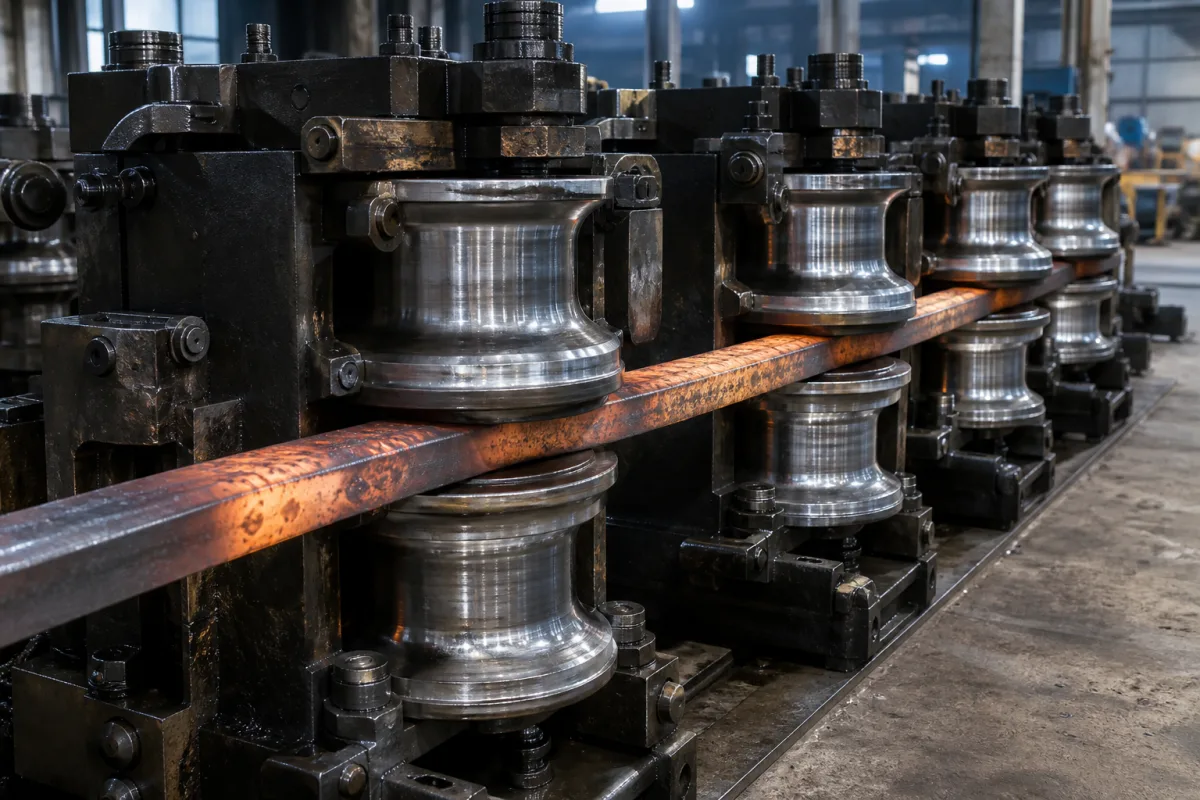
Straightening Roll in a manufacturing environment
Representative product image. Confirm appearance and specifications with the manufacturer.

Product Specifications

Technical details and manufacturing context for Straightening Roll

Definition
The straightening roll is a critical component of a straightening roller bank used in metal processing and manufacturing. It functions as the contact surface that applies controlled pressure to materials (typically metal sheets, strips, or bars) to remove bends, twists, or other deformations, ensuring the material achieves the required flatness or straightness before further processing or final use. The roll is typically made from alloy steel, hardened steel, or carbide-coated steel, with material grades such as GCr15, 42CrMo, or 9Cr2Mo, referenced to standards GB/T 18254 and GB/T 3077. Key parameters include roll diameter (80–300 mm), roll body length (500–3000 mm), straightening speed (5–60 m/min), surface hardness (HRC 45–62), surface roughness (Ra 0.2–0.8 µm), straightening accuracy (±0.05–0.2 mm/m), operating temperature (-20–200 °C), roll weight (50–2000 kg), and diameter tolerance (±0.02–0.05 mm, per ISO 286). These values are directory reference ranges and must be confirmed for the specific model and application. The roll's performance depends on correct selection based on material type, thickness, width, and desired straightness. Verification questions should address the material grade, hardness, surface finish, and dimensional tolerances relative to the intended use. Maintenance signals include excessive wear, surface damage, or loss of straightening accuracy. Failure boundaries include operating beyond the specified temperature range or applying loads exceeding the roll's capacity, which may lead to premature failure. Always verify model-specific values and standards with the legal manufacturer or supplier.
Working Principle
The straightening roll rotates while material passes through it. It applies precise mechanical pressure against the material surface, typically in coordination with other rolls in the bank. The pressure distribution and roll positioning are adjusted based on material thickness, type, and desired straightness, effectively stretching the convex side and compressing the concave side of the material to achieve uniform flatness. The roll's surface hardness and finish influence the material's final surface quality. The straightening speed and roll diameter affect throughput and the degree of deformation correction. Proper alignment and pressure settings are critical to avoid over-stressing the material or causing surface defects.
Common Materials
Alloy Steel, Hardened Steel, Carbide-Coated Steel
Technical Parameters
ParameterTypical rangeNotes & selection driver
Roll Diameter80–300 mmDetermines contact area and pressure distribution
Roll Body Length500–3000 mmMust match material width
Straightening Speed5–60 m/minAffects throughput and surface quality
Roll Surface HardnessHRC 45–62 HRCHigher hardness improves wear resistance
Surface RoughnessRa 0.2–0.8 µmCritical for material surface finish
Straightening Accuracy±0.05–0.2 mm/mTighter tolerance for precision applications
Roll Material GradeGCr15, 42CrMo, 9Cr2MoSelect based on load and wear requirementsGB/T 18254, GB/T 3077
Operating Temperature-20–200 °CExceeding may affect material properties
Roll Weight50–2000 kgAffects handling and installation
Tolerance of Diameter±0.02–0.05 mmEnsures uniform pressure across rollISO 286

Ranges are indicative industry figures for RFQ preparation, not a supplier commitment. Confirm every value and standard with the legal manufacturer before ordering.

Components / BOM
  • Roll Body Part
    Main cylindrical structure that contacts and straightens the material
    Material: Hardened Steel
  • Bearing Housing Part
    Supports the roll and allows rotation within the roller bank frame
    Material: Cast Iron or Steel
  • Surface Coating Part
    Wear-resistant layer to extend roll life and maintain surface quality
    Material: Chrome Plating or Carbide Coating

Applied To / Applications

This component is essential for the following industrial systems and equipment:

Industrial Ecosystem & Supply Chain Structure

Complementary Systems
Downstream Applications
Specialized Tooling

Application Fit & Sizing Matrix

Operational Limits
pressure: Up to 500 MPa
other spec: Material thickness range: 0.5-50 mm, Roll speed: 0.1-10 m/s
temperature: -20°C to 200°C
Media Compatibility
✓ Steel sheets ✓ Aluminum coils ✓ Copper strips
Unsuitable: Abrasive slurries or corrosive chemical environments
Sizing Data Required
  • Material yield strength (MPa)
  • Required straightness tolerance (mm/m)
  • Production throughput (tons/hour)

Reliability & Engineering Risk Analysis

Failure Mode & Root Cause
Surface fatigue and spalling
Cause: Cyclic loading from material processing leads to subsurface crack initiation and propagation, exacerbated by improper alignment or excessive tension.
Bearing seizure or premature wear
Cause: Inadequate lubrication, contamination ingress (dust, scale, coolant), or misalignment causing uneven load distribution on roll journals.
Maintenance Indicators
  • Visible surface scoring, pitting, or flaking on the roll barrel indicating material degradation.
  • Abnormal audible grinding, knocking, or vibration during operation, suggesting bearing issues or imbalance.
Engineering Tips
  • Implement precision laser alignment during installation and periodic checks to ensure parallel roll positioning and uniform load distribution.
  • Establish a proactive lubrication regimen using high-temperature, anti-wear greases, and install effective sealing systems to prevent contaminant ingress.

Indicative industry ranges for design and RFQ preparation. Confirm the exact figures and applicable standard with the manufacturer before specifying.

Compliance & Manufacturing Standards

Applicable Standards
ASTM A29/A29M-20 - Standard Specification for Steel Bars, Carbon and Alloy, Hot-Wrought DIN EN 10083-2 - Steels for quenching and tempering

Quoted from the published standard.

Manufacturing Precision
  • Bore diameter: +/-0.02 mm
  • Surface flatness: 0.1 mm per meter length
Quality Inspection
  • Dye Penetrant Test for surface defects
  • Hardness testing (Rockwell C scale) for material consistency

Manufacturers of Straightening Roll

2 companies list this product among what they make. Company figures are quoted from each company's own website; every card states where the relationship came from.

Jiangsu Hero Way Rolling Co., Ltd.
Jiangsu, CN
Listed on the company's own website · profile compiled by CNFX from public sources
Listed there as: “Straightening Roll...”
View source page ↗ millrollchina.com · checked 2026-08-27
Suzhou Jungu Precision Mould Co., Ltd.
Suzhou, Jiangsu, CN
Listed on the company's own website · profile compiled by CNFX from public sources
Listed there as: “Straightening Rolls”
View source page ↗ jungumoulds.com · checked 2026-09-10

Manufacturer listings support early research and capability understanding. They are not certification, ranking, or transaction guarantees.

Share this page
Technical documentation
Request current drawings, revision history, and a signed specification sheet.
Manufacturing capability
Verify equipment lists, process limits, capacity, and representative production evidence.
Inspection readiness
Confirm test methods, calibrated equipment, sampling plans, and traceable reports.
Supplier transparency
Check the legal entity, factory address, ownership, certifications, and direct contacts.

CNFX does not score or rank suppliers. Buyers must verify all claims and documents with the legal manufacturer before ordering.

Supply Chain Compatible Machinery & Devices

Hydraulic Press

Industrial machine using hydraulic pressure to compress, form, or assemble materials

Explore Specs →
Heavy-Duty CNC Plasma Cutting Machine

The Heavy-Duty CNC Plasma Cutting Machine is a standalone industrial device designed for cutting conductive metals such as steel, stainless steel, aluminum, and copper alloys.

Explore Specs →
Automated Powder Coating System

Integrated industrial system for applying dry powder coatings to metal substrates.

Explore Specs →
Centrifugal Pump Impeller

The centrifugal pump impeller is a critical rotating component that converts mechanical energy from the motor into kinetic energy in fluid systems.

Explore Specs →

Frequently Asked Questions

What materials are straightening rolls typically made of?

Straightening rolls are commonly made from alloy steel, hardened steel, or carbide-coated steel. Specific material grades may include GCr15, 42CrMo, or 9Cr2Mo, as referenced in standards GB/T 18254 and GB/T 3077. The choice depends on the application's load and wear requirements.

What are the typical diameter and length ranges for straightening rolls?

Directory reference ranges indicate a roll diameter of 80–300 mm and a roll body length of 500–3000 mm. These values must be confirmed for the specific model and application, as they determine contact area and pressure distribution.

How does surface hardness affect straightening roll performance?

Higher surface hardness (HRC 45–62) improves wear resistance, extending the roll's service life. However, the hardness must be balanced with the material being processed to avoid surface damage. The specified range is a reference and should be verified with the manufacturer.

What maintenance signals indicate a straightening roll needs attention?

Signs include visible wear, surface damage such as pitting or scoring, and a decline in straightening accuracy. Regular inspection of surface roughness and dimensional tolerances is recommended. If the roll no longer meets the required straightness, it may need reconditioning or replacement.

Data Basis

Editorial classification, named public sources where available, and source-reviewed manufacturer records.

Preliminary Technical Classification
This page supports structured research, RFQ preparation, and supplier evaluation. It does not replace buyer-led supplier qualification, standards review, or technical approval.
Buyer enquiry

Request manufacturing insight for Straightening Roll

Ask for use case, specification boundaries, supplier type, and RFQ preparation information for this product.

Where it goes
Straight to the CNFX editorial desk, and to the manufacturer if this product is linked to a claimed profile. Nothing is broadcast to a supplier list.
Your details stay here
We do not sell or rent enquiry data, and we do not add you to a mailing list. Used only to answer this request.
No commission, no middleman
CNFX is a directory. We take no cut of any order and never negotiate on a supplier's behalf.
What we don't claim
A listing is not an endorsement. Qualify every supplier and verify every figure yourself before ordering.

Your business information is used only to process this request.

Thank you! Your message has been sent. We'll respond within 1–3 business days.
Sorry, we couldn't send your message. Please try again, or email us at [email protected].

Need to Manufacture Straightening Roll?

Compare manufacturer profiles with relevant product and process capability.

Previous Product
Sterilization Zone
Next Product
Structural Frame (Gantry)
Get QuotesChat