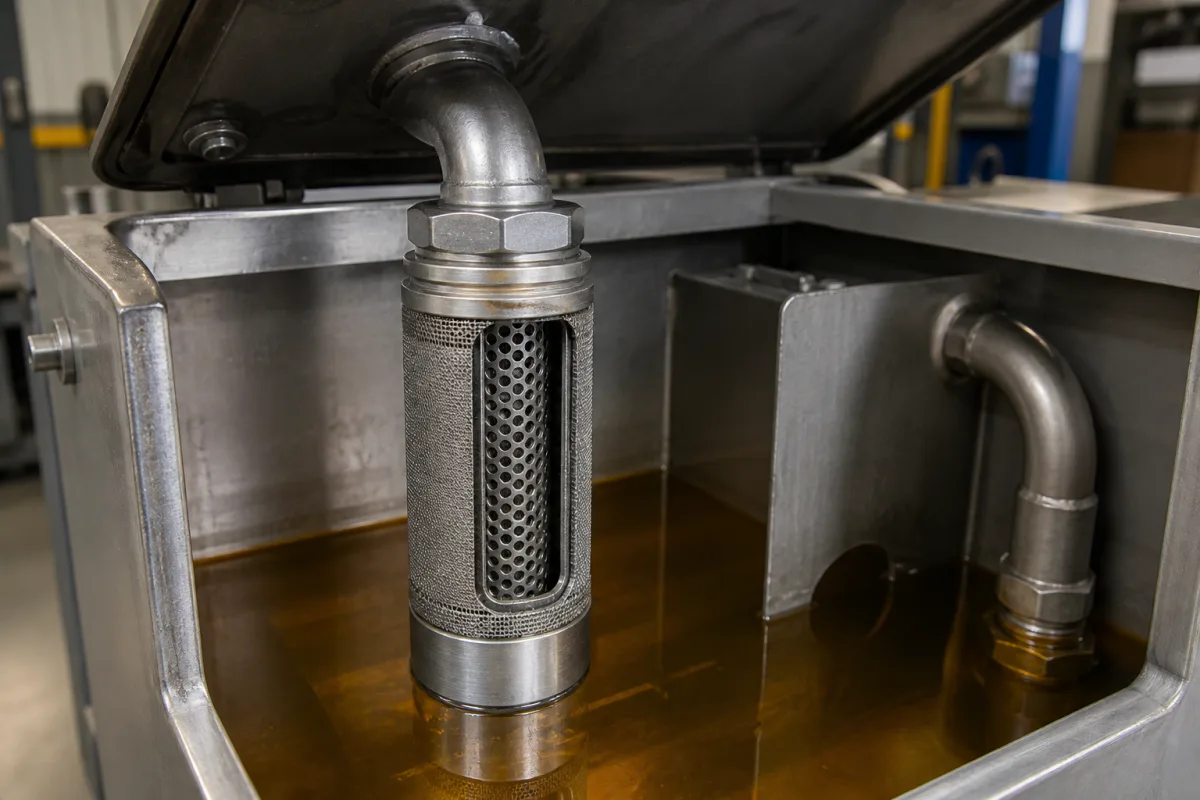
An in-tank hydraulic suction strainer is a cylindrical wire-mesh element screwed onto the pump suction pipe inside the reservoir, below the minimum oil level, to stop coarse debris reaching the pump. It is a pump-protection screen, not a cleanliness filter: its mesh is measured in tens to hundreds of micrometres and it is sized so that the clean element adds only a small pressure drop at the pump inlet. Ask three things first: the pump flow and inlet port size, the mesh rating, and whether a bypass valve is fitted for cold starts.
Hydraulic reservoir suction strainers: in-tank immersion elements with threaded connections, tank-wall mounted strainers with hose barb or flange, and magnetic suction separators, specified by flow at a stated pressure drop, mesh rating, bypass setting and connection. Pressure, return and off-line hydraulic filters rated by Beta ratio and ISO 4406 cleanliness are covered on the Hydraulic filter page. Pipeline Y and basket strainers, pump suction diffusers and fire-fighting foam suction strainers are outside this page.
CNFX editorial research · Sources checked October 12, 2026 · 3 sources
HYDAC advises that its suction strainer elements be sized for clean element pressure drops of no higher than 0.5 to 0.7 psi, and states that pressure drop will be below 2 psi within the recommended flow range with a fluid of 141 SSU and specific gravity 0.86. Its SFE in-tank elements run from 3/8 in NPT at a nominal 3 gpm to 3 in NPT at 100 gpm, and HYDAC notes that high-velocity or low-temperature applications may require a strainer with a higher flow rating. [1] Editorial calculation: 0.5–0.7 psi ≈ 0.034–0.048 bar; 100 gpm ≈ 379 l/min.
Filtrec rates its FS1 strainers at a pressure drop of 0.02 bar with a clean element and oil of 32 cSt and density 0.875 kg/dm³, gives 0.02 bar as the maximum recommended pressure drop, and lists flows from 16 l/min for a G 3/8 connection to 500 l/min for G 3 in its sizes 10 to 40. [2]
MP Filtri rates its STRC and MPAC suction strainers at a pressure drop of 0.08 bar with oil of 30 cSt and density 0.86 kg/dm³: 19 l/min at 3/8 in, 126 l/min at 1 in, 480 l/min at 2 in and 995 l/min at 3 in. It sizes suction filters on the total pressure drop of housing plus element, with corrective factors for element type and viscosity. [3]
Editorial note: the three makers rate flow at different pressure drops (0.02 bar, 0.08 bar, and 0.5–0.7 psi) and viscosities, so compare strainers only at the same Δp and fluid. Give the supplier the pump flow, the lowest start-up oil temperature and its viscosity, and the pump's permitted inlet pressure.
Send the pump type and flow, suction port size and thread, fluid type and viscosity at the coldest start, reservoir minimum oil level and space under the pipe, required mesh rating, bypass requirement, magnet option, and operating temperature range.
02
Choose a coarse mesh and decide on the bypass
Suction strainers screen coarse particles. HYDAC offers 74 µm (200 mesh) and 149 µm (100 mesh) stainless steel wire screen; its magnetic suction separators come with 74 µm, 300 µm (50 mesh) or 850 µm (20 mesh) screens. [1] Filtrec lists stainless steel wire mesh of 125 µm and 60 µm and zinc-plated steel mesh of 250 µm. [2] MP Filtri names 60 to 125 µm as the main gross filtration grades for its suction filters. [3]
A bypass valve opens when the element clogs or the oil is cold and thick. HYDAC's opens at 3 psi, to reduce high pressure drops caused by contaminated elements or high-viscosity fluid during cold starting. [1] Filtrec's is set at 0.25 bar, with a differential collapse pressure of 1 bar under ISO 2941. [2] MP Filtri's STRC bypass opens at 0.03 MPa (0.3 bar), and its wire mesh element has a 1 bar Δp rating. [3] Editorial calculation: 3 psi ≈ 0.21 bar.
HYDAC states that suction strainer elements are only intended to protect hydraulic pumps against catastrophic failure caused by coarse contaminant, should be inspected and cleaned regularly, must always be mounted below the minimum oil level of the reservoir, and should not be the only filtration in a hydraulic system; pressure and return line filters must handle fine contaminants. [1] MP Filtri describes placing suction filters under the fluid head to use the fluid's static pressure and reduce the risk of cavitation. [3]
03
Compare suction strainer arrangements
The arrangements below come from the catalogues reviewed.
Type
What the source says
Ask the supplier for
In-tank immersion element
Screwed on the suction pipe below oil level; SFE 3/8–3 in NPT. [1]
Thread, length, flow at Δp.
Tank-wall strainer with hose barb
Externally mounted with SAE tank thread (HTMS). [1]
Hose barb and SAE sizes.
Strainer with shut-off valve
SFMC up to 160 l/min; valve closes when the cover is removed. [3]
Mounting side, flange or thread.
Magnetic suction separator
Ceramic magnets along the separator; 1–3 in NPTF. [1]
YMX and ZD list suction strainers for pump inlets; confirm the in-tank hydraulic version, mesh rating and flow rating for your pump.
YMX FILTER
Manufacturing site to be confirmed for the order
Lists suction strainers for installation inside storage tanks, at the inlet of hydraulic pumps and in pipeline suction lines, alongside wire mesh filters.
Explore company information and manufacturing capabilities, then discuss the scope of your project with a relevant supplier.
Share this page
Compiled and source-reviewed by the CNFX editorial team.
Each manufacturer above links to the page on that company's own website where the product is listed, with the date we checked it. How we source and review
· Page last updated 13 October 2026
Buyer questions
What pressure drop should a suction strainer have?
HYDAC sizes for clean element drops no higher than 0.5–0.7 psi; Filtrec gives 0.02 bar as the maximum recommended drop. [1][2]
What mesh do hydraulic suction strainers use?
Coarse wire mesh: 60, 125 and 250 µm at Filtrec; 74 µm (200 mesh) and 149 µm (100 mesh) at HYDAC. [2][1]
Is a suction strainer enough filtration for a hydraulic system?
No. HYDAC states suction strainers should not be the only filtration; pressure and return line filters must handle fine contaminants. [1]
Sources and what still needs a direct check
Sources checked 2026-10-12. HYDAC, Filtrec and MP Filtri are hydraulic filter makers publishing catalogue data for their own suction strainers; their flow ratings use different pressure drops and test fluids.