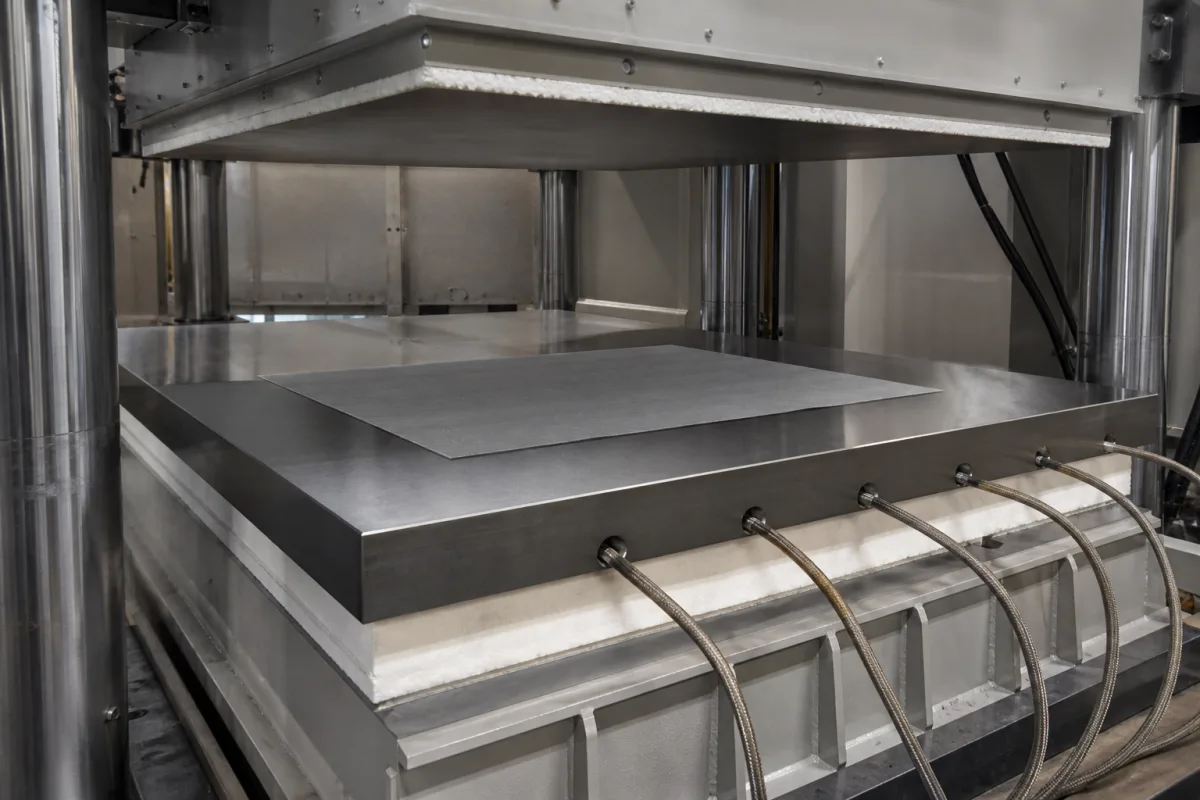
Heated press platen (electrically heated surface plate with cartridge heaters, cooling channels and an insulation board)
Heated platens for hot presses · cartridge heaters drilled through the plate, heat-up time and press force, electric versus steam and hot-oil heating, cooling channels, and the insulation board between platen and press
A heated press platen is the thick metal plate in a hot press that carries heat and pressure into the part: a laminate book, a moulding, a heat-transfer print. In an electric platen, cartridge heaters slide into holes drilled through the plate, thermocouples sit between them, and some designs add channels for cooling air, mist or water. Under the platen an insulation board keeps the heat out of the press bolster while carrying the full press force. The questions are the platen size and material, the temperature and how fast it must be reached, the press force it must carry, whether controlled cooling is needed, and what the insulation must withstand.
Electrically heated platens for hot presses — laminating, compression moulding, heat-transfer and similar presses — with their cartridge heaters, thermocouples, cooling channels and the insulation board between platen and press. Granite and cast-iron surface plates for inspection and metrology are covered on the Granite surface plate and base page. Single cartridge heaters for casting moulds are covered on the Casting mould temperature control cartridge heater page, and small heating stages for PCB dispensing on the Heating stage for underfill and adhesive dispensing on PCB assemblies page. Complete presses and steam or hot-oil heating systems are outside this page except where compared.
CNFX editorial research · Sources checked October 12, 2026 · 3 sources
Cartridge heaters through a 5-inch platen: hole count, diameter, unheated length and heat-up time
Tempco describes a heat press for transfer printing with top and bottom cast aluminium plates 44 × 48 in, 5 in thick, a total press force of 220,000 lb, and a requirement to heat from ambient to about 350 °F within 30 minutes. Sixteen holes are drilled the full length of each plate and take 3/4 in high-density cartridge heaters 45 in long, with 1 in of unheated length at the lead end, a potted end seal rated for 1,000 °F (538 °C) and a mounting flange that holds each heater against plate movement. [1]
Tempco names watt density, temperature range, insulation and ease of installation as the factors in choosing heaters for a heated press: higher watt density gives faster heat-up, and proper insulation cuts heat loss. It specifies a flexible, internally connected termination for this press because the leads see continuous movement. [1]
Editorial calculation: 220,000 lb over 44 × 48 in (2,112 in²) is about 104 psi, or 0.72 MPa, if the force acts over the whole platen; 350 °F is about 177 °C. Sixteen holes across 44 in put the heaters about 2.75 in apart if spread evenly, an assumption the source does not state.
Give the platen supplier the working area, plate material and thickness, set temperature and heat-up time, press force, the number of control zones, the cartridge heater diameter and length if replacing existing heaters, and the lead exit and termination the press movement allows.
02
Electric, steam or hot-oil platens, and counterflow cooling channels for laminating
IBM's laminating-platen patent sets out the three press types used to make printed wiring boards. Steam presses circulate fluid through the platen for heating and cooling and heat up fast with good uniformity, but are limited to peak temperatures around 450 °F. Hot-oil presses heat in the same way and are limited to around 750 °F. Electric presses use resistance cartridge heaters in the platen with separate passages for cooling fluid, and offer multi-zone control within the platen, much higher peak temperature and fewer safety concerns than oil or steam. [2]
Cooling an electric platen is the harder part. The patent describes up to three cooling modes chosen by platen temperature — air only, air with water mist, and water — and notes that cold fluid entering the passages removes heat quickly at the inlet but almost none at the outlet; at 600 °F, room-temperature air cools the inlet end fast and the outlet end hardly at all. Uneven cooling leaves stresses that bow the laminate. [2]
IBM's answer is a low-carbon steel platen with two serpentine cooling channels, one near each face, running in opposite directions, and electric heating rods inserted from both edges and interdigitated between the channels. Platens are arranged so the coolant on the two sides of the book flows in opposite directions; where more uniformity is needed, additional counterflow channel pairs form side-by-side cooling zones. The patent targets PTFE dielectric laminates for chip carriers and circuit boards. [2]
Editorial calculation: 450 °F is about 232 °C, 600 °F about 316 °C and 750 °F about 399 °C.
State the peak temperature, the cooling rate the laminate or moulding needs, the coolant available (air, mist, water), and whether heating and cooling must be zoned.
03
Insulation board under the platen: temperature, compressive strength and heat loss
The board between a heated platen and the press bolster has to stop heat flow without crushing. KNARR's 77600 insulation board lists a short-term application temperature of 210 °C, permanent compressive strength of 600 N/mm² at 23 °C and 350 N/mm² at 200 °C, and thermal conductivity of 0.19 W/mK; the datasheet drawing gives a thickness tolerance of ±0.05 mm and parallelism of 0.01/100. [3]
Editorial calculation: against the 0.72 MPa average pressure of the Tempco press above, the board's 350 N/mm² rating at 200 °C leaves a wide margin when the force is spread over the full platen; the margin shrinks where the board is cut into strips or pads. The 210 °C short-term limit is above the 177 °C of that press but below the 232 °C steam and 316 °C laminating examples, which need a board rated for those temperatures. [3][1][2]
Editorial calculation, with assumed values: a 20 mm board with λ = 0.19 W/mK between a platen at 177 °C and a bolster at 50 °C passes about 0.19 × 127 ÷ 0.02 ≈ 1,200 W/m²; over a 44 × 48 in platen (1.36 m²) that is about 1.6 kW per side of continuous heat loss the heaters must make up. [3]
Item
Published figure
Ask for
Platen (example)
44 × 48 in cast aluminium, 5 in thick, 16 heater holes [1]
Material, thickness, flatness after machining
Cartridge heaters (example)
3/4 in, 45 in long, 1 in unheated, seal rated 1,000 °F [1]
Wattage and watt density, hole fit, termination
Heating medium limits
Steam about 450 °F, hot oil about 750 °F, electric higher [2]
210 °C short-term; 600 / 350 N/mm² at 23 / 200 °C; 0.19 W/mK [3]
Rating at your platen temperature; thickness
04
Data for a heated platen quotation
Paste it into your enquiry below or into an email to a maker, then replace every bracket.
Press: [type; force; daylight; bolster size]
Platen: [working area; material; thickness; flatness and surface finish]
Heating: [set and peak temperature; heat-up time; number of zones; voltage and total power]
Heaters: [cartridge diameter and length; watt density; termination; replacements for existing holes]
Sensing: [thermocouple or RTD type and positions; controller]
Cooling: [none, air, mist or water; channel layout; cooling rate]
Insulation: [board grade and thickness; temperature rating]
Work: [laminate, moulding or transfer; release sheets or caul plates]
Explore company information and manufacturing capabilities, then discuss the scope of your project with a relevant supplier.
Share this page
Compiled and source-reviewed by the CNFX editorial team.
Each manufacturer above links to the page on that company's own website where the product is listed, with the date we checked it. How we source and review
· Page last updated 13 October 2026
Buyer questions
How are heated press platens heated electrically?
Cartridge heaters are inserted in holes drilled through the plate; in Tempco's example, sixteen 3/4 in heaters 45 in long heat a 44 × 48 in, 5 in thick aluminium plate to about 350 °F in 30 minutes. [1]
Why choose an electric platen over steam or hot oil?
IBM's patent gives peak limits around 450 °F for steam and 750 °F for hot oil, and credits electric platens with multi-zone control, much higher peak temperature and fewer safety concerns. [2]
How is a heated platen cooled evenly?
IBM's design uses two serpentine cooling channels near opposite faces with flow in opposite directions, and arranges platens so coolant runs in opposite directions on each side of the laminate. [2]
What insulation goes under a heated platen?
A compression-resistant insulation board; KNARR's 77600 is rated 210 °C short-term, 350 N/mm² at 200 °C and 0.19 W/mK. [3]
Sources and what still needs a direct check
Sources checked 2026-10-12. Tempco is a heater maker describing one customer press; the IBM patent describes laminating-press practice and its own platen design; KNARR is a mould standard-parts supplier stating its board ratings.