Industry-Verified Manufacturing Data (2026)

Heated Platens

Based on aggregated insights from multiple verified factory profiles within the CNFX directory, the standard Heated Platens used in the Rubber and Plastic Product Manufacturing sector typically supports operational capacities ranging from standard industrial configurations to heavy-duty production requirements.

Technical Definition & Core Assembly

A canonical Heated Platens is characterized by the integration of Heating Elements and Temperature Sensors. In industrial production environments, manufacturers listed on CNFX commonly emphasize Tool steel construction to support stable, high-cycle operation across diverse manufacturing scenarios.

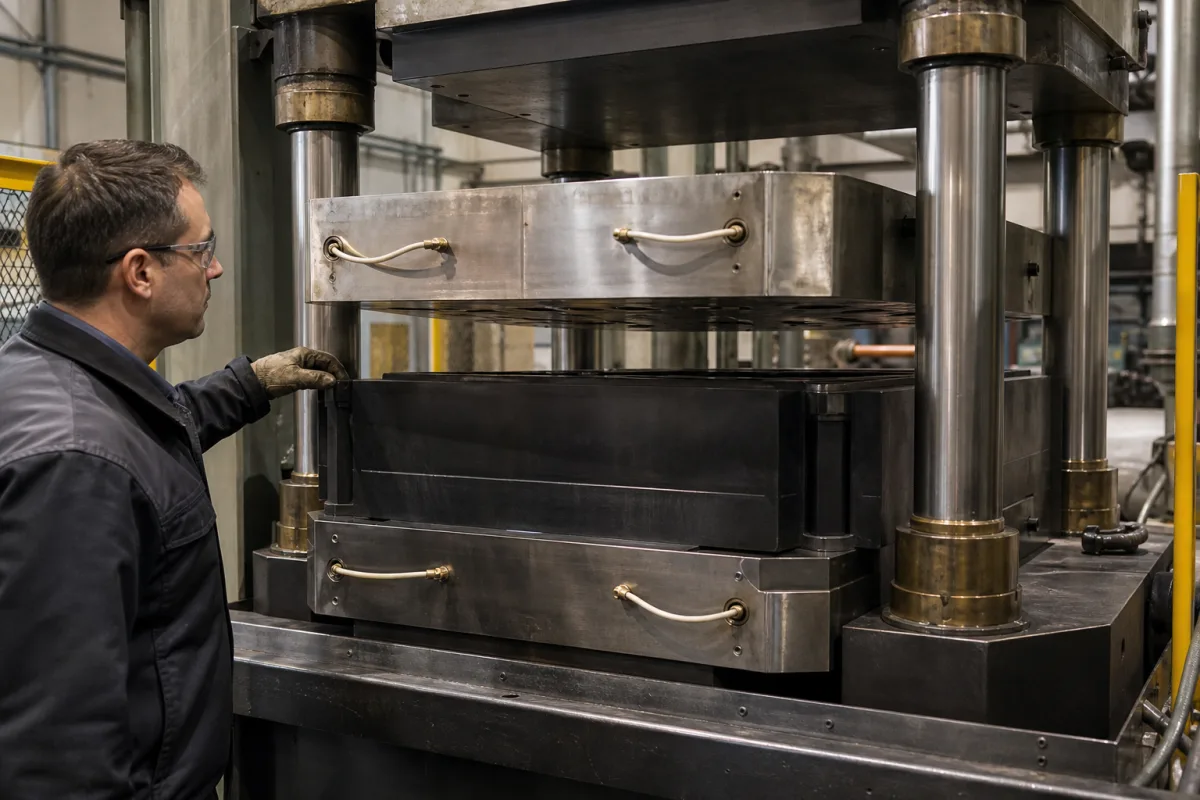
Heated metal plates that provide uniform thermal energy for vulcanizing rubber soles in molding presses.
Product Specifications

Technical details and manufacturing context for Heated Platens

Definition
Heated platens are critical components in industrial footwear sole molding presses that apply controlled heat and pressure to rubber or thermoplastic materials during the vulcanization or molding process. These flat, heated surfaces ensure uniform temperature distribution across the sole material, enabling proper curing and bonding to create durable, high-quality footwear soles with consistent thickness and material properties.
Working Principle
Heated platens operate by converting electrical energy into thermal energy through embedded heating elements (typically resistance heaters). The platens maintain precise temperature control (typically 150-200°C for rubber vulcanization) and apply pressure to the sole material placed between them. This combination of heat and pressure activates the vulcanization process, cross-linking polymer chains to create durable rubber soles with the desired shape and properties.
Common Materials
Tool steel, Stainless steel, Aluminum alloy
Technical Parameters
  • Standard platen dimensions for footwear sole molding typically range from 400x400mm to 600x800mm, with thicknesses of 40-80mm to ensure structural rigidity and even heat distribution. (mm) Per Request
Components / BOM
  • Heating Elements
    Convert electrical energy to thermal energy through resistance heating
    Material: Nickel-chromium alloy
  • Temperature Sensors
    Monitor and regulate platen surface temperature
    Material: Stainless steel with thermocouple elements
  • Insulation Layer
    Minimize heat loss to surrounding press structure
    Material: Ceramic fiber or mineral wool
  • Surface Plate
    Provide flat, durable contact surface for sole material
    Material: Hardened tool steel or stainless steel
Engineering Reasoning
150-220°C with ±2°C uniformity across platen surface
Thermal gradient exceeding 15°C/cm or surface temperature exceeding 250°C
Design Rationale: Differential thermal expansion between Invar alloy heating elements (α=1.2×10⁻⁶/°C) and steel platen body (α=11×10⁻⁶/°C) causing stress exceeding yield strength of 345 MPa
Risk Mitigation (FMEA)
Trigger PID controller integral windup during rapid temperature setpoint changes
Mode: Thermal overshoot to 280°C causing rubber scorching and platen surface oxidation
Strategy: Implement anti-windup compensation with 0.5 second time constant and temperature rate limiting at 10°C/minute
Trigger Mineral scale deposition from hard water in steam channels exceeding 2 mm thickness
Mode: Localized hot spots reaching 300°C due to 40% reduction in heat transfer coefficient
Strategy: Install inline water softener maintaining hardness below 50 ppm CaCO₃ and ultrasonic descaling system operating at 28 kHz

Industry Taxonomies & Aliases

Commonly used trade names and technical identifiers for Heated Platens.

Industrial Ecosystem & Supply Chain DNA

Complementary Systems
Downstream Applications
Specialized Tooling

Application Fit & Sizing Matrix

Operational Limits
pressure: Maximum 10-20 MPa (1450-2900 psi) depending on construction and sealing
other spec: Heating rate: 2-5°C/min, Temperature uniformity: ±2-5°C across platen surface, Power density: 5-15 W/in²
temperature: Typically 150°C to 250°C (302°F to 482°F), with specialized units up to 400°C (752°F)
Media Compatibility
✓ Natural rubber compounds ✓ Synthetic rubber (SBR, EPDM, NBR) ✓ Thermoplastic elastomers (TPE/TPU)
Unsuitable: Highly corrosive chemical environments (e.g., strong acids, chlorinated compounds) without protective coatings
Sizing Data Required
  • Required platen dimensions (length × width)
  • Target vulcanization temperature and heating rate
  • Maximum molding pressure and cycle time

Reliability & Engineering Risk Analysis

Failure Mode & Root Cause
Thermal fatigue cracking
Cause: Repeated heating and cooling cycles causing expansion/contraction stresses, often exacerbated by uneven temperature distribution or rapid thermal cycling
Surface degradation and hot spots
Cause: Localized overheating due to poor contact with heating elements, scale buildup, or electrical imbalance in heating circuits leading to material breakdown
Maintenance Indicators
  • Visible hot spots or discoloration patterns on platen surface indicating uneven heating
  • Audible popping or cracking sounds during heating/cooling cycles signaling thermal stress
Engineering Tips
  • Implement controlled ramp-up/ramp-down procedures to minimize thermal shock and maintain uniform temperature gradients
  • Establish regular infrared thermography inspections to detect early-stage hot spots and ensure even heat distribution

Compliance & Manufacturing Standards

Reference Standards
ISO 9001:2015 - Quality Management Systems ASTM E230/E230M - Standard Specification and Temperature-Electromotive Force (EMF) Tables for Standardized Thermocouples CE Marking - Directive 2014/35/EU (Low Voltage Directive) and 2014/30/EU (Electromagnetic Compatibility)
Manufacturing Precision
  • Flatness: ≤0.1 mm per meter of platen length
  • Temperature Uniformity: ±5°C across entire working surface at setpoint
Quality Inspection
  • Dimensional Verification using Coordinate Measuring Machine (CMM) for flatness and parallelism
  • Thermal Imaging and Calibration Test to verify temperature uniformity and accuracy

Factories Producing Heated Platens

Verified manufacturers with capability to produce this product in China

✓ 96% Supplier Capability Match Found

T Technical Director from Australia Feb 27, 2026
★★★★★
"Standard OEM quality for Rubber and Plastic Product Manufacturing applications. The Heated Platens arrived with full certification."
Technical Specifications Verified
P Project Engineer from Singapore Feb 24, 2026
★★★★☆
"Great transparency on the Heated Platens components. Essential for our Rubber and Plastic Product Manufacturing supply chain. (Delivery took slightly longer than expected, but technical support was excellent.)"
Technical Specifications Verified
S Sourcing Manager from Germany Feb 21, 2026
★★★★★
"The Heated Platens we sourced perfectly fits our Rubber and Plastic Product Manufacturing production line requirements."
Technical Specifications Verified
Verification Protocol

“Feedback is collected from verified sourcing managers during RFQ (Request for Quote) and factory evaluation processes on CNFX. These reports represent historical performance data and technical audit summaries from our B2B manufacturing network.”

10 sourcing managers are analyzing this specification now. Last inquiry for Heated Platens from Germany (12m ago).

Supply Chain Compatible Machinery & Devices

Modular Injection Molded Plastic Pallet

Interlocking plastic pallet system for logistics and storage.

Explore Specs →
Multi-Layer Co-Extruded Barrier Film

Plastic film with multiple layers for superior barrier properties.

Explore Specs →
High-Precision Silicone Gasket

Custom-molded silicone seal for industrial equipment.

Explore Specs →
High-Density Polyethylene Storage Container

Industrial-grade plastic container for bulk material storage and transport.

Explore Specs →

Frequently Asked Questions

What materials are best for heated platens in rubber manufacturing?

Tool steel offers durability for high-pressure applications, stainless steel provides corrosion resistance, and aluminum alloy ensures rapid heat transfer for efficient vulcanization.

How do heated platens ensure uniform vulcanization of rubber soles?

They incorporate precise heating elements, insulation layers, and temperature sensors to maintain consistent thermal distribution across the surface plate, preventing defects in molded rubber products.

What maintenance do heated platens require for optimal performance?

Regular inspection of heating elements and sensors, cleaning of the surface plate to prevent residue buildup, and calibration of temperature controls to sustain efficiency in rubber molding processes.

Can I contact factories directly on CNFX?

CNFX is an open directory, not a transaction platform. Each factory profile provides direct contact information and production details to help you initiate direct inquiries with Chinese suppliers.

Get Quote for Heated Platens

Request technical pricing, lead times, or customized specifications for Heated Platens directly from verified manufacturing units.

Your business information is encrypted and only shared with verified Heated Platens suppliers.

Thank you! Your message has been sent. We'll respond within 1–3 business days.

Need to Manufacture Heated Platens?

Connect with verified factories specializing in this product category

Add Your Factory Contact Us
Previous Product
Gasket Body
Next Product
Heated Transfer Lines