Editorial Technical Reference

Swivel Mechanism

This page explains how Swivel Mechanism is classified within Machinery and Equipment Manufacturing. Technical values and manufacturer relationships are research references; confirm the current specification and supplier evidence for each order.

Technical Definition & Core Assembly

A mechanical assembly that enables rotational movement and directional change in drive wheel systems.
Swivel Mechanism in a manufacturing environment
Representative product image. Confirm appearance and specifications with the manufacturer.

Product Specifications

Technical details and manufacturing context for Swivel Mechanism

Definition
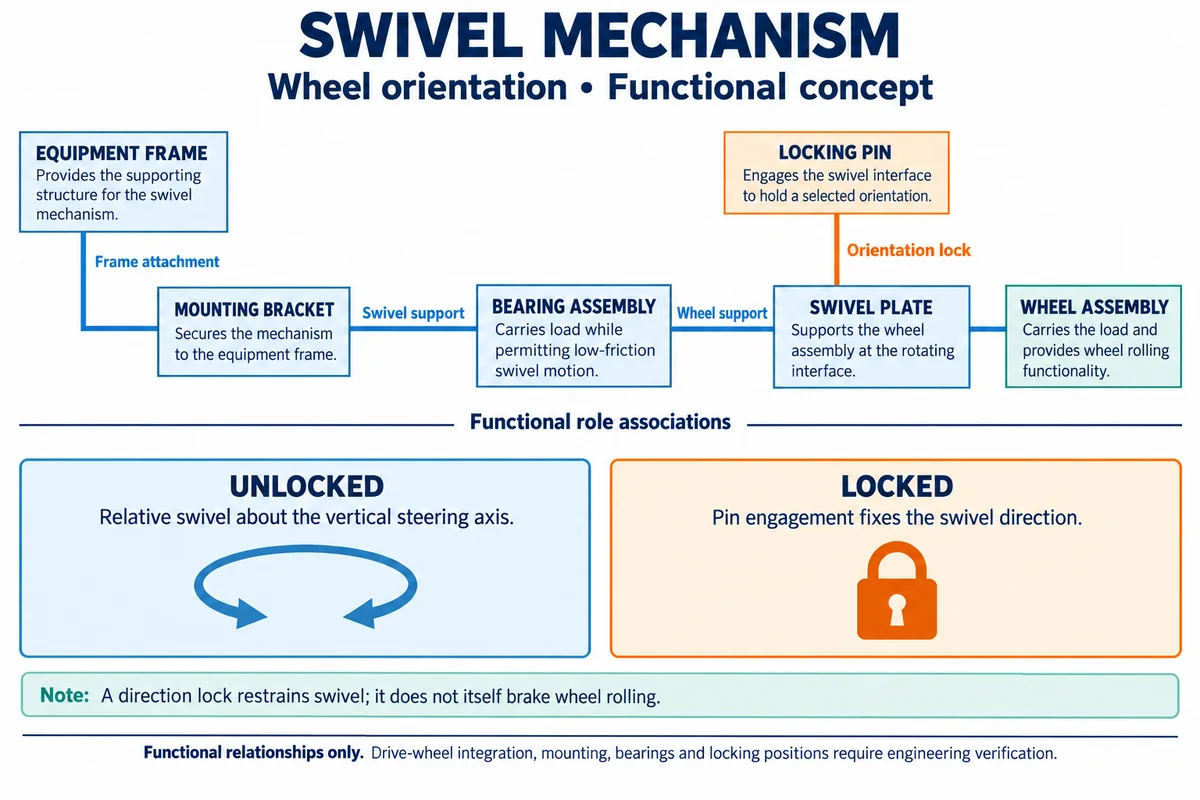
A swivel mechanism is a critical component of drive wheel assemblies that allows the wheel to rotate around a vertical axis, facilitating steering, maneuvering, and directional changes in various industrial equipment and vehicles. It typically consists of bearings, mounting plates, and locking components that provide smooth rotation while maintaining structural integrity. The mechanism is designed to support significant loads while enabling precise control of wheel orientation. It is commonly used in material handling equipment, automated guided vehicles, and other machinery requiring maneuverability. The swivel mechanism must be selected based on the specific application's load capacity, torque requirements, and environmental conditions. Verification of model-specific parameters, such as rated torque, rotation angle, operating pressure, temperature range, rotational speed, positioning accuracy, backlash, load capacity, IP rating, material, and weight, is essential. These values are reference ranges and must be confirmed with the legal manufacturer or supplier for the intended use. The mechanism's performance is influenced by factors such as bearing type, lubrication, and seal integrity. Regular maintenance, including inspection of bearings and seals, is necessary to ensure reliable operation. Failure to maintain proper lubrication or to address wear can lead to increased friction, reduced accuracy, and eventual failure. The swivel mechanism is a key element in ensuring the safety and efficiency of industrial vehicles and equipment. Its design must comply with relevant standards, such as IEC 60529 for ingress protection, as applicable. Always verify that the selected mechanism meets the required specifications and standards for your specific application.
Working Principle
The swivel mechanism operates by using a central pivot point with bearings (such as ball bearings or tapered roller bearings) that reduce friction during rotation. When force is applied to change direction, the mechanism allows the wheel assembly to rotate around this pivot, enabling the equipment to turn while maintaining load-bearing capacity and stability. The bearings support the load and facilitate smooth rotation, while locking components may be used to secure the wheel in a desired position. The mechanism's design ensures that the wheel can rotate 360 degrees, providing full maneuverability. The rated torque indicates the force required to overcome load and friction, and the positioning accuracy and backlash are critical for precise control. The operating pressure and temperature ranges are limited by seal materials and must be considered for the application environment.
Common Materials
Carbon Steel, Stainless Steel, Alloy Steel
Technical Parameters
ParameterTypical rangeNotes & selection driver
Rated Torque50–200 N·mRequired to overcome load and friction
Rotation Angle0–360 °Full rotation capability
Operating Temperature-20–80 °CSeal material limits range
Rotational Speed0–30 rpmMax continuous speed
Positioning Accuracy±0.05 °Repeatability for precise control
Backlash≤0.1 °Lower is better for precision
Load Capacity500–2000 kgStatic load rating
IP RatingIP54–IP65Protection against dust and waterIEC 60529
Material40CrAlloy steel for strength and wearGB/T 3077
Weight15–60 kgDepends on size and configuration

Ranges are indicative industry figures for RFQ preparation, not a supplier commitment. Confirm every value and standard with the legal manufacturer before ordering.

Components / BOM
  • Swivel Plate Part
    Main structural component that rotates and supports the wheel assembly
    Material: Carbon Steel
  • Bearing Assembly
    Reduces friction and enables smooth rotation around the pivot point
    Material: Chrome Steel
  • Mounting Bracket Part
    Secures the swivel mechanism to the equipment frame
    Material: Steel
  • Locking Pin Part
    Secures the swivel mechanism in a fixed position when needed
    Material: Alloy Steel

Application & selection

Application Fit & Sizing Matrix

Operational Limits
pressure: Up to 300 bar
other spec: Max rotational speed: 100 RPM, Load capacity: 5000 N
temperature: -40°C to 120°C
Media Compatibility
✓ Hydraulic fluids ✓ Lubricated air ✓ Water-based coolants
Unsuitable: Abrasive slurry environments
Sizing Data Required
  • Axial load (N)
  • Required torque (Nm)
  • Operating speed (RPM)

Risk, maintenance & compliance

Reliability & Engineering Risk Analysis

Failure Mode & Root Cause
Bearing seizure
Cause: Inadequate lubrication leading to metal-on-metal contact, heat generation, and eventual welding of bearing surfaces.
Seal degradation
Cause: Exposure to contaminants, UV radiation, or chemical attack compromising sealing integrity and allowing ingress of debris/moisture.
Maintenance Indicators
  • Audible grinding or clicking during rotation
  • Visible fluid leakage around the swivel joint
Engineering Tips
  • Implement condition-based lubrication using high-temperature, water-resistant grease at manufacturer-specified intervals
  • Install protective boots or shields to prevent contaminant ingress and reduce UV/chemical exposure on seals

Indicative industry ranges for design and RFQ preparation. Confirm the exact figures and applicable standard with the manufacturer before specifying.

Compliance & Manufacturing Standards

Applicable Standards
ANSI B18.3 - Socket Cap, Shoulder, and Set Screws DIN 71802 - Swivel Joints for Hydraulic Systems

Quoted from the published standard.

Manufacturing Precision
  • Bore Diameter: +/-0.02mm
  • Flatness of Mounting Surface: 0.1mm
Quality Inspection
  • Dye Penetrant Test for Surface Cracks
  • Spectrographic Analysis for Material Composition
Technical documentation
Request current drawings, revision history, and a signed specification sheet.
Manufacturing capability
Verify equipment lists, process limits, capacity, and representative production evidence.
Inspection readiness
Confirm test methods, calibrated equipment, sampling plans, and traceable reports.
Supplier transparency
Check the legal entity, factory address, ownership, certifications, and direct contacts.

Compare the published product scope and source details, then include your specifications and quantity in an enquiry.

Manufacturers of Swivel Mechanism

1 company lists this product among what they make. Company figures are quoted from each company's own website; every card states where the relationship came from.

Xiamen Kench Technology Co., Ltd.
Xiamen, Fujian, CN
Listed on the company's own website · profile compiled by CNFX from public sources
Listed there as: “Auto Seat Swivel Mechanism”
View source page ↗ conversionvaninterior.com · recorded 2026-09-07

Explore company information and manufacturing capabilities, then discuss the scope of your project with a relevant supplier.

Buyer enquiry

Request manufacturing insight for Swivel Mechanism

Ask for use case, specification boundaries, supplier type, and RFQ preparation information for this product.

Where it goes
Straight to the CNFX editorial desk, and to the manufacturer if this product is linked to a claimed profile. Nothing is broadcast to a supplier list.
Your details stay here
We do not sell or rent enquiry data, and we do not add you to a mailing list. Used only to answer this request.
No commission, no middleman
CNFX is a directory. We take no cut of any order and never negotiate on a supplier's behalf.
What to include
Share your product specifications, quantity, destination and target delivery date.

Your business information is used only to process this request.

Thank you! Your message has been sent. We'll respond within 1–3 business days.
Sorry, we couldn't send your message. Please try again, or email us at [email protected].

Frequently Asked Questions

What is the typical load capacity of a swivel mechanism?

The load capacity is a reference range of 500–2000 kg, but the actual value depends on the specific model and configuration. Always verify the load rating with the manufacturer for your application.

Can the swivel mechanism rotate a full 360 degrees?

Yes, the rotation angle is specified as 0–360 degrees, allowing full rotation. However, the actual rotation may be limited by the design and installation, so confirm with the supplier.

What is the operating temperature range?

The operating temperature range is -20 to 80 degrees Celsius, but this is limited by seal materials. Ensure the mechanism is suitable for your environmental conditions.

What standards apply to the swivel mechanism?

The listed standards include IEC 60529 for IP rating. These are reference standards; verify compliance with the manufacturer.

Related equipment

Applied To / Applications

This component is essential for the following industrial systems and equipment:

Industry Taxonomies & Aliases

Commonly used trade names and technical identifiers for Swivel Mechanism.

Data Basis

Editorial classification, named public sources where available, and source-reviewed manufacturer records.

Preliminary Technical Classification
This page supports structured research, RFQ preparation, and supplier evaluation. It does not replace buyer-led supplier qualification, standards review, or technical approval.

Need to Manufacture Swivel Mechanism?

Compare manufacturer profiles with relevant product and process capability.

Previous Product
Swirl Vane Assembly
Next Product
Syringe Holder/Clamp
Get QuotesChat