Editorial Technical Reference

Temperature Sensor(s)

This page explains how Temperature Sensor(s) is classified within Machinery and Equipment Manufacturing. Technical values and manufacturer relationships are research references; confirm the current specification and supplier evidence for each order.

Technical Definition & Core Assembly

A device that measures and monitors temperature within an insulated heating chamber.
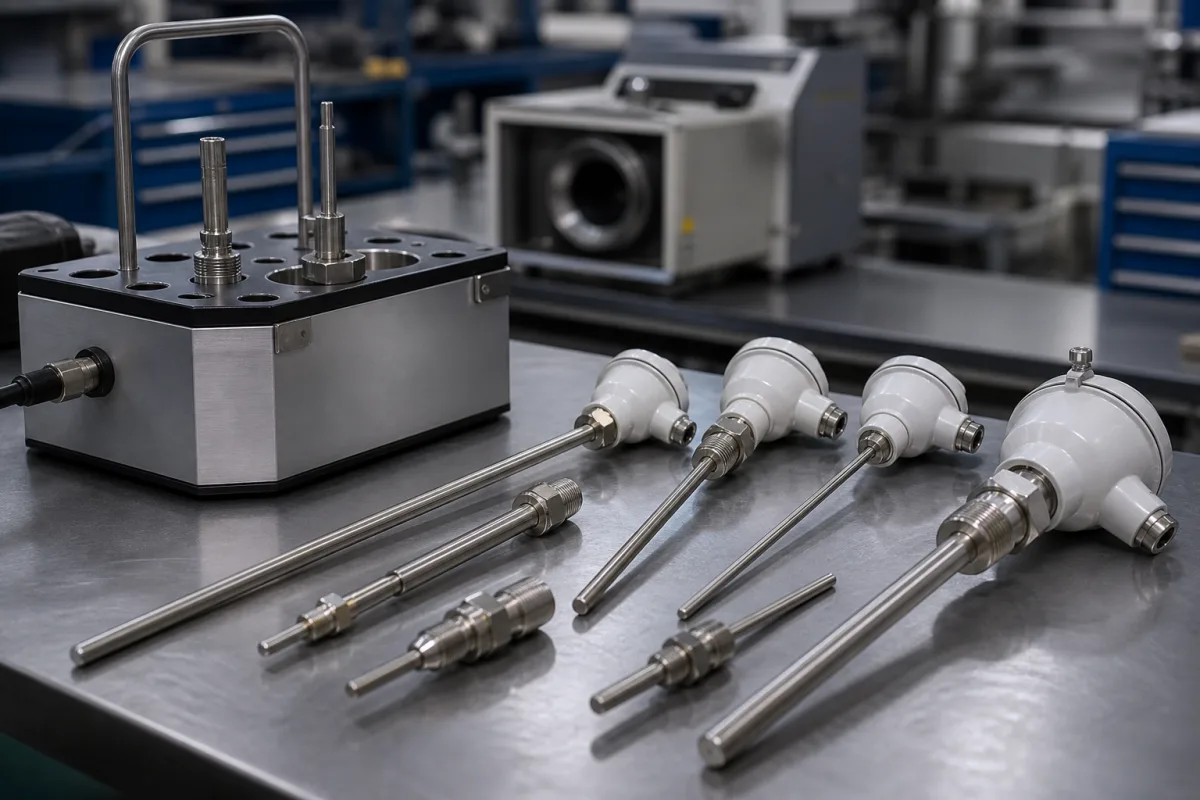
AI-assisted product visualization. Verify appearance with the manufacturer.

Product Specifications

Technical details and manufacturing context for Temperature Sensor(s)

Definition
Temperature sensors are critical components of insulated heating chambers that detect and provide real-time temperature readings to ensure precise thermal control. They play a vital role in maintaining consistent heating conditions, preventing overheating, and ensuring process reliability in industrial heating applications.
Working Principle
Temperature sensors operate by converting thermal energy into electrical signals through various mechanisms such as resistance changes (RTDs, thermistors), voltage generation (thermocouples), or infrared detection. These signals are then transmitted to control systems for monitoring and regulation.
Common Materials
Stainless Steel, Ceramic, Platinum, Nickel-Chromium Alloy
Technical Parameters
ParameterNotes & selection driver
Spec(°C) Temperature measurement range and accuracy specifications
Components / BOM
  • Sensing Element Part
    Detects temperature changes and converts them to electrical signals
    Material: Platinum/Nickel/Copper
  • Protective Sheath Part
    Protects sensing element from environmental damage and contamination
    Material: Stainless Steel/Ceramic
  • Connection Head
    Houses electrical connections and provides mounting interface
    Material: Aluminum/Stainless Steel
  • Signal Wires Part
    Transmits electrical signals from sensor to control system
    Material: Copper with insulation

Industry Taxonomies & Aliases

Commonly used trade names and technical identifiers for Temperature Sensor(s).

Applied To / Applications

This component is essential for the following industrial systems and equipment:

Industrial Ecosystem & Supply Chain Structure

Complementary Systems
Downstream Applications
Specialized Tooling

Application Fit & Sizing Matrix

Operational Limits
pressure: 0 to 10 bar
other spec: Response time: <2 seconds, Accuracy: ±0.5°C
temperature: -50°C to 400°C
Media Compatibility
✓ Air/Gas Mixtures ✓ Water/Aqueous Solutions ✓ Non-corrosive Oils
Unsuitable: Concentrated Acids or Caustic Solutions
Sizing Data Required
  • Required Temperature Range
  • Process Connection Type/Size
  • Required Accuracy and Response Time

Reliability & Engineering Risk Analysis

Failure Mode & Root Cause
Drift/Calibration Loss
Cause: Thermal cycling, aging of sensing elements (thermocouple/RTD), contamination of sensing surfaces, or electrical degradation in signal conditioning circuits.
Open Circuit or Signal Loss
Cause: Vibration-induced wire fatigue, corrosion at connection points, moisture ingress leading to short circuits, or physical damage from impact or environmental exposure.
Maintenance Indicators
  • Inconsistent or erratic temperature readings compared to known process conditions or redundant sensors
  • Physical damage such as cracked housing, exposed wiring, or corrosion at the sensor body or connection points
Engineering Tips
  • Implement regular calibration checks and thermal profiling against a reference standard to detect and correct drift early
  • Use proper mounting hardware and vibration-dampening techniques, ensure environmental sealing (e.g., NEMA/IP ratings), and protect wiring with conduits or strain relief

Compliance & Manufacturing Standards

Reference Standards
ISO 9001:2015 - Quality management systems IEC 60751:2022 - Industrial platinum resistance thermometers and platinum temperature sensors ASTM E1137/E1137M-20 - Standard Specification for Industrial Platinum Resistance Thermometers
Manufacturing Precision
  • Temperature accuracy: ±0.1°C at 0°C reference point
  • Response time: 90% of final reading within 5 seconds in stirred water bath
Quality Inspection
  • Calibration verification against NIST-traceable standards across operating range
  • Environmental stress testing (thermal cycling, vibration, humidity per IEC 60068-2 series)

Published Manufacturer Relationships

Source-reviewed profile relationships currently associated with Temperature Sensor(s)

No source-reviewed manufacturer relationship is currently published for this product.

Manufacturer listings support early research and capability understanding. They are not certification, ranking, or transaction guarantees.

Technical documentation
Request current drawings, revision history, and a signed specification sheet.
Manufacturing capability
Verify equipment lists, process limits, capacity, and representative production evidence.
Inspection readiness
Confirm test methods, calibrated equipment, sampling plans, and traceable reports.
Supplier transparency
Check the legal entity, factory address, ownership, certifications, and direct contacts.

CNFX does not score or rank suppliers. Buyers must verify all claims and documents with the legal manufacturer before ordering.

Supply Chain Compatible Machinery & Devices

Automated Powder Coating System

Integrated industrial system for applying dry powder coatings to metal substrates.

Explore Specs →
High-Precision CNC Laser Cutting Machine

Computer-controlled industrial machine using focused laser beams to cut sheet metal with micron-level accuracy.

Explore Specs →
Infeed Conveyor

A conveyor system component designed to receive and transport raw materials or workpieces into an industrial processing system.

Explore Specs →
Heating Zone

A designated section within an industrial system where controlled thermal energy is applied to materials or products.

Explore Specs →

Frequently Asked Questions

What materials make these temperature sensors suitable for machinery manufacturing environments?

Our temperature sensors feature stainless steel and ceramic construction with platinum or nickel-chromium alloy sensing elements, providing corrosion resistance, durability, and accurate readings in harsh industrial environments.

How do these sensors monitor temperature within insulated heating chambers?

The sensors use precision sensing elements housed in protective sheaths that penetrate chamber insulation. Signal wires transmit real-time temperature data to control systems, ensuring optimal heating process management.

What components are included in the temperature sensor BOM for machinery applications?

Each sensor includes a connection head for secure mounting, a protective sheath for durability, a precision sensing element (platinum or nickel-chromium alloy), and signal wires for reliable data transmission to monitoring systems.

Data Basis

Editorial classification, named public sources where available, and source-reviewed manufacturer records.

Preliminary Technical Classification
This page supports structured research, RFQ preparation, and supplier evaluation. It does not replace buyer-led supplier qualification, standards review, or technical approval.

Request Manufacturing Insight for Temperature Sensor(s)

Ask for use case, specification boundaries, supplier type, and RFQ preparation information for Temperature Sensor(s).

Your business information is used only to process this request.

Thank you! Your message has been sent. We'll respond within 1–3 business days.

Need to Manufacture Temperature Sensor(s)?

Compare manufacturer profiles with relevant product and process capability.

Create Manufacturer Profile Contact Us
Previous Product
Workpiece Fixture
Last Product