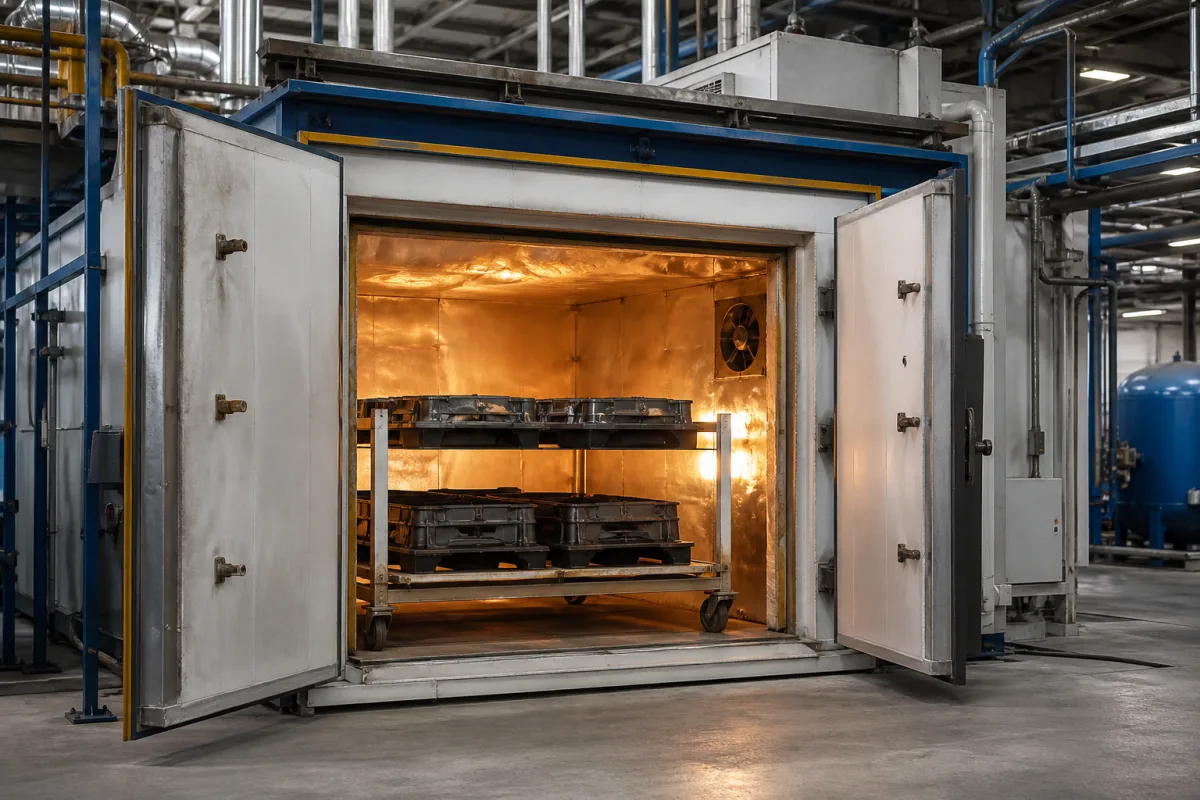
Insulated heating chamber for mould preheating: bringing dip-moulding and coating moulds to temperature before the plastisol
The insulated chamber that brings moulds up to temperature before they are dipped or coated · why plastisol only builds a wall on a hot mould, how much heat a mould carries out of the oven, and what the chamber is built from
In dip moulding and similar coating processes, the oven is not heating the product: it is charging the mould with heat. A metal or ceramic mould comes out of an insulated chamber, is dipped into liquid plastisol, and the coating gels where the mould is hot enough. How hot the mould leaves the chamber, how evenly, and how much heat it stores therefore decide wall thickness and whether a second dip still takes. That makes a mould preheating chamber a different purchase from a drying or curing oven, even if the two look alike.
Insulated chambers and batch or conveyor ovens used to preheat moulds, formers and dies before dip moulding, plastisol coating and similar processes in which the mould's stored heat gels the coating, including their walls, floor, heat chamber, air circulation and controls. Forced-air batch ovens and their uniformity testing are covered on the Industrial hot air oven page; cartridge heaters that hold die-casting moulds at temperature in the machine on the Casting mould temperature control cartridge heater page; walk-in and truck-in drying ovens for racked parts on the Walk-in and truck-in drying oven page; infrared emitter zones on the Infrared heating zone page; winding-varnish curing ovens on their own pages.
CNFX editorial research · Sources checked October 12, 2026 · 3 sources
The mould carries the heat: preheating hotter to cover the delay between two plastisol dips
US patent 3,906,071 (Leon Chemical & Plastics, published 1975) states that dip moulding moulds must be preheated before vinyl plastisol will coat on them, and that if the mould cools too much it will not coat. Its process for two-hardness seat-belt housings conveys sets of moulds through a preheating oven and then into two plastisol tanks in turn. [1]
The patent describes the problem it solved: dipping straight from the first tank into the second, within seconds, kept the mould hot enough but let the second plastisol coat too heavily and wasted material. [1] It gives no mould temperature figure, leaving the choice to the particular plastisol in use. [1]
Editorial note: for a preheating chamber this means the required exit temperature is set by the slowest, coldest dip in the sequence, not by the plastisol's fusing temperature alone. Ask the moulding line to state the mould temperature needed at each dip and the time between leaving the chamber and the last dip.
Step in the Leon patent
Published value or rule
Preheat
Mould heated above the temperature the second plastisol would need on its own, high enough to cover heat lost until the second dip [1]
First dip
Shortened by about 10 to 30 seconds against a normal dip, because the mould is hotter [1]
Delay before second dip
About 30 to 90 seconds, so the first coat can gel and cool somewhat [1]
Give the oven supplier: mould material, mass and number per load, required mould temperature at exit, time from exit to each dip, and whether moulds travel on a conveyor or on racks.
02
How much heat a mould can carry: porcelain formers, salt-bath heating and a 350 °F cure
US patent 3,487,146 (Tillotson Corp., published 1969) makes vinyl gloves with a thicker cuff on porcelain moulds. The mould is heated in a salt bath for about 3 minutes, its lower part is cooled in warm water for ½ to 1 minute so the cuff region stays hotter, it is dipped into plastisol over about 5 to 15 seconds, held for 5 to 15 seconds and withdrawn over 2 to 8 minutes, then cured in an oven at about 350 °F. [2]
The patent's reasoning is that a mould with high volumetric heat capacity and low conductivity can be heated differentially and still hold enough heat to gel the plastisol, building a thicker wall where it is hotter. [2]
Editorial calculation: at 0.625 cal/(°C·cm³), one litre of porcelain heated through 100 °C stores 0.625 × 1,000 × 100 = 62,500 cal, about 262 kJ; at the patent's 0.45 lower limit, about 188 kJ. Multiplying by mould volume and number of moulds per load gives the heat the chamber must deliver before losses — a figure to compare with the heater rating and the heat-up time a supplier quotes.
What the chamber is built from: 8-in walls, 6-in floor, aluminised steel and a 900 °F top-mounted heat chamber
Grieve's No. 846, described in Plastics Machinery Manufacturing (December 2015), is a walk-in oven built for a customer to preheat steel moulds, for quick turnarounds and for feeding presses with preheated moulds. [3]
Editorial note: the article does not say whether the 50 × 96 × 96 in figure is the work space or the overall size; ask any supplier to state both, and to give the heater rating, the heat-up time with a full mould load, and the temperature uniformity across the load at the set point you will use.
Editorial note: two compartments in one chamber let one load heat while the other is being unloaded, which matters when moulds must leave the chamber at a steady interval for a dipping or press cycle; the article lists the compartments but not how they are controlled. [3]
Digital programming controller; recirculating blower air-flow safety switch [3]
—
Ask for the maximum and working temperatures, wall and floor insulation thickness, heater power, heat-up time with your mould load, uniformity at the working temperature, door and compartment arrangement, and air-flow safety interlocks.
04
What to tell a supplier about a mould preheating chamber
Paste it into your enquiry below or into an email to a maker, then replace every bracket.
Moulds: [material; mass and volume each; number per load; steel, aluminium or ceramic]
Temperature: [required mould temperature at exit; tolerance; working and maximum chamber temperature]
Cycle: [moulds per hour; time from exit to dip or press]
Loading: [racks, trolleys or conveyor; compartments]
Chamber: [insulation thickness; interior material; heater power; air circulation]
Controls: [programmer; air-flow and over-temperature safety]
Acceptance: [heat-up time with full load; uniformity check]
Explore company information and manufacturing capabilities, then discuss the scope of your project with a relevant supplier.
Share this page
Compiled and source-reviewed by the CNFX editorial team.
Each manufacturer above links to the page on that company's own website where the product is listed, with the date we checked it. How we source and review
· Page last updated 13 October 2026
Buyer questions
Why are moulds preheated before plastisol dip moulding?
Leon's US patent 3,906,071 states that moulds must be preheated before vinyl plastisol will coat on them, and that a mould which cools too much will not coat. [1]
How long can a preheated mould wait between two dips?
In the Leon patent's two-plastisol process, the mould is preheated extra and the second dip starts about 30 to 90 seconds after the first. [1]
What temperature is dip-moulded plastisol cured at?
Tillotson's US patent 3,487,146 cures the plastisol in an oven at about 350 °F. [2]
How well insulated is a mould preheating oven?
Grieve's No. 846 mould preheat oven has 8-inch insulated walls, a 6-inch insulated floor and a 900 °F maximum temperature. [3]
Sources and what still needs a direct check
Sources checked 2026-10-12. The role of mould preheat and the two-dip timing come from Leon Chemical & Plastics' US patent 3,906,071; mould thermal properties, dipping times and cure temperature from Tillotson Corp.'s US patent 3,487,146; chamber construction from Grieve's No. 846 oven as reported by Plastics Machinery Manufacturing.