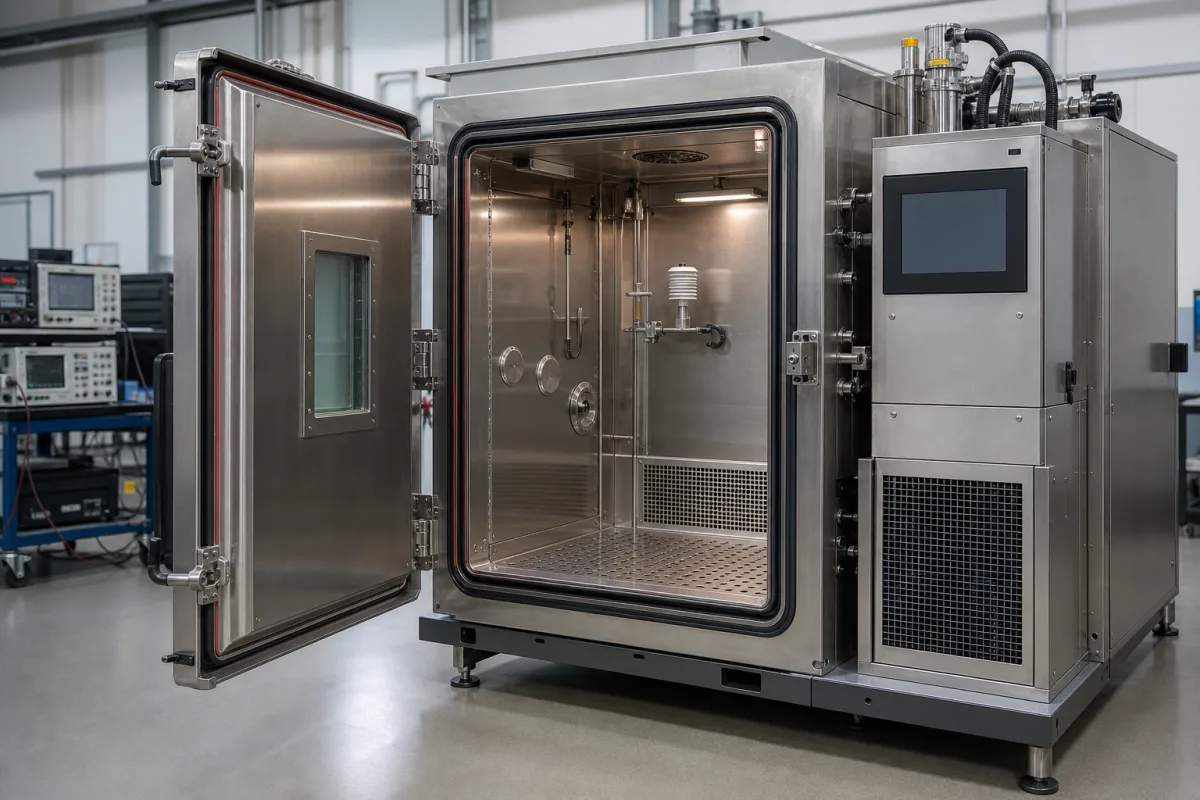
Altitude test chamber (low air pressure chamber with temperature control)
Low air pressure testing · altitude chambers with temperature control, pressure floor, pump-down rate, pressure control error, sealed feedthroughs
An altitude test chamber is a pressure-tight test enclosure, with a vacuum pump and pressure control added to the heating and refrigeration of a climatic chamber, that lowers the air pressure around a specimen to the value found at a given altitude and holds it, alone or combined with high or low temperature. Ask three things first: how low the pressure goes and how fast it gets there, how closely pressure and temperature are held at each level, and how cables, sensors and coolant reach the specimen through the chamber wall.
Chambers for low air pressure (altitude) testing, alone or combined with temperature and humidity, from benchtop to walk-in. Temperature, humidity, thermal-shock and stability chambers at normal pressure are covered on the Test chamber page; package leak testers that use vacuum decay or bubble emission are covered on the Food packaging integrity (leak) tester page. Vacuum ovens, space-simulation thermal-vacuum systems and pressure vessels are outside this page.
CNFX editorial research · Sources checked October 12, 2026 · 4 sources
Set the pressure floor, pump-down rate and control error
NOAA's National Weather Service runs a Thermotron altitude chamber at its Sterling Field Support Center to simulate what a radiosonde meets on a balloon flight. It lists a temperature range of −75 °C to +177 °C and pressure from ambient down to 5 hPa, approximately 35,356.8 m elevation. Pressure change rates are staged: about 176 hPa per minute from 1000 to 117 hPa, about 7 hPa per minute from 117 to 45 hPa and about 3 hPa per minute from 45 to 5 hPa. [1]
Editorial calculation: at those rates the three stages take about 883 ÷ 176 ≈ 5.0 min, 72 ÷ 7 ≈ 10.3 min and 40 ÷ 3 ≈ 13.3 min, roughly 29 minutes from 1000 hPa to 5 hPa. The pump-down slows as the pressure falls, so ask for the time to your lowest test pressure, not only the first-stage rate. [1]
Qualitest's QualiATC table (250, 500, 1000 and 2000 L) lists pressure from normal pressure down to 0.5 kPa (500 Pa), a pressure control error of ±2 kPa above 40 kPa, ±5% from 2 to 40 kPa and ±0.1 kPa below 2 kPa, depressurisation from normal pressure to 1 kPa in about 30 minutes, and pressure recovery below 10 kPa/min. The same brochure's text says the pressure can be brought down to 0.5 kPa "in just a matter of seconds"; since that conflicts with the 30-minute table value, confirm the pump-down time in writing. [2]
A test laboratory, Anbotek, lists its own low-pressure chamber at −60 to 100 °C, 20–98% RH, normal pressure to 0.5 kPa, temperature change ≤1.5 °C/min and depressurisation from 101 kPa to 10 kPa in 2 minutes or less, in a 1000 × 1000 × 1000 mm workspace. [3] Editorial calculation: 91 kPa in 2 min is an average of at least 45.5 kPa/min over that span.
Give the supplier the lowest test pressure and its equivalent altitude, the pump-down and recovery times you need, the pressure tolerance at each level, the temperature and humidity at each pressure, the specimen size, mass and heat dissipation, and every cable, sensor and coolant line that must pass through the wall.
02
Choose combined temperature and low-pressure test levels
IEC 60068-2-13 (Test M: low air pressure) applies to specimens that can meet low air pressure in transport, storage or service: the specimen goes into the chamber, the pressure is reduced to the value in the relevant specification and held for the specified duration. Where a simultaneous high or low temperature matters for the stresses or failure mechanisms, the standard refers to IEC 60068-2-39 instead. It also cautions against contaminating the chamber air with ancillary equipment and with the air let in when pressure is restored. [4]
Anbotek lists combined levels it runs, among them −55 °C at 5, 15, 25 or 40 kPa for 2 h; −40 °C at 55 or 70 kPa for 2 or 16 h; 55 °C at 15 to 70 kPa; and 85 °C at 5 or 15 kPa for 2 h, under GB/T 2423.27-2020, IEC 60068-2-39:2015, GJB 150.2A-2009 and MIL-STD-810H. [3]
The laboratory names the hazards these tests look for: deformation, rupture or seal failure; overheating because heat transfer falls in thin air; and arcing, surface or corona discharge, since the dielectric strength of air falls at low pressure, especially combined with high temperature. [3] Editorial note: if the specimen is powered and hot during the test, ask how the chamber removes its heat at the lowest pressure, where air convection is weakest.
On humidity, Qualitest's table gives 20–98% RH with the note that it works under atmospheric humidity, so ask whether humidity can be controlled at reduced pressure or only at ambient pressure. [2]
03
Compare published chambers
No linked manufacturer record lists an altitude chamber yet. The table compares published chambers from the sources.
Ask each supplier for the pressure floor, pump-down time to that floor with the empty and loaded chamber, pressure control error by range, and the temperature limits that apply at low pressure.
Explore company information and manufacturing capabilities, then discuss the scope of your project with a relevant supplier.
Share this page
Compiled and source-reviewed by the CNFX editorial team.
Each manufacturer above links to the page on that company's own website where the product is listed, with the date we checked it. How we source and review
· Page last updated 13 October 2026
Buyer questions
How low does an altitude test chamber go?
Reviewed chambers reach 0.5 kPa (Qualitest, Anbotek) or 5 hPa, about 35,357 m (NOAA's Sterling chamber). [2][3][1]
Which standard covers low air pressure testing?
IEC 60068-2-13 Test M covers low air pressure alone; where temperature at the same time matters, it points to IEC 60068-2-39. [4]
Why are powered specimens at risk at low pressure?
Anbotek notes that air's dielectric strength falls at low pressure, raising the risk of arcing and corona, and that reduced heat transfer can overheat equipment. [3]
Sources and what still needs a direct check
Sources checked 2026-10-12. NOAA's National Weather Service publishes the specification of its own altitude chamber; Qualitest publishes a brochure for its chamber series; Anbotek is a testing laboratory describing its test levels and equipment; IEC 60068-2-13 is the test standard, read from its public preview.