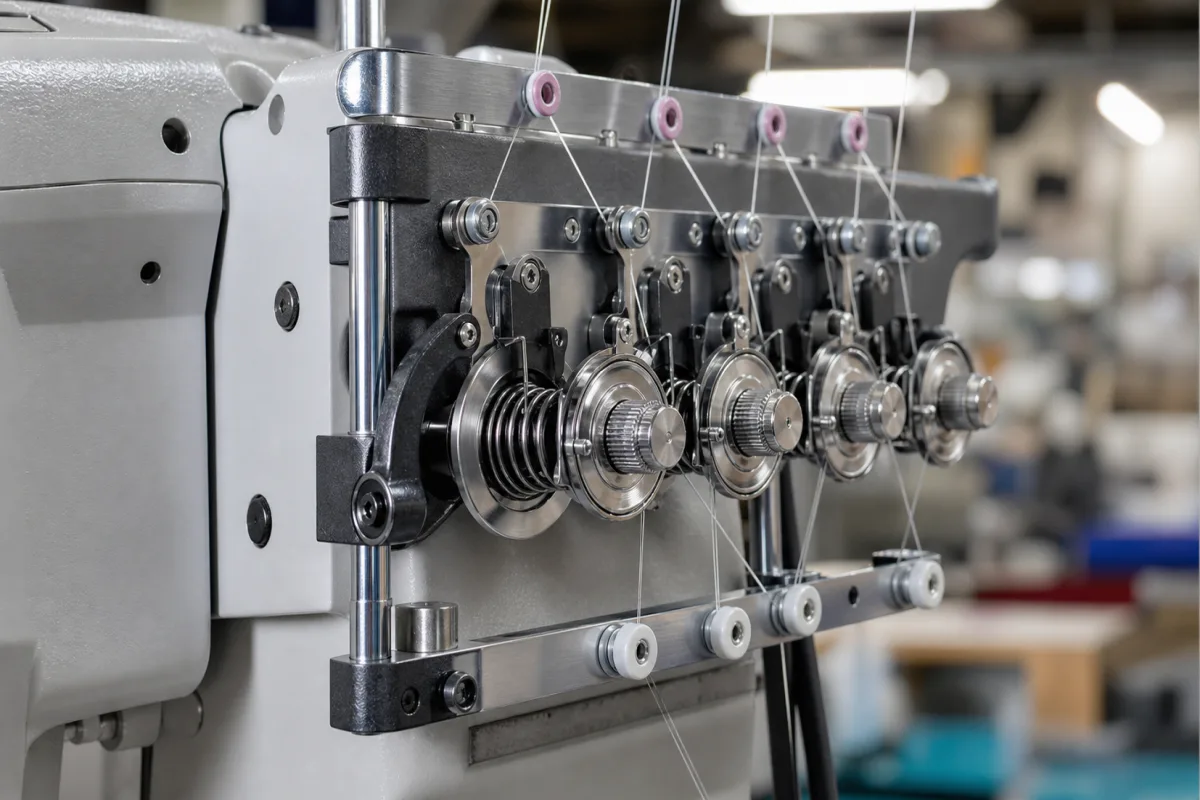
Thread tension assembly for industrial sewing machines: tension discs, check spring and wrap posts, and measuring needle-thread tension in cN
The disc-and-spring units that brake each thread on an industrial sewing machine · how a wrap round a post multiplies disc tension 2.57 times, what the check spring does to loop timing, closed-loop electromagnetic tension that measures the force, and reading tension in cN
A lockstitch or chainstitch is only balanced when each thread arrives at the stitch with the right tension. The tension assembly does that with a pair of discs squeezed by a spring, a check spring that takes up shock and decides when the thread is released for the next loop, and guides or posts the thread wraps around. Because the same knob setting gives different forces on different machines and threads, plants that want repeatable seams measure the result in centinewtons.
Needle- and looper-thread tension assemblies of industrial sewing machines: tension discs and springs, check springs, wrap posts and guides, electromagnetic and closed-loop tension units, and the meters used to measure thread tension. Complete unison-feed upholstery machines are covered on the Industrial upholstery sewing machine page; web tension control for winding lines and wire tensioners for coil winding have their own pages; bobbin cases and hooks are not covered here.
CNFX editorial research · Sources checked October 12, 2026 · 4 sources
Disc pressure, check spring and a post that multiplies tension by e^(fα)
Gene Boyd's patent describes the parts of a needle-thread tension system: a disc assembly whose spring pressure is infinitely variable, a check spring between the discs and the take-up arm, and fixed posts or apertured rods that brake the thread by the path it is wrapped along. [1]
The check spring, the patent explains, cushions the jump in thread tension when the take-up arm pulls the stitch tight, and also sets when pressure on the needle thread is released before the next loop forms: raising its preload reduces the thread available for the loop and delays loop formation, lowering it does the opposite. [1]
Boyd adds a grooved control post after the discs and applies the rope-on-drum relation T₁ = T₂·e^(fα): with a dynamic friction coefficient of about 0.15, one full wrap (about 360°) makes the tension after the post 2.57 times the disc tension, and two wraps (about 720°) 6.59 times. Its post carries a V groove with an included angle of about 135°, faces at about 30° and 15° to the post axis. [1] Editorial calculation: e^(0.15 × 2π) = 2.57 and e^(0.15 × 4π) = 6.59, so the post multiplies whatever the discs are set to, and a change in thread friction changes the multiplier.
Editorial note: on multi-thread machines such as the one pictured, each thread has its own disc unit, so the same principle applies thread by thread and each unit is set and measured separately.
Name the stitch type, the threads (type and ticket) and the material, and ask whether the machine uses mechanical discs, electromagnetic tension or closed-loop control on each thread.
02
Electromagnetic tension that measures the thread force, not just the disc pressure
Jochen Fischer's patent for Kochs Adler, now Dürkopp Adler, points out the flaw in tension units that only hold the disc clamping force constant: thread tension is that force times the coefficient of friction, and friction varies. [2]
Its unit mounts the two discs on a lever that pivots against a spring when the passing thread drags them; a light beam reflected from the lever onto a photosensor, or a strain gauge in other embodiments, measures that deflection, and a control unit drives an electromagnet that presses the discs together until the measured thread force matches the value set on a three-digit display, such as 50 grams. The discs can move up to about 3 mm, and the electromagnet acts along the lever's pivot axis so that its reaction does not disturb the measurement. [2] Editorial calculation: 50 g-force is about 49 cN.
The patent sets the target force from experience as a function of material thickness and density and thread and needle size. [2]
For electromagnetic units, ask whether tension is held by current alone or by measured thread force, and how values are stored per seam programme.
03
Reading needle-thread tension in cN: meter range, pull-off speed and procedure
Hans Schmidt's MST 2000 thread tension meter, as listed by embroidery-machine maker ZSK, is built for setting thread brakes on sewing and embroidery machines: [3]
Thread maker Amann sets out a procedure for a hand-held meter: thread the machine correctly, place the cones and spool stand so the first guide is centred above the spool, bring the take-up lever to its upper reversal point, clamp the thread pulled through the take-up guide, and draw the meter horizontally away from the take-up lever at its height while reading cN. It warns that values transfer only between identical machines of the same maker and class, that different thread tickets need different settings, and that needle and bobbin tension must be judged together. [4]
Editorial calculation: at 9 m/min the meter draws 15 cm of thread per second, so a one-second reading covers about 150 mm of thread.
Explore company information and manufacturing capabilities, then discuss the scope of your project with a relevant supplier.
Share this page
Compiled and source-reviewed by the CNFX editorial team.
Each manufacturer above links to the page on that company's own website where the product is listed, with the date we checked it. How we source and review
· Page last updated 13 October 2026
Buyer questions
How does a tension post increase thread tension?
By friction over the wrap angle: with friction 0.15, one wrap multiplies the disc tension 2.57 times and two wraps 6.59 times, according to Boyd's patent. [1]
What does the check spring do?
It cushions the tension rise when the take-up arm tightens the stitch and sets when the needle thread is released for the next loop; more preload delays loop formation. [1]
Why measure thread force rather than disc pressure?
Because thread tension equals clamping force times friction, and friction varies; Dürkopp Adler's patent measures the drag on a pivoting disc carrier and adjusts an electromagnet to hold it. [2]
How is needle-thread tension measured?
With a thread tension meter drawn at the take-up lever height, read in cN; one electronic meter covers 1 to 2,000 cN at a constant 9 m/min pull-off. [4][3]
Sources and what still needs a direct check
Sources checked 2026-10-12. Mechanisms come from two patents, one by an independent inventor and one assigned to the sewing-machine maker Dürkopp Adler; meter data from ZSK's listing of a Hans Schmidt instrument; the measuring procedure from thread maker Amann.