Industry-Verified Manufacturing Data (2026)

Tool Gripper / Arm

Based on aggregated insights from multiple verified factory profiles within the CNFX directory, the standard Tool Gripper / Arm used in the Machinery and Equipment Manufacturing sector typically supports operational capacities ranging from standard industrial configurations to heavy-duty production requirements.

Technical Definition & Core Assembly

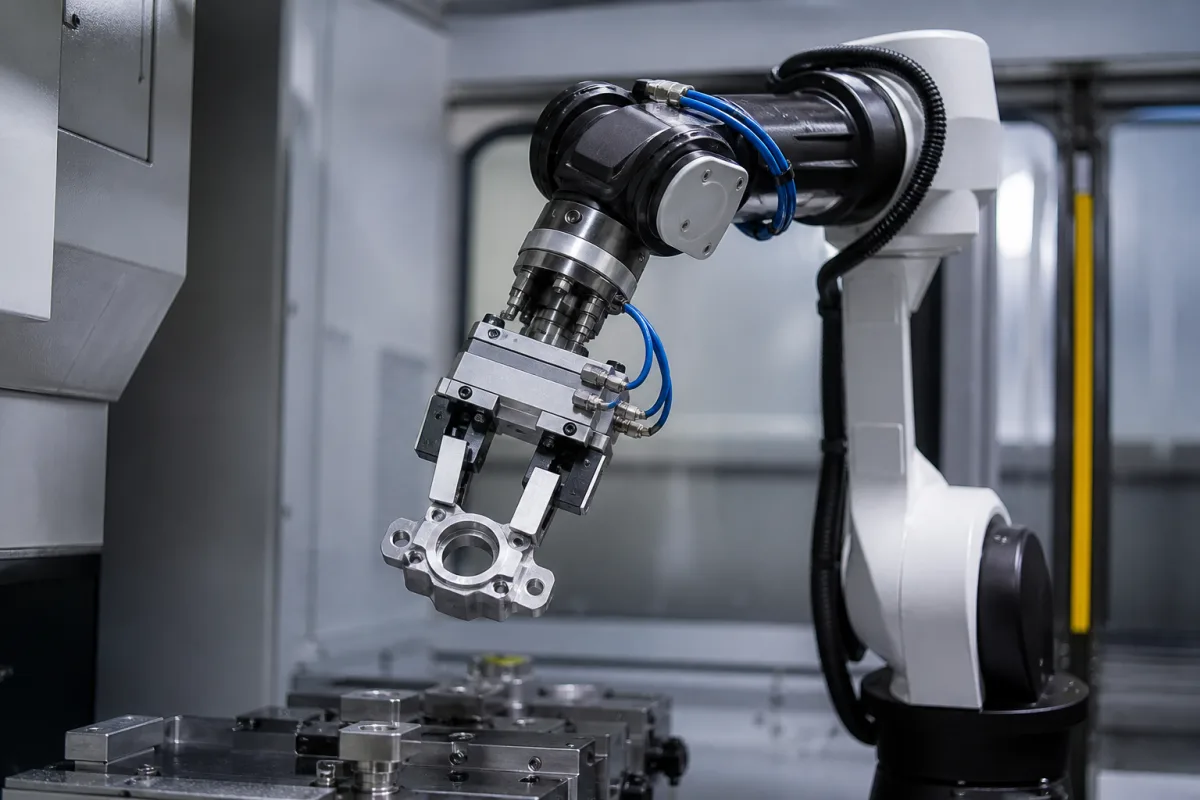
A canonical Tool Gripper / Arm is characterized by the integration of Gripper Jaws/Fingers and Actuator (Pneumatic Cylinder/Servo Motor). In industrial production environments, manufacturers listed on CNFX commonly emphasize Alloy Steel construction to support stable, high-cycle operation across diverse manufacturing scenarios.

Mechanical component of an Automatic Tool Changer that physically grasps, holds, and manipulates tools during the exchange process.
Product Specifications

Technical details and manufacturing context for Tool Gripper / Arm

Definition
The Tool Gripper/Arm is a critical mechanical subsystem within an Automatic Tool Changer (ATC) system. Its primary function is to securely grasp a tool (such as a drill bit, milling cutter, or other machining implement) from either the machine spindle or a tool magazine, transport it to the designated location, and release it with precise positioning. It ensures reliable tool handling, minimizes exchange time, and maintains tool orientation and alignment accuracy, directly impacting machining efficiency and setup flexibility in automated manufacturing systems.
Working Principle
The gripper/arm typically operates via pneumatic, hydraulic, or servo-electric actuation. Upon receiving a command from the ATC controller, the actuator moves the arm to the target tool position. A clamping mechanism (often using mechanical fingers, collets, or a bayonet-style interface) engages with a standardized tool holder (like CAT, BT, or HSK). Sensors confirm secure grip and position. The arm then retracts, transports the tool along a programmed path, and inserts or removes it from the machine spindle. The process reverses to return a tool to storage. Precision is maintained through guided linear or rotational motion and feedback systems.
Common Materials
Alloy Steel, Aluminum Alloy, Hardened Tool Steel
Technical Parameters
  • Gripping range or tool holder interface size (e.g., compatible with CAT40, BT30 holders) (mm) Standard Spec
Components / BOM
  • Gripper Jaws/Fingers
    Directly contact and clamp onto the tool holder's retention knob or flange
    Material: Hardened Tool Steel
  • Actuator (Pneumatic Cylinder/Servo Motor)
    Provides the mechanical force to open/close the gripper and/or extend/retract the arm
    Material: Aluminum Alloy/Steel
  • Arm Structure/Linkage
    Provides rigid support and guided motion for transporting the tool between spindle and magazine
    Material: Alloy Steel or Aluminum Alloy
  • Position Sensors
    Detect arm position, gripper open/close status, and tool presence for feedback control
    Material: Various (housing typically plastic or metal)
Engineering Reasoning
Gripping force: 150-1200 N, Jaw travel: 0-25 mm, Positioning accuracy: ±0.02 mm, Maximum tool weight: 15 kg
Gripping force below 100 N causes tool slippage, jaw misalignment exceeding 0.05 mm prevents proper tool seating, actuator pressure below 6 MPa results in insufficient clamping force
Design Rationale: Mechanical wear at jaw contact surfaces reduces friction coefficient below μ=0.15, thermal expansion of aluminum actuator housing creates 0.03 mm clearance at 80°C, hydraulic fluid viscosity drop below 32 cSt at 60°C reduces pressure transmission efficiency
Risk Mitigation (FMEA)
Trigger Pneumatic cylinder seal degradation from 100 ppm oil contamination in compressed air
Mode: Actuator pressure loss from 0.7 MPa to 0.3 MPa within 50 cycles
Strategy: Install coalescing filter with 0.01 μm rating and desiccant dryer maintaining -40°C dew point
Trigger Servo motor encoder misalignment of 0.5° due to mounting bolt torque variation exceeding ±15%
Mode: Position feedback error accumulation of 1.2 mm after 100 positioning cycles
Strategy: Implement laser alignment procedure with 0.01° tolerance and digital torque wrench with 2% accuracy

Industry Taxonomies & Aliases

Commonly used trade names and technical identifiers for Tool Gripper / Arm.

Applied To / Applications

This component is essential for the following industrial systems and equipment:

Industrial Ecosystem & Supply Chain DNA

Complementary Systems
Downstream Applications
Specialized Tooling

Application Fit & Sizing Matrix

Operational Limits
pressure: 0 to 10 bar
cycle life: ≥1,000,000 cycles
temperature: -20°C to 120°C
gripping force: 50 to 500 N
Media Compatibility
✓ ISO 40/50 taper tool holders ✓ HSK tool holders ✓ CAT/BT tool shanks
Unsuitable: Corrosive chemical environments without protective coating
Sizing Data Required
  • Tool holder taper type and size
  • Maximum tool weight (kg)
  • Required gripping force (N)

Reliability & Engineering Risk Analysis

Failure Mode & Root Cause
Wear and tear on gripping surfaces
Cause: Repeated friction and impact from handling objects, leading to material degradation and loss of gripping force
Actuator or pneumatic/hydraulic system failure
Cause: Contamination, seal degradation, or pressure loss in the actuation mechanism, resulting in incomplete or slow gripping/release actions
Maintenance Indicators
  • Inconsistent or slipping grip during operation
  • Unusual noises (e.g., grinding, hissing) from the arm or actuator during movement
Engineering Tips
  • Implement regular cleaning and lubrication schedules for moving parts and gripping surfaces to reduce friction and contamination buildup
  • Use condition monitoring (e.g., pressure sensors, vibration analysis) to detect early signs of actuator or mechanical wear before failure occurs

Compliance & Manufacturing Standards

Reference Standards
ISO 9283:1998 - Manipulating industrial robots - Performance criteria and related test methods ANSI/RIA R15.06 - Industrial Robots and Robot Systems - Safety Requirements DIN EN ISO 10218-1 - Robots and robotic devices - Safety requirements for industrial robots
Manufacturing Precision
  • Positioning repeatability: +/-0.02mm
  • Parallelism of gripping surfaces: 0.05mm
Quality Inspection
  • Dimensional verification with coordinate measuring machine (CMM)
  • Load capacity and fatigue testing

Factories Producing Tool Gripper / Arm

Verified manufacturers with capability to produce this product in China

✓ 95% Supplier Capability Match Found

P Procurement Specialist from Brazil Feb 16, 2026
★★★★★
"The technical documentation for this Tool Gripper / Arm is very thorough, especially regarding technical reliability."
Technical Specifications Verified
T Technical Director from Canada Feb 13, 2026
★★★★★
"Reliable performance in harsh Machinery and Equipment Manufacturing environments. No issues with the Tool Gripper / Arm so far."
Technical Specifications Verified
P Project Engineer from United States Feb 10, 2026
★★★★★
"Testing the Tool Gripper / Arm now; the technical reliability results are within 1% of the laboratory datasheet."
Technical Specifications Verified
Verification Protocol

“Feedback is collected from verified sourcing managers during RFQ (Request for Quote) and factory evaluation processes on CNFX. These reports represent historical performance data and technical audit summaries from our B2B manufacturing network.”

6 sourcing managers are analyzing this specification now. Last inquiry for Tool Gripper / Arm from UAE (43m ago).

Supply Chain Compatible Machinery & Devices

Heavy-Duty CNC Plasma Cutting Machine

Industrial machine for precision metal cutting using plasma arc technology

Explore Specs →
Automated Assembly Line System

Integrated production system for sequential component assembly operations

Explore Specs →
Automated Powder Coating System

Integrated industrial system for applying dry powder coatings to metal substrates.

Explore Specs →
Centrifugal Pump Impeller

Rotating component that transfers energy to fluid in centrifugal pumps.

Explore Specs →

Frequently Asked Questions

What materials are used in the construction of this tool gripper arm?

The tool gripper arm is constructed from high-strength alloy steel, aluminum alloy for lightweight components, and hardened tool steel for the gripping jaws to ensure durability and precision in tool manipulation.

How does the tool gripper arm integrate with automatic tool changers?

The gripper arm connects to the automatic tool changer system via an actuator (pneumatic cylinder or servo motor) and uses position sensors to accurately grasp, hold, and exchange tools during machining operations.

What maintenance is required for the tool gripper arm components?

Regular inspection of gripper jaws for wear, lubrication of linkage joints, and calibration of position sensors are recommended to maintain optimal performance and prevent downtime in manufacturing equipment.

Can I contact factories directly on CNFX?

CNFX is an open directory, not a transaction platform. Each factory profile provides direct contact information and production details to help you initiate direct inquiries with Chinese suppliers.

Get Quote for Tool Gripper / Arm

Request technical pricing, lead times, or customized specifications for Tool Gripper / Arm directly from verified manufacturing units.

Your business information is encrypted and only shared with verified Tool Gripper / Arm suppliers.

Thank you! Your message has been sent. We'll respond within 1–3 business days.

Need to Manufacture Tool Gripper / Arm?

Connect with verified factories specializing in this product category

Add Your Factory Contact Us
Previous Product
Tool Gripper
Next Product
Tool Head Assembly