Structured Manufacturing Data (2026)

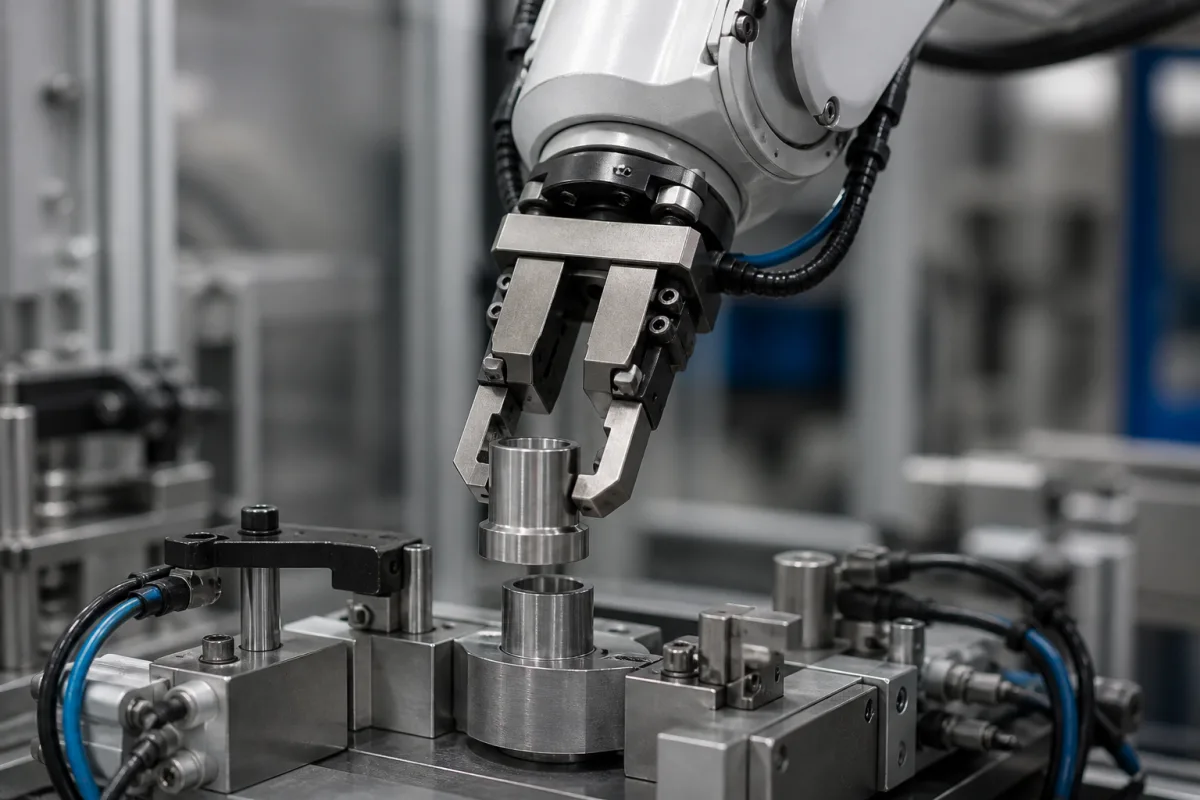
Tool Gripper

Based on aggregated insights from structured factory profiles within the CNFX directory, the standard Tool Gripper used in the Machinery and Equipment Manufacturing sector typically supports operational capacities ranging from standard industrial configurations to heavy-duty production requirements.

Technical Definition & Core Assembly

A canonical Tool Gripper is characterized by the integration of Jaws / Fingers and Actuator. In industrial production environments, manufacturers listed on CNFX commonly emphasize Aluminum Alloy construction to support stable, high-cycle operation across diverse manufacturing scenarios.

A mechanical component of a Tool Arm designed to securely grasp, hold, and release tools or workpieces during automated operations.
Product Specifications

Technical details and manufacturing context for Tool Gripper

Definition
The Tool Gripper is the end-effector component of a Tool Arm, responsible for the physical interface and secure manipulation of tools, parts, or materials. It enables the Tool Arm to perform its primary function by providing a reliable gripping mechanism that can be actuated to open, close, and apply controlled force, facilitating tasks such as assembly, handling, machining, or inspection in automated systems.
Working Principle
The gripper typically operates via pneumatic, hydraulic, or electric actuation. A control signal triggers an actuator (like a piston or motor), which converts energy into mechanical motion. This motion is transmitted through a linkage or gear system to move the gripper's jaws or fingers. The jaws close to apply clamping force on the object, securing it based on parameters like grip force and stroke. Sensors may provide feedback on position or force for precise control.
Common Materials
Aluminum Alloy, Steel, Engineering Plastic
Technical Parameters
  • Gripper stroke or jaw travel distance, defining the range of object sizes it can accommodate. (mm) Per Request
Components / BOM
  • Jaws / Fingers Part
    Directly contact and grip the tool or workpiece; often interchangeable for different object shapes.
    Material: Steel or Hardened Aluminum
  • Actuator
    Converts energy (pneumatic, electric, hydraulic) into mechanical motion to drive the jaw movement.
    Material: Aluminum Alloy, Steel
  • Body / Housing Part
    Encloses and supports internal mechanisms, providing mounting points to the Tool Arm.
    Material: Aluminum Alloy

Industry Taxonomies & Aliases

Commonly used trade names and technical identifiers for Tool Gripper.

Applied To / Applications

This component is essential for the following industrial systems and equipment:

Industrial Ecosystem & Supply Chain Structure

Complementary Systems
Downstream Applications
Specialized Tooling

Application Fit & Sizing Matrix

Operational Limits
pressure: 0 to 10 bar
cycle life: ≥1,000,000 cycles
grip force: 50 to 500 N
temperature: -20°C to 120°C
Media Compatibility
✓ metal workpieces (steel, aluminum) ✓ plastic components (ABS, polycarbonate) ✓ ceramic tools
Unsuitable: highly corrosive chemical environments (e.g., concentrated acids)
Sizing Data Required
  • workpiece/tool weight (kg)
  • gripping surface geometry (mm)
  • required grip force (N)

Reliability & Engineering Risk Analysis

Failure Mode & Root Cause
Wear and Tear on Gripping Surfaces
Cause: Abrasive particles from handled materials or environmental contaminants causing gradual material loss, reducing grip force and precision.
Actuator Seal Failure
Cause: Degradation of pneumatic or hydraulic seals due to contamination, improper lubrication, or excessive cycle frequency leading to pressure loss and reduced gripping force.
Maintenance Indicators
  • Audible hissing or air leakage sounds during operation indicating seal or pneumatic system failure
  • Visible misalignment or inconsistent gripping patterns on handled objects suggesting wear or mechanical issues
Engineering Tips
  • Implement regular cleaning protocols for gripping surfaces and actuator components to prevent abrasive contamination buildup
  • Establish preventive maintenance schedules for seal inspection and replacement based on cycle counts rather than waiting for failure symptoms

Compliance & Manufacturing Standards

Reference Standards
ISO 9001:2015 - Quality management systems ANSI B11.19 - Performance requirements for safeguarding CE Marking - Machinery Directive 2006/42/EC
Manufacturing Precision
  • Bore diameter tolerance: +/-0.01 mm
  • Parallelism of gripping surfaces: 0.02 mm
Quality Inspection
  • Hardness testing (Rockwell C scale)
  • Dimensional verification with coordinate measuring machine (CMM)

Factories Producing Tool Gripper

Manufacturer profiles with relevant production capability in China

Manufacturer listings support early research and capability understanding. They are not certification, ranking, or transaction guarantees.

Technical documentation
4/5
Manufacturing capability
4/5
Inspection readiness
5/5
Supplier transparency
3/5

These scores are example evaluation dimensions, not real customer ratings, country-specific buyer feedback, or live inquiry activity.

Supply Chain Compatible Machinery & Devices

Automated Assembly Line System

Integrated production system for sequential component assembly operations

Explore Specs →
Automated Powder Coating System

Integrated industrial system for applying dry powder coatings to metal substrates.

Explore Specs →
Centrifugal Pump Impeller

Rotating component that transfers energy to fluid in centrifugal pumps.

Explore Specs →
High-Precision CNC Laser Cutting Machine

Computer-controlled industrial machine using focused laser beams to cut sheet metal with micron-level accuracy.

Explore Specs →

Frequently Asked Questions

What materials are available for the Tool Gripper?

The Tool Gripper is available in Aluminum Alloy for lightweight applications, Steel for high-strength requirements, and Engineering Plastic for corrosion-resistant or non-marring applications.

What are the main components in the Tool Gripper BOM?

The Bill of Materials includes Jaws/Fingers for direct contact with tools/workpieces, an Actuator for precise movement control, and a Body/Housing that provides structural integrity and mounting points.

How does the Tool Gripper integrate with automated systems?

The Tool Gripper is designed as a mechanical component of a Tool Arm, enabling seamless integration with robotic arms, CNC machines, and assembly lines for secure grasping, holding, and releasing during automated operations.

Can I contact factories directly on CNFX?

CNFX is an open directory, not a transaction platform. Each factory profile provides direct contact information and production details to help you initiate direct inquiries with Chinese suppliers.

Data Basis

CNFX manufacturer profiles, technical classification, publicly available product information, and ongoing plausibility checks.

Preliminary Technical Classification
This page supports structured research, RFQ preparation, and supplier evaluation. It does not replace buyer-led supplier qualification, standards review, or technical approval.

Request Manufacturing Insight for Tool Gripper

Ask for use case, specification boundaries, supplier type, and RFQ preparation information for Tool Gripper.

Your business information is used only to process this request.

Thank you! Your message has been sent. We'll respond within 1–3 business days.

Need to Manufacture Tool Gripper?

Compare manufacturer profiles with relevant product and process capability.

Create Manufacturer Profile Contact Us
Previous Product
Tool Exchange Arm
Next Product
Tool Gripper / Arm