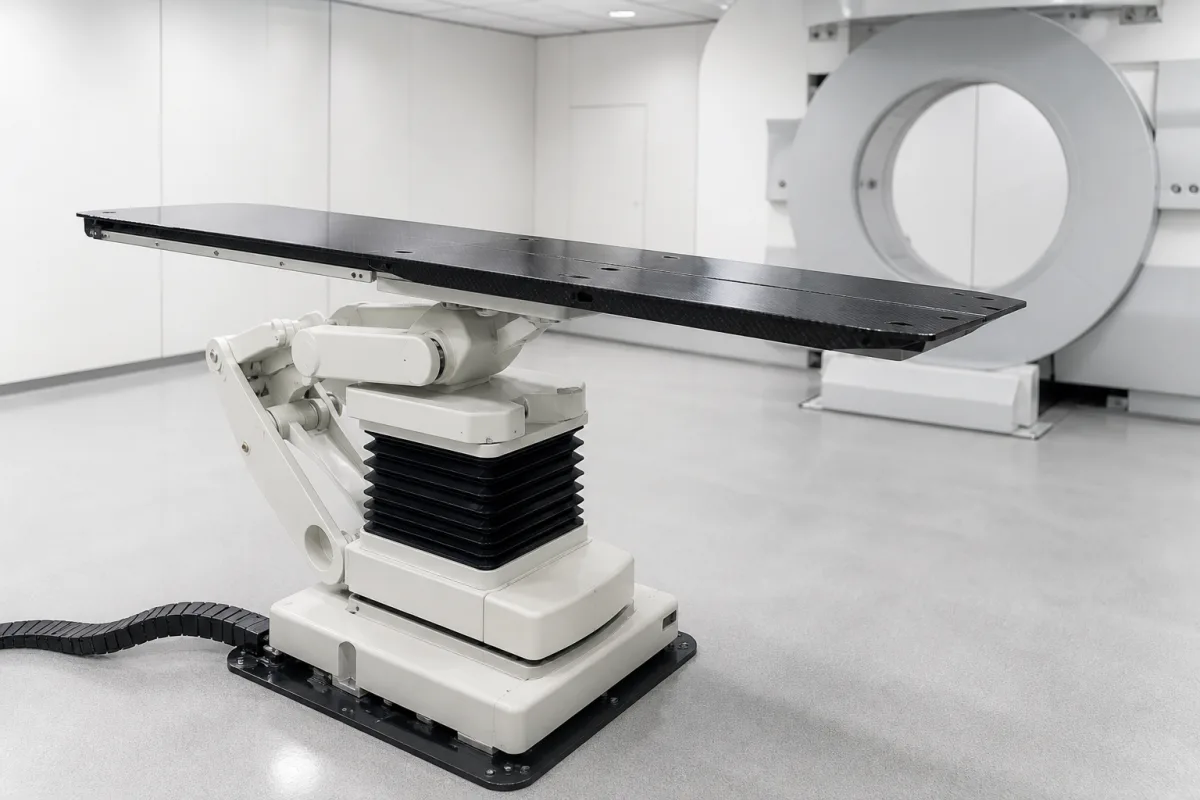
Six-degree-of-freedom radiotherapy treatment couch: pitch and roll correction, robotic positioning accuracy and couch-top attenuation
The six-degree-of-freedom patient couch of an image-guided radiotherapy linac · pitch and roll corrections measured over 2,945 fractions, robotic correction to 0.2 mm and 0.07°, and what the carbon-fibre couch top does to the beam and the skin
Once the cone-beam CT has been matched to the planning CT, the couch has to move the patient to where the plan expects them. A standard couch corrects three translations and the yaw of its turntable; a six-degree-of-freedom couch adds pitch and roll. This page is about that couch: how large the rotational corrections are in practice and for which sites, how precisely a robotic couch top applies them and where its range runs out, and how the carbon-fibre top that carries the patient affects the beams that pass through it.
Patient support couches for external-beam radiotherapy with six-degree-of-freedom (6DoF) correction — robotic couch tops and 6DoF couches that add pitch and roll to translations and couch rotation — and their carbon-fibre couch tops and inserts. The complete medical linear accelerator, with its treatment head, imaging and gantry, is covered on the Medical linear accelerator page; beam shaping on the Multi-leaf collimator page; the linac's electron source on the Electron gun for a medical linear accelerator page. The planning software into which a couch model is loaded is covered on the Treatment planning stations (radiotherapy TPS) page. Diagnostic imaging tables and general hospital beds are outside this page.
CNFX editorial research · Sources checked October 12, 2026 · 3 sources
How large pitch and roll corrections are: 2,945 fractions on a 6D couch top, by treatment site
Mancosu et al. analysed the corrections a PerfectPitch 6D robotic couch top (Varian) applied after kV cone-beam CT matching for 376 consecutive patients over its first six months of use. [1]
The authors conclude that adjusting all six dimensions, including pitch and roll, improves set-up at all sites, with the greatest gain for brain tumours. [1]
Editorial calculation: 2,945 fractions over 376 patients is about 7.8 fractions per patient; combined corrections above 2° were about 4.3 times as frequent for brain (29.1%) as for pancreas (6.7%). A couch without pitch and roll leaves such rotations either uncorrected or to be compensated by re-positioning the patient.
Tell the couch supplier which sites and techniques the couch will serve (for example cranial stereotactic work), the imaging used for matching, and the largest rotation you expect to correct remotely.
02
Robotic correction to 0.2 mm and 0.07°, and what happens when rotations exceed the couch's range
Wilbert et al. (Würzburg) combined infrared-guided manual pre-positioning of the head with a HexaPOD 6DoF couch top on an Elekta linac, which then corrected the remaining translations and rotations remotely; they cite the system accuracy as 0.1 mm and 0.1°. [2]
The authors write that when the required corrections exceed the HexaPOD's capability, rough approximation with the base couch must come first, and that in their experience the required corrections exceeded what the HexaPOD could correct remotely on average every third fraction (unpublished data) — the reason they pre-position the head to within ± 2° first. [2] They also note that large rotational corrections can themselves cause translations of the anatomy inside a thermoplastic mask. [2]
Editorial note: a 6DoF couch's rotational range is a hard limit; ask the supplier for the pitch and roll range at full patient load, how the couch handles a correction beyond it, and how its accuracy was verified (phantom, imaging method, load).
Result (Wilbert et al., 2010)
Value
Phantom, after HexaPOD 6DoF correction
RMS error 0.2 ± 0.2 mm (translations) and 0.07 ± 0.08° (rotations); mean 3D vector 0.4 ± 0.2 mm [2]
The carbon-fibre couch top in the beam: 3.6% to 10.8% attenuation and up to fourfold surface dose
Seppälä et al. measured eight commercial couch inserts in 6 and 15 MV beams, every 5° from gantry 90° to 180°, and the surface dose they cause with a posterior beam. [3]
The authors describe the highest increases as four- and threefold compared with the posterior open-field surface doses at 6 and 15 MV, and conclude that despite the good properties of carbon-fibre tabletops, insert attenuation can be significant. [3]
Editorial calculation: 98.6% ÷ 35.2% ≈ 2.8, the 280% figure for 6 MV. Editorial note: a beam passing obliquely through the couch top crosses more material, which is why attenuation rises from the posterior value toward the oblique maximum; ask the couch supplier for a model of the top for the treatment planning system and measured attenuation at the energies and angles you will treat through.
For each couch top and insert, ask for measured attenuation versus gantry angle at your beam energies, the surface-dose effect, and a validated couch model for your planning system.
04
What to send for a 6DoF treatment couch
Paste it into your enquiry below or into an email to a maker, then replace every bracket.
Linac: [make and model; imaging for matching]
Techniques: [sites; stereotactic or not]
Motion: [translations; couch rotation; pitch and roll range needed]
Load: [maximum patient weight with accessories]
Accuracy: [required residual error; verification method]
Couch top: [carbon-fibre top and inserts; attenuation data; planning model]
Integration: [record-and-verify; remote correction from imaging]
Explore company information and manufacturing capabilities, then discuss the scope of your project with a relevant supplier.
Share this page
Compiled and source-reviewed by the CNFX editorial team.
Each manufacturer above links to the page on that company's own website where the product is listed, with the date we checked it. How we source and review
· Page last updated 13 October 2026
Buyer questions
How large are pitch and roll corrections on a 6D couch?
Over 2,945 fractions on a PerfectPitch couch, mean absolute pitch and roll were 0.58° and 0.69°; brain patients had the largest, 0.73° and 0.80°. [1]
How accurate is a 6DoF robotic couch?
In a phantom study, a HexaPOD couch corrected to an RMS error of 0.2 ± 0.2 mm and 0.07 ± 0.08°. [2]
Does the couch top attenuate the treatment beam?
Seppälä et al. measured up to 3.6% (6 MV) through a posterior beam and up to 10.8% at oblique angles, with surface dose increasing up to four-fold. [3]
Sources and what still needs a direct check
Sources checked 2026-10-12. Clinical pitch and roll corrections come from Mancosu et al. in the British Journal of Radiology (2015); robotic correction accuracy and range from Wilbert et al. in Radiation Oncology (2010); couch-top attenuation and surface dose from Seppälä et al. in the Journal of Applied Clinical Medical Physics (2011).