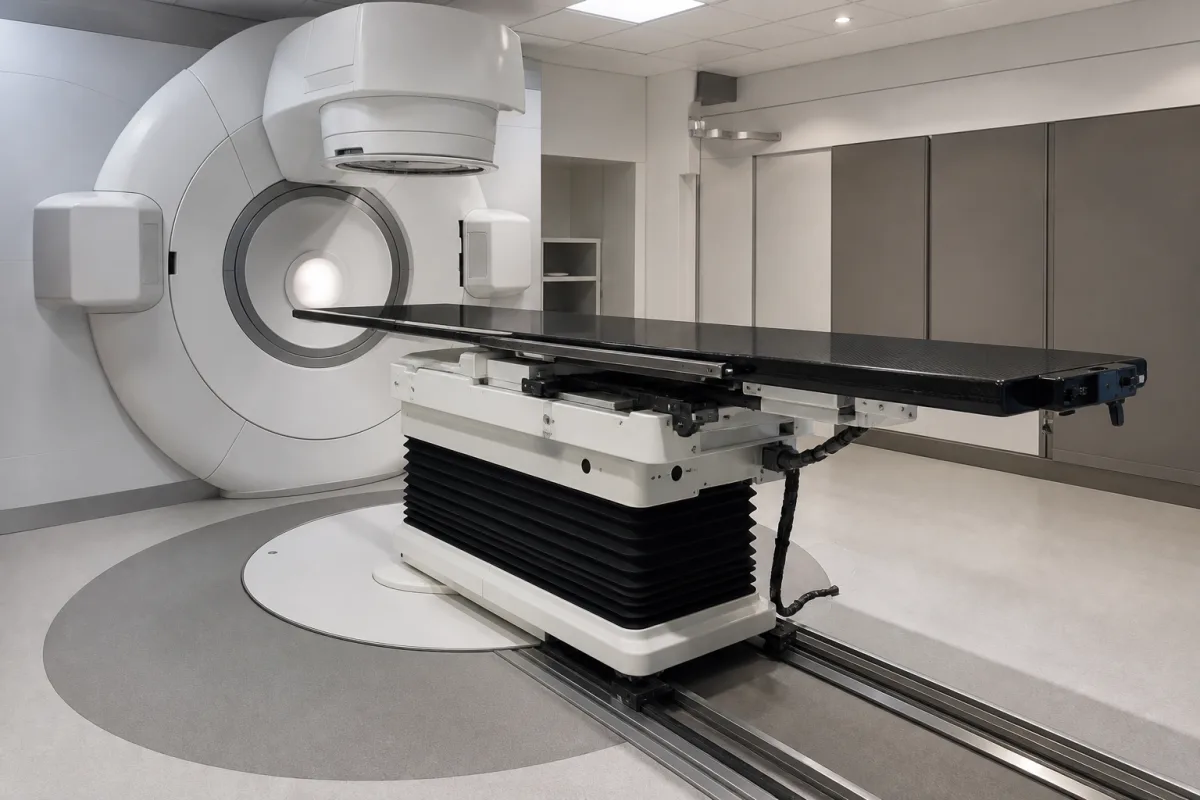
The illustrated table stands on a turntable in front of the linac, so the whole couch can swing around a vertical axis for beams that do not lie in the gantry plane. That axis is mechanical; the beam's isocentre is radiological. When they do not coincide, every couch rotation moves the patient sideways relative to the beam. Three studies give the numbers: an EPID method for aligning the axis, an off-isocentre Winston–Lutz study of rotational errors, and a QA set for checking couch moves against TG-142's stereotactic criteria.
Covers the rotation of radiotherapy treatment tables about the turntable axis: alignment of that axis with the MV radiation isocentre, its stability, the effect of couch and other rotational errors on targets away from isocentre, and the couch tolerances that QA work checks against. Six-degree-of-freedom pitch and roll correction and couch-top attenuation are on 6DoF Radiotherapy Treatment Couch (2904); tabletop sag, base travel between CT and treatment isocentres and extension joints on Radiotherapy Patient Positioning Couch (2962); the linac control system and interlocks on 3568.
CNFX editorial research · Sources checked October 13, 2026 · 3 sources
Table rotation axis against MV isocentre: 0.91–2.11 mm off, 0.40 ± 0.12 mm after adjustment
Nyflot and colleagues at the University of Washington measured how far the table rotation axis of four Elekta linacs lay from the MV radiation isocentre, and developed an EPID-based method to correct it, published in the Journal of Applied Clinical Medical Physics (2014).
The study's point is that a perfect table rotating about the radiation isocentre would leave the ball bearing still in every image; a real table makes it trace an arc, and the centre of that arc shows where the axis really is. The correction is mechanical, at the table base, not a software offset.
The authors note that the TG-142 annual test of coincidence of radiation and mechanical isocentre has a tolerance of ±1 mm from baseline for units performing stereotactic radiosurgery, and that the report does not say how to perform the test or how to correct a unit out of tolerance.
Item
Finding
Method
Steel ball bearing set within 0.1 mm of MV isocentre; EPID images at 15 table angles; circle fitted to the bearing positions (least-squares Kasa method); offset of the fitted centre from isocentre is the needed correction
Initial misalignment
0.91 to 2.11 mm across four linacs
Linac-A (HexaPod top)
More than 2 mm; correction −1.33 mm towards A and −0.04 mm towards T, applied by turning two screws at the table base; afterwards 0.40 ± 0.12 mm, stable over 15 measurements in 231 days
Linac-B (not adjusted)
Mean 1.40 ± 0.22 mm over 27 measurements in 363 days; greater variability attributed by the authors to an interchangeable two-piece couch allowing more lateral movement
Stability study
49 measurements over 363 days on four linacs
The figures are for four Elekta linacs in one department; other tables and turntables need their own measurement.
02
Rotation errors away from isocentre: a 0.5° error reached 1.24 mm at 7 cm
Nakayama, Tanabe and Fujii (Okayama University repository) ran an off-isocentre Winston–Lutz test with a MultiMet-WL phantom on an Elekta linac, with six targets and deliberate rotation errors of +0.5° and +1.0° added to collimator, gantry and couch in turn.
Pure geometry shows why distance matters: a point 70 mm from the rotation axis moves 70 × 0.5° in radians = 0.61 mm for a 0.5° error and 1.22 mm for 1.0° (Editorial calculation). For multi-target or off-isocentre treatments with couch kicks, a rotation error that passes a ±1° check can still use up a millimetre-scale margin.
Finding
Value or ranking
Effect of distance
Targets further from isocentre showed larger displacement
Largest effect
Collimator rotation: S value up to 1.24 mm at 7 cm from isocentre with a 0.5° error
Second
Couch rotation
Smallest
Gantry rotation, because a good share of the targets lay close to its axis
Conclusion on TG-142's ±1.0°
A minimum standard; depending on target layout it may not guarantee clinically sufficient margin
The Okayama study used one Elekta linac and one phantom; its ranking reflects that target layout.
03
Checking couch moves against TG-142's stereotactic criteria: 1 mm and 0.5°
Jeong and colleagues at Yonsei Cancer Center built a QA set with a Penta-Guide phantom to verify image-guided couch corrections on two linacs with 6DoF couches and CBCT, judging residuals against the TG-142 stereotactic criteria they cite.
The set used offsets of 10, 14 and 12 mm, a first CBCT registration to move the couch and a second to measure what was left; each condition was imaged 15 times. The yaw residual was obtained as an approximation with the fusion-rotation function of MIM software and compared with the value corrected in XVI.
Direction
Criterion used (TG-142 SRS/SBRT, as cited)
Measured residual after correction
Translation TX
≤ 1 mm
0.25 ± 0.18 mm
Translation TY
≤ 1 mm
0.25 ± 0.25 mm
Translation TZ
≤ 1 mm
0.36 ± 0.2 mm
Rotation RX (pitch)
≤ 0.5°
0.18 ± 0.08°
Rotation RY (roll)
≤ 0.5°
0.26 ± 0.09°
Rotation RZ (yaw)
≤ 0.5°
0.11 ± 0.08°
Criteria are as cited by the authors from TG-142 for SRS/SBRT; check the current AAPM report and the department's own baselines.
04
What to ask about a treatment table's rotation
Paste it into your enquiry below or into an email to a maker, then replace every bracket.
Ask how the turntable axis is aligned with the radiation isocentre at installation, what offset is specified and how it can be adjusted, the angle readout resolution and accuracy, the rotation range, how the tabletop (one-piece, two-piece or 6DoF) affects lateral play, and which QA phantoms and tests the maker supports for couch rotation and off-isocentre checks.
Explore company information and manufacturing capabilities, then discuss the scope of your project with a relevant supplier.
Share this page
Compiled and source-reviewed by the CNFX editorial team.
Each manufacturer above links to the page on that company's own website where the product is listed, with the date we checked it. How we source and review
· Page last updated 13 October 2026
Buyer questions
How far can a couch rotation axis be from isocentre?
Nyflot and colleagues found 0.91 to 2.11 mm on four Elekta linacs; an EPID-guided adjustment at the table base brought one to 0.40 ± 0.12 mm, stable over 231 days. [1]
What does TG-142 require for isocentre coincidence?
As cited by Nyflot and colleagues, an annual test with ±1 mm tolerance from baseline for stereotactic radiosurgery units, without a prescribed method. [1]
How much does a 0.5° couch error matter?
In the Okayama off-isocentre Winston–Lutz study, couch rotation errors ranked second after collimator errors; a 0.5° collimator error already reached 1.24 mm at 7 cm. Geometrically, 0.5° at 70 mm is 0.61 mm (Editorial calculation). [2]
What residual error do 6DoF couch corrections leave?
In the Yonsei QA set study, translations were within 0.25–0.36 mm and rotations within 0.11–0.26° on average, against 1 mm and 0.5° criteria. [3]
Sources and what still needs a direct check
Sources checked 2026-10-13. Three peer-reviewed studies: a JACMP paper on aligning table rotation with the MV isocentre, an Okayama study of rotational errors on off-isocentre targets, and a Korean radiotherapy society paper on verifying 6DoF couch moves.