Industry-Verified Manufacturing Data (2026)

Tunnel Housing

Based on aggregated insights from multiple verified factory profiles within the CNFX directory, the standard Tunnel Housing used in the Machinery and Equipment Manufacturing sector typically supports operational capacities ranging from standard industrial configurations to heavy-duty production requirements.

Technical Definition & Core Assembly

A canonical Tunnel Housing is characterized by the integration of Structural Frame and Insulated Panels. In industrial production environments, manufacturers listed on CNFX commonly emphasize Stainless Steel construction to support stable, high-cycle operation across diverse manufacturing scenarios.

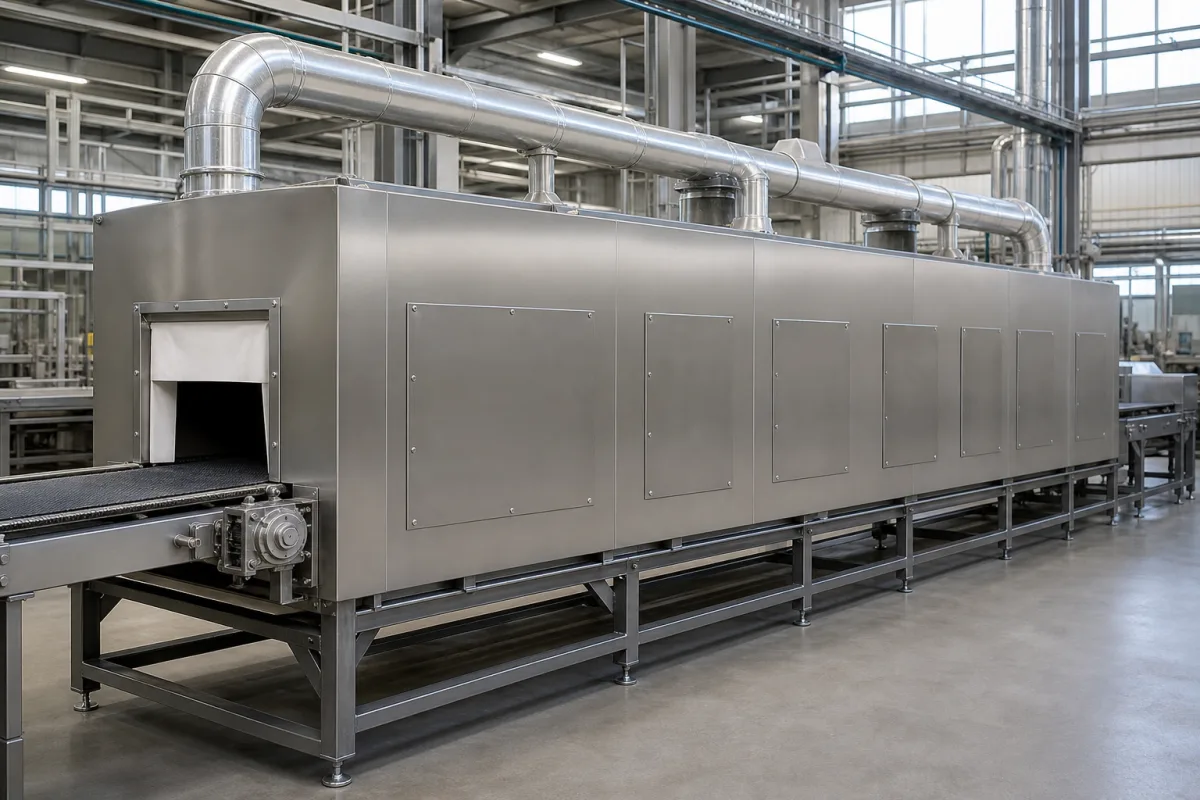
The structural enclosure of an IR drying/curing tunnel that contains the process environment and supports internal components.
Product Specifications

Technical details and manufacturing context for Tunnel Housing

Definition
Tunnel Housing is the main structural component of an IR Drying/Curing Tunnel system that forms the enclosed passage through which products travel during the drying or curing process. It provides thermal insulation, contains the infrared radiation, supports heating elements and conveyor systems, and maintains controlled environmental conditions for efficient heat transfer to the processed materials.
Working Principle
The tunnel housing creates an enclosed chamber that contains infrared radiation emitted by heating elements, preventing energy loss to the surrounding environment. Its insulated structure maintains consistent temperature profiles along the tunnel length while providing structural support for all internal components including IR emitters, reflectors, conveyor systems, and ventilation equipment.
Common Materials
Stainless Steel, Insulated Steel Panels, Thermal Insulation Materials
Technical Parameters
  • Overall dimensions including length, width, and height of the tunnel housing structure (mm) Per Request
Components / BOM
  • Structural Frame
    Provides primary structural support and rigidity to the tunnel housing
    Material: Steel
  • Insulated Panels
    Forms the walls and ceiling of the tunnel with thermal insulation properties
    Material: Insulated Steel Panels
  • Access Doors
    Provides entry points for maintenance and inspection of internal components
    Material: Steel with Insulation
  • Observation Windows
    Allows visual monitoring of the drying/curing process without opening the housing
    Material: Heat-Resistant Glass
  • Mounting Brackets
    Supports installation of IR heating elements, reflectors, and conveyor systems
    Material: Steel
Engineering Reasoning
0-250°C internal temperature, 0-5 kPa positive pressure differential
Structural deformation exceeding 5 mm deflection at 300°C or pressure differential exceeding 7.5 kPa
Design Rationale: Thermal expansion mismatch between stainless steel (17.3 μm/m·K) and insulation materials (0.5-5 μm/m·K) causing stress concentrations at weld joints, combined with Euler buckling under external vacuum conditions
Risk Mitigation (FMEA)
Trigger Insulation degradation from UV exposure at 280-400 nm wavelength
Mode: Internal temperature gradient exceeding 50°C/m causing thermal bowing
Strategy: Ceramic fiber insulation with aluminum foil vapor barrier (0.02 W/m·K thermal conductivity)
Trigger Condensate accumulation at dew point of 45°C with 80% relative humidity
Mode: Corrosion-induced pitting at stress concentration points (Kt=3.2)
Strategy: 316L stainless steel construction with electropolished interior (Ra<0.8 μm) and sloped floor drainage (2° minimum)

Industry Taxonomies & Aliases

Commonly used trade names and technical identifiers for Tunnel Housing.

Applied To / Applications

This component is essential for the following industrial systems and equipment:

Industrial Ecosystem & Supply Chain DNA

Complementary Systems
Downstream Applications
Specialized Tooling

Application Fit & Sizing Matrix

Operational Limits
pressure: Atmospheric to 0.5 bar gauge (positive pressure for containment)
other spec: Flow Rate: 0.1-5 m/s air velocity, Slurry Concentration: Up to 60% solids by weight
temperature: Ambient to 250°C (typical IR drying/curing range)
Media Compatibility
✓ Water-based coatings ✓ Solvent-based paints ✓ UV-curable inks
Unsuitable: Highly corrosive acidic environments (e.g., concentrated sulfuric acid exposure)
Sizing Data Required
  • Product dimensions (LxWxH)
  • Required process temperature profile
  • Conveyor system load capacity

Reliability & Engineering Risk Analysis

Failure Mode & Root Cause
Fatigue cracking at weld joints
Cause: Cyclic thermal and mechanical stresses from fluid flow variations and pressure transients, exacerbated by poor weld quality or stress concentrations
Corrosion and erosion of internal surfaces
Cause: Chemical attack from process fluids combined with abrasive particle impingement, often accelerated by improper material selection or protective coating degradation
Maintenance Indicators
  • Visible fluid leaks or weeping at housing seams and connections
  • Abnormal vibration or audible knocking sounds during operation indicating internal component contact or flow disruption
Engineering Tips
  • Implement regular non-destructive testing (ultrasonic or radiographic) of critical welds and high-stress areas to detect crack initiation before catastrophic failure
  • Establish a comprehensive corrosion monitoring program including thickness measurements, fluid chemistry analysis, and protective coating inspections with scheduled reapplication intervals

Compliance & Manufacturing Standards

Reference Standards
ISO 286-1:2010 - Geometrical product specifications (GPS) - ISO code system for tolerances on linear sizes ASTM A370-24 - Standard Test Methods and Definitions for Mechanical Testing of Steel Products EN 1090-1:2009+A1:2011 - Execution of steel structures and aluminium structures - Part 1: Requirements for conformity assessment of structural components
Manufacturing Precision
  • Bore diameter tolerance: +/-0.05mm
  • Parallelism of mounting surfaces: 0.1mm over 100mm length
Quality Inspection
  • Dimensional verification using coordinate measuring machine (CMM)
  • Magnetic particle inspection for surface and near-surface defects

Factories Producing Tunnel Housing

Verified manufacturers with capability to produce this product in China

✓ 96% Supplier Capability Match Found

P Project Engineer from Australia Jan 25, 2026
★★★★★
"Testing the Tunnel Housing now; the technical reliability results are within 1% of the laboratory datasheet."
Technical Specifications Verified
S Sourcing Manager from Singapore Jan 22, 2026
★★★★★
"Impressive build quality. Especially the technical reliability is very stable during long-term operation."
Technical Specifications Verified
P Procurement Specialist from Germany Jan 19, 2026
★★★★★
"As a professional in the Machinery and Equipment Manufacturing sector, I confirm this Tunnel Housing meets all ISO standards."
Technical Specifications Verified
Verification Protocol

“Feedback is collected from verified sourcing managers during RFQ (Request for Quote) and factory evaluation processes on CNFX. These reports represent historical performance data and technical audit summaries from our B2B manufacturing network.”

18 sourcing managers are analyzing this specification now. Last inquiry for Tunnel Housing from Brazil (1h ago).

Supply Chain Compatible Machinery & Devices

Automated Assembly Line System

Integrated production system for sequential component assembly operations

Explore Specs →
Automated Powder Coating System

Integrated industrial system for applying dry powder coatings to metal substrates.

Explore Specs →
Centrifugal Pump Impeller

Rotating component that transfers energy to fluid in centrifugal pumps.

Explore Specs →
High-Precision CNC Laser Cutting Machine

Computer-controlled industrial machine using focused laser beams to cut sheet metal with micron-level accuracy.

Explore Specs →

Frequently Asked Questions

What materials are used in tunnel housing construction?

Our tunnel housing is constructed from durable stainless steel and insulated steel panels with thermal insulation materials to maintain process temperatures and ensure structural integrity.

What components are included in the tunnel housing BOM?

The bill of materials includes access doors, insulated panels, mounting brackets, observation windows, and a structural frame to support internal drying/curing components.

How does tunnel housing protect industrial drying processes?

The enclosure contains the IR drying/curing environment, prevents heat loss with thermal insulation, and provides structural support for internal machinery components in manufacturing applications.

Can I contact factories directly on CNFX?

CNFX is an open directory, not a transaction platform. Each factory profile provides direct contact information and production details to help you initiate direct inquiries with Chinese suppliers.

Get Quote for Tunnel Housing

Request technical pricing, lead times, or customized specifications for Tunnel Housing directly from verified manufacturing units.

Your business information is encrypted and only shared with verified Tunnel Housing suppliers.

Thank you! Your message has been sent. We'll respond within 1–3 business days.

Need to Manufacture Tunnel Housing?

Connect with verified factories specializing in this product category

Add Your Factory Contact Us
Previous Product
Tunnel Boring Machine
Next Product
Turbine Blades/Rotor