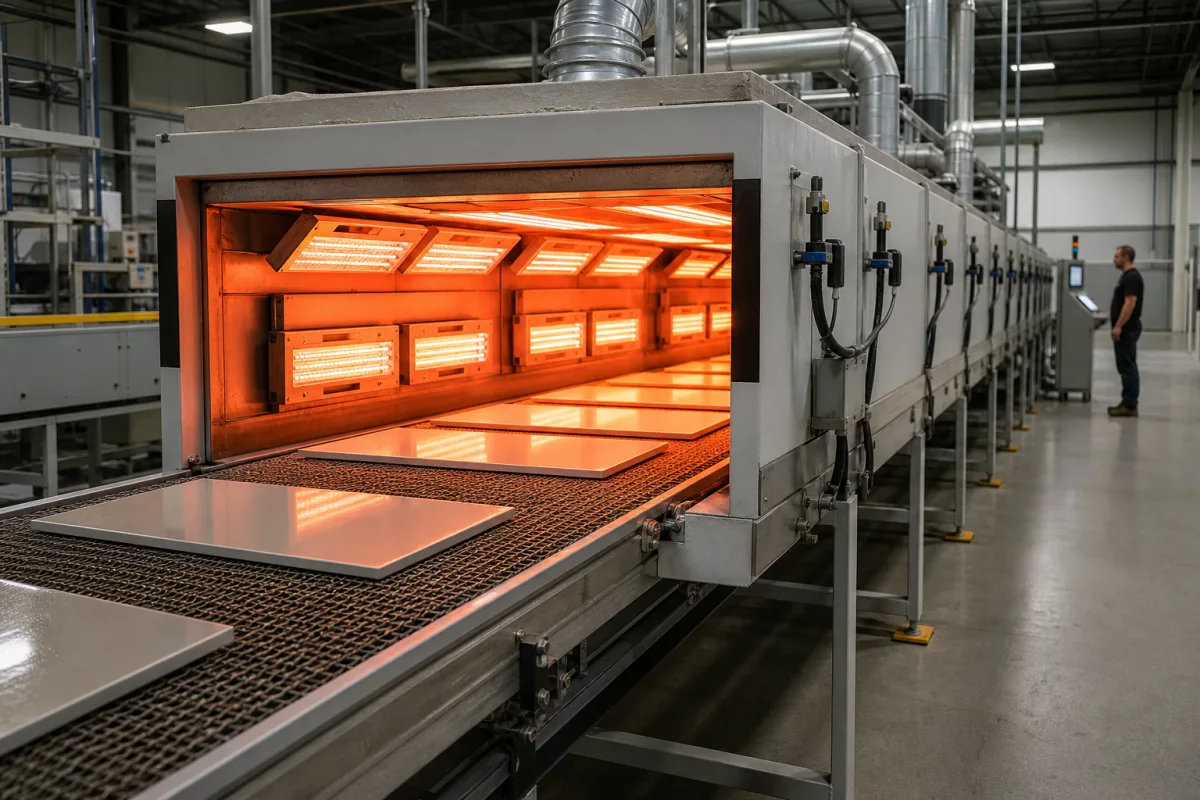
Infrared drying and curing tunnels · Conveyorised tunnels with quartz-lamp or ceramic-face infrared emitters above a belt: wavelength band, power density, zoning across the width, closed-loop temperature control, fast start and stop, belt width and chamber length
An IR drying or curing tunnel carries products on a conveyor under infrared emitters that heat coatings, inks or surfaces directly by radiation, so drying or curing happens in a short heated length. Ask three things first: what the product and coating are and which emitter wavelength they absorb, what power density, zoning and control the cure needs, and what belt width, chamber length and speed the line runs at.
Conveyorised infrared drying and curing tunnels and the infrared heaters used in them, for coatings, inks, adhesives and webs. Hot-air convection ovens, UV curing systems, infrared detectors and pyrometers (see infrared pyrometer) are outside this page.
CNFX editorial research · Sources checked October 12, 2026 · 4 sources
Choose the emitter type, wavelength and power density
Glenro's Radplane infrared heaters are for predrying, drying, curing, preheating and heating. They emit a broad band of medium and long wavelengths that, in Glenro's words, is "easily absorbed by most products", from elements mounted on high-temperature insulation that radiate directly at the product, delivering up to 4,800 W per square foot at temperatures up to 1,500 °F. [1]
Glenro's quartz tube infrared heaters deliver 50–100 W per linear inch in medium or short wavelength tubes (medium-wave in its Series 262 and 263, a high-intensity T-3 tube in Series 251), with gold-backed tubes available to direct heat, and are offered for coating and printing lines with multizone control across wide webs and for clean rooms. [2] Its ceramic-face Radplane heaters give a uniform pattern from edge to edge and can be mounted inches from the product. [1]
Editorial calculation: 4,800 W/ft² is about 51.7 kW/m² and 1,500 °F is about 816 °C; 50–100 W per linear inch is about 1.97–3.94 kW per metre of tube. [1][2]
Give the supplier the product and substrate, coating or ink and its cure schedule, solvent or water load, required surface temperature, emitter preference (short, medium or long wave; quartz or ceramic), width to be heated, line speed, available supply voltage and power, extraction, and clean-room or hazardous-area requirements.
02
Size the conveyor, zones and control
Glenro says its Radplane heaters reach operating temperature in seconds on start-up and lose heat quickly on line stops so residual heat does not damage the product, use closed-loop feedback temperature control, and can form edge and centre zones; its Series 81 elements run in machine direction with edge zones switched or run hotter to match web width or offset edge losses. [1] Glenro also states its infrared systems offer instant heat-up and cool-down and precise wavelength control. [3]
BBC Industries' T Series infrared conveyor ovens come in sixteen models combining belt width, bed length, chamber, voltage and belt material: 4 or 5 ft chambers, 36 or 48 in belts in Teflon or stainless steel, 208 or 240 V supply, digital solid-state temperature control on all models, analogue speed control, interchangeable conveyor and chamber lengths, and adjustable curtains to retain heat. [4]
Editorial calculation: 36 and 48 in belts are 914 and 1,219 mm wide, and 4 and 5 ft chambers are 1,219 and 1,524 mm long. [4]
03
Emitter, zoning, belt and extraction details to get from an IR tunnel supplier
Ask any supplier for emitter type and wavelength, installed power and power density, number of zones and control method, surface temperature measurement, belt width, material and speed range, heated and total length, extraction, supply voltage, safety interlocks, footprint and weight, and trials on your product.
04
Emitters, reflectors, zone and temperature control, belt and curtains
Emitter, reflector and zone rows come from Glenro's heater pages; belt and curtain rows come from BBC Industries' T Series, whose adjustable curtains retain heat in the chamber. [1][4]
Chamber length, belt width, power density and emitter temperature for an IR tunnel
Seven of the fourteen rows have no value in the reviewed sources; installed power, air flow and exhaust volume have to come from the supplier's offer for your cure schedule.
1 company lists this product among what they make. Company figures are quoted from each
company's own website; every card states where the relationship came from.
Joisun Screen Printing Machinery Co., Ltd.
Manufacturing site to be confirmed for the order
Its website has a product page for ir drying/curing tunnel.
Explore company information and manufacturing capabilities, then discuss the scope of your project with a relevant supplier.
Share this page
Compiled and source-reviewed by the CNFX editorial team.
Each manufacturer above links to the page on that company's own website where the product is listed, with the date we checked it. How we source and review
· Page last updated 13 October 2026
Buyer questions
How much power can industrial IR heaters deliver?
Glenro states its Radplane heaters deliver up to 4,800 W per square foot at up to 1,500 °F. [1]
Why use infrared rather than hot air for drying?
Glenro cites heat-up in seconds, rapid cool-down on line stops and direct radiation onto the product. [1][3]
What belt widths do IR conveyor ovens use?
BBC Industries' T Series uses 36 or 48 in belts in Teflon or stainless steel. [4]
Sources and what still needs a direct check
Sources checked 2026-10-12. Glenro makes industrial infrared heaters; BBC Industries makes infrared conveyor ovens.