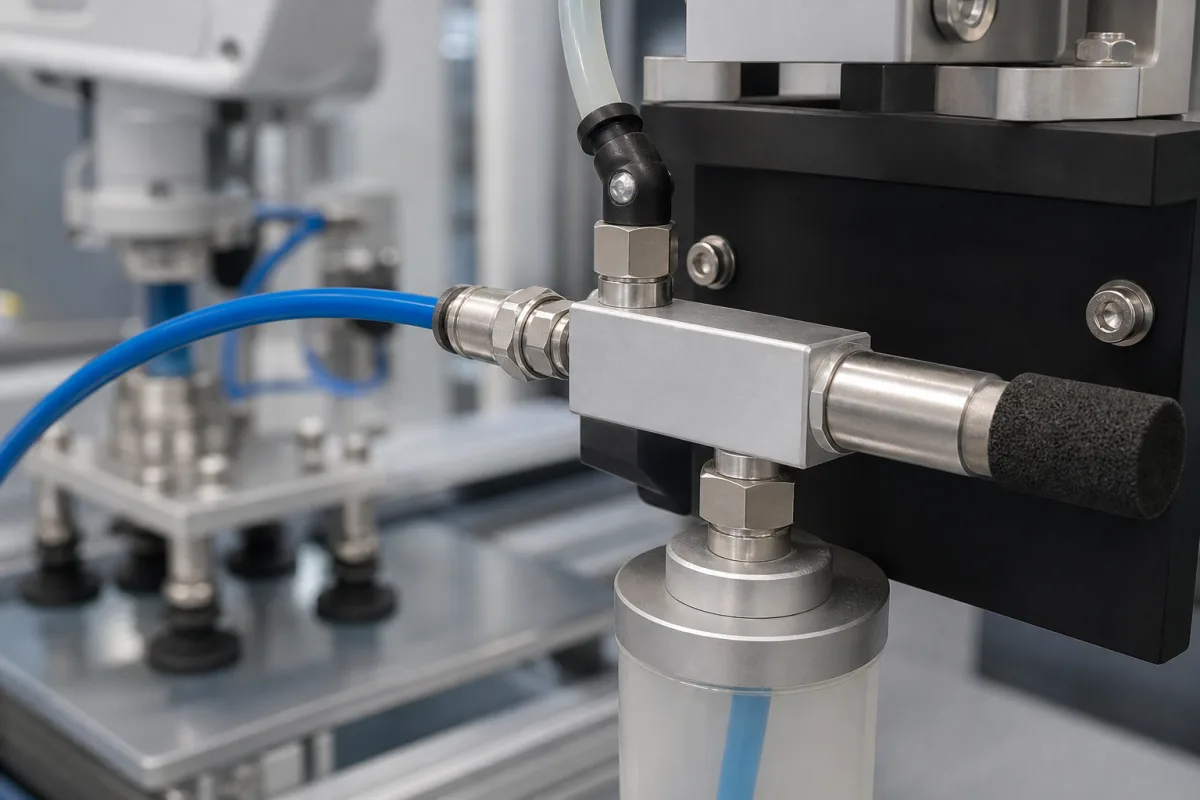
Vacuum generator (Venturi ejector) for vacuum gripping
Vacuum gripping · Venturi ejectors, vacuum level versus suction flow, air consumption, holding force
A vacuum generator (ejector) uses compressed air flowing through a Venturi nozzle to create vacuum for suction cups, with no flexible parts. Ask three things first: what vacuum level and suction flow your workpiece and cups need, how much compressed air the ejector uses to get there, and whether valves, air saving, filters and a vacuum switch are built in.
Compressed-air vacuum generators (Venturi and multistage ejectors) for vacuum gripping and handling, including inline, compact and manifold-mounted types. Electrically driven vacuum pumps and blowers, and packaging machines that merely contain an ejector, are outside this page.
CNFX editorial research · Sources checked October 18, 2026 · 4 sources
Schmalz describes compressed air passing through a Venturi nozzle, with the supply air and aspirated air discharged through a silencer. Its compact ejectors add suction and blow-off valves, with monitoring and air-saving functions on selected versions. [1] SMC lists the ZH series at 0.45 MPa supply: Type S reaches −90 kPa; Type L reaches −48 kPa with 0.5–1.3 mm nozzles or −66 kPa with 1.5–2.0 mm nozzles. For the 1.0 mm nozzle, the listed maximum suction flow is 26 l/min (ANR) for S or 52 l/min (ANR) for L, with air consumption of 52 l/min (ANR). These are representative catalogue characteristics. Maximum vacuum and maximum suction flow are different points on the flow curve; they are not simultaneous operating conditions. Select the required flow at the working vacuum from the curve. [3]
Coval recommends limiting the vacuum level from 30% where a high flow of vacuum must be maintained to 80% in an airtight circuit, because a high vacuum costs more energy and takes longer to establish. It suggests expressing vacuum as a percentage of atmospheric pressure because atmospheric pressure varies with altitude. [4] SMC likewise notes that its values are representative and vary with atmospheric pressure, weather and altitude. [3]
Editorial calculation: assuming atmospheric pressure is 101.3 kPa and using vacuum percentage = pressure difference / atmospheric pressure × 100, pressure differences of 90, 66 and 48 kPa give approximately 89%, 65% and 47% vacuum. These are conversions under an assumed atmosphere, not maker-published or measured operating values. SMC’s two maximum-flow entries for the 1.0 mm nozzle differ by a factor of two, but the flow at the required vacuum must be read separately. [3][4]
Schmalz describes compact ejectors with built-in suction and blow-off valves, filter and vacuum switch, some with air-saving regulation that stops vacuum generation once a safe vacuum is reached and restarts it only when vacuum falls below a preset minimum. [1]
Give the supplier the workpiece (material, surface, porosity, weight, size), cup type and number, required vacuum level, cycle time, supply pressure available, hose lengths and diameters, and whether you need integrated valves, blow-off, filter, vacuum switch or air saving.
02
Check the holding force with your vacuum level
Schmalz defines a suction cup's holding force as the pressure difference multiplied by the effective suction area, F = Δp × A. It is a theoretical value given without safety factors, and Schmalz notes: "It is usual to state the holding force of a suction cup with a relative vacuum of 60%." [2]
Editorial calculation: assuming a circular effective suction diameter of 40 mm, a uniform maintained pressure difference, atmospheric pressure of 101.3 kPa, and no leakage or dynamic loads, A = πd²/4 ≈ 12.6 cm². At 60% vacuum, Δp = 60.78 kPa and F ≈ 76 N; assuming Δp = 90 kPa gives approximately 113 N, and assuming Δp = 48 kPa gives approximately 60 N. These are theoretical calculations, not manufacturer-published or measured operating forces. They contain no safety factor and do not establish that a particular ejector maintains these pressures with the workpiece attached. [2]
Editorial note: a higher vacuum raises force only if the workpiece seals; on porous or leaking parts the flow the ejector can maintain matters more, which is the case Coval's 30% recommendation addresses. [4]
03
Single-stage nozzles and integrated valve blocks
A nozzle-only ejector requires external suction control and vacuum monitoring; Schmalz’s compact versions integrate valves and offer a filter, vacuum switch and optional air-saving regulation. [1]
04
Motive nozzle, diffuser and exhaust path
The nozzle and diffuser define the air path; the SMC ZH construction drawing separates the body, diffuser, seals and exhaust connection. Control valves and monitoring belong to the selected ejector package. [3][1]
The ZH maximum-flow entries cannot replace a flow reading at the required cup vacuum. Match the nozzle size, supply pressure and fitting configuration before using these catalogue values. [3]
6 companies list this product among what they make. Company figures are quoted from each
company's own website; every card states where the relationship came from.
HanTian Automation (ZheJiang) Co.,Ltd.
TBC
Lists basic, multistage, combined, integrated and conveying vacuum generators with suction cups.
Explore company information and manufacturing capabilities, then discuss the scope of your project with a relevant supplier.
Share this page
Compiled and source-reviewed by the CNFX editorial team.
Each manufacturer above links to the page on that company's own website where the product is listed, with the date we checked it. How we source and review
· Page last updated 13 October 2026
Buyer questions
How does a vacuum generator work?
Schmalz explains that compressed air is accelerated through a Venturi nozzle and slows after it, creating vacuum that draws air in through the vacuum port; both leave through the silencer. [1]
Should I choose high vacuum or high flow?
At 0.45 MPa supply, SMC lists representative maximum vacuum values of −90 kPa for ZH Type S and −48 or −66 kPa for Type L, depending on nozzle size. Maximum suction flow is a separate catalogue entry; use the curve for flow at the required vacuum. Coval recommends vacuum levels from 30% for high-flow applications to 80% for airtight circuits. [3][4]
How is suction cup holding force calculated?
Schmalz gives F = Δp × effective area, a theoretical value without safety factors, and says "It is usual to state the holding force of a suction cup with a relative vacuum of 60%." [2]
Sources and what still needs a direct check
Sources checked 2026-10-18. Schmalz, SMC and Coval are vacuum component makers; the ZH values are SMC's representative data for its own series, not general ratings.