Industry-Verified Manufacturing Data (2026)

Vacuum Nozzle

Based on aggregated insights from multiple verified factory profiles within the CNFX directory, the standard Vacuum Nozzle used in the Machinery and Equipment Manufacturing sector typically supports operational capacities ranging from standard industrial configurations to heavy-duty production requirements.

Technical Definition & Core Assembly

A canonical Vacuum Nozzle is characterized by the integration of Nozzle Body/Shaft and Tip/Orifice. In industrial production environments, manufacturers listed on CNFX commonly emphasize Stainless Steel construction to support stable, high-cycle operation across diverse manufacturing scenarios.

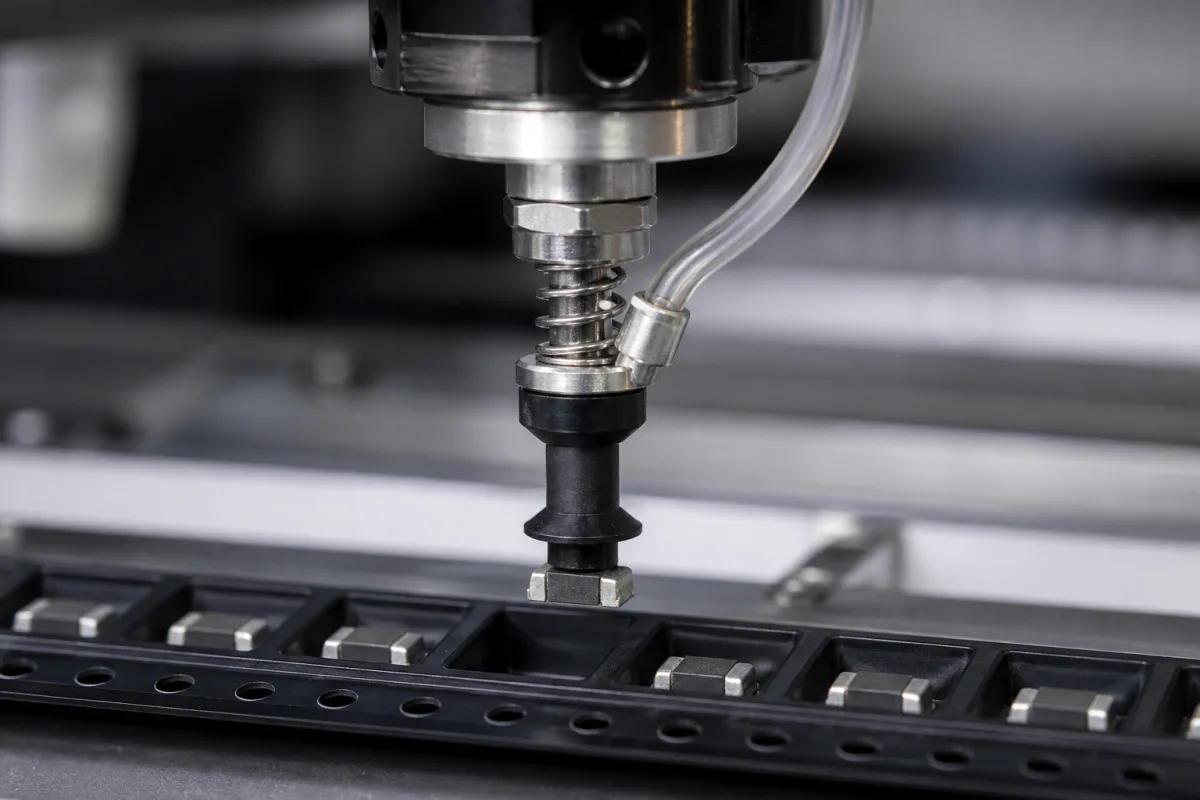
A precision component of a placement head that uses vacuum pressure to pick up and hold electronic components during surface mount assembly.
Product Specifications

Technical details and manufacturing context for Vacuum Nozzle

Definition
The vacuum nozzle is a critical interface component within a placement head system used in surface mount technology (SMT) assembly lines. It creates a vacuum seal to securely pick up electronic components from feeders, transport them accurately to the PCB, and release them precisely at the designated placement location. Its design directly impacts placement accuracy, speed, and reliability.
Working Principle
The nozzle connects to a vacuum pump or generator via internal channels in the placement head. When activated, negative pressure (vacuum) is created at the nozzle tip orifice. This pressure differential causes the component to be sucked against the nozzle tip and held securely by atmospheric pressure. To release the component, the vacuum is switched off or positive pressure (a 'blow-off') is briefly applied.
Common Materials
Stainless Steel, Ceramic (Alumina/Zirconia), Tungsten Carbide, Polymer (PEEK, UHMW-PE)
Technical Parameters
  • The inner diameter of the nozzle tip orifice, which must match the size of the component to be picked. Common sizes range from 0.3mm for 0201 chips to over 10mm for large connectors. (mm) Per Request
Components / BOM
  • Nozzle Body/Shaft
    Provides structural integrity, houses the vacuum channel, and interfaces with the placement head.
    Material: Stainless Steel or Hardened Polymer
  • Tip/Orifice
    The precision-machined end that makes direct contact with the component. Its geometry and finish ensure a reliable vacuum seal.
    Material: Ceramic, Tungsten Carbide, or Specialty Steel
  • Internal Vacuum Channel
    A bored passage through the body that transmits vacuum pressure from the head to the tip orifice.
    Material: Defined by nozzle body material
  • Sealing O-ring/Gasket (if applicable)
    Ensures an airtight seal between the nozzle and the placement head spindle.
    Material: Viton, Buna-N, or other elastomers
Engineering Reasoning
0.3-0.8 bar vacuum pressure, 20-80°C operating temperature, 0.01-0.05 mm tip clearance
Vacuum pressure below 0.15 bar causes component drop, tip wear exceeding 0.1 mm diameter change causes misalignment, temperature above 120°C degrades elastomer seals
Design Rationale: Bernoulli's principle failure at low pressure differentials, abrasive wear from ceramic component edges exceeding Mohs hardness 7, thermal expansion mismatch between stainless steel (17.3 μm/m·K) and silicone rubber (250 μm/m·K) seals
Risk Mitigation (FMEA)
Trigger Particulate contamination exceeding ISO 14644-1 Class 5 standard
Mode: Vacuum flow restriction causing 40% pressure drop
Strategy: Integrated 5 μm sintered bronze filter with ultrasonic cleaning port
Trigger Cyclic fatigue from 60,000 placements/hour operation
Mode: Micro-crack propagation in 316L stainless steel tip exceeding 0.5 mm length
Strategy: Shot peening surface treatment to induce 400 MPa compressive residual stress layer

Industry Taxonomies & Aliases

Commonly used trade names and technical identifiers for Vacuum Nozzle.

Applied To / Applications

This component is essential for the following industrial systems and equipment:

Industrial Ecosystem & Supply Chain DNA

Complementary Systems
Downstream Applications
Specialized Tooling

Application Fit & Sizing Matrix

Operational Limits
pressure: Up to 90 kPa vacuum
flow rate: 0.5 to 5.0 L/min
temperature: -20°C to 150°C
slurry concentration: Not applicable (dry components only)
Media Compatibility
✓ SMT components (0402 to QFP) ✓ Ceramic substrates ✓ Plastic IC packages
Unsuitable: Wet or adhesive-coated surfaces
Sizing Data Required
  • Component size and weight
  • Required placement accuracy
  • Pick-and-place cycle rate

Reliability & Engineering Risk Analysis

Failure Mode & Root Cause
Clogging/Blockage
Cause: Accumulation of particulate matter, debris, or viscous materials in the nozzle orifice or internal passages, often due to inadequate filtration of the vacuumed media or operation in contaminated environments.
Wear/Erosion of Nozzle Tip
Cause: Abrasive particles in the airflow or contact with hard surfaces during operation, leading to material loss, increased clearances, and reduced vacuum efficiency and seal integrity.
Maintenance Indicators
  • Audible hissing or whistling from the nozzle during operation, indicating air leaks due to wear, cracks, or poor sealing.
  • Visible damage such as cracks, chips, or deformation at the nozzle tip or body, often accompanied by a noticeable drop in suction performance.
Engineering Tips
  • Implement regular inspection and cleaning schedules, using appropriate tools (e.g., soft brushes, compressed air) to remove debris and prevent clogging, especially in dusty or particulate-heavy applications.
  • Use nozzle tips made from wear-resistant materials (e.g., hardened steel, ceramic, or polyurethane) and ensure proper alignment during operation to minimize abrasive contact and extend service life.

Compliance & Manufacturing Standards

Reference Standards
ISO 2941: Hydraulic fluid power - Filter elements - Verification of collapse/burst pressure rating ANSI/ASME B40.100: Pressure Gauges and Gauge Attachments DIN 28400: Vacuum technology; acceptance specifications for vacuum pumps; rules
Manufacturing Precision
  • Bore diameter: +/-0.01mm
  • Surface flatness: 0.05mm
Quality Inspection
  • Leak rate test (helium mass spectrometry)
  • Material composition verification (X-ray fluorescence analysis)

Factories Producing Vacuum Nozzle

Verified manufacturers with capability to produce this product in China

✓ 95% Supplier Capability Match Found

P Project Engineer from Brazil Feb 18, 2026
★★★★★
"Standard OEM quality for Machinery and Equipment Manufacturing applications. The Vacuum Nozzle arrived with full certification."
Technical Specifications Verified
S Sourcing Manager from Canada Feb 15, 2026
★★★★★
"Great transparency on the Vacuum Nozzle components. Essential for our Machinery and Equipment Manufacturing supply chain."
Technical Specifications Verified
P Procurement Specialist from United States Feb 12, 2026
★★★★★
"The Vacuum Nozzle we sourced perfectly fits our Machinery and Equipment Manufacturing production line requirements."
Technical Specifications Verified
Verification Protocol

“Feedback is collected from verified sourcing managers during RFQ (Request for Quote) and factory evaluation processes on CNFX. These reports represent historical performance data and technical audit summaries from our B2B manufacturing network.”

5 sourcing managers are analyzing this specification now. Last inquiry for Vacuum Nozzle from USA (1h ago).

Supply Chain Compatible Machinery & Devices

Automated Assembly Line System

Integrated production system for sequential component assembly operations

Explore Specs →
Automated Powder Coating System

Integrated industrial system for applying dry powder coatings to metal substrates.

Explore Specs →
Centrifugal Pump Impeller

Rotating component that transfers energy to fluid in centrifugal pumps.

Explore Specs →
High-Precision CNC Laser Cutting Machine

Computer-controlled industrial machine using focused laser beams to cut sheet metal with micron-level accuracy.

Explore Specs →

Frequently Asked Questions

What materials are best for vacuum nozzles in high-temperature SMT applications?

For high-temperature surface mount assembly, ceramic materials like alumina or zirconia offer excellent heat resistance and durability, while tungsten carbide provides superior wear resistance for high-volume production.

How do I choose between stainless steel and polymer vacuum nozzles?

Stainless steel nozzles provide maximum durability and precision for standard applications, while polymer nozzles (PEEK or UHMW-PE) are ideal for delicate components where component damage prevention is critical, offering anti-static properties and reduced marking.

What maintenance is required for vacuum nozzles in placement equipment?

Regular inspection of the tip/orifice for wear or clogging, checking O-ring seals for leaks, and cleaning internal vacuum channels to maintain optimal suction pressure. Nozzle life varies by material and usage frequency.

Can I contact factories directly on CNFX?

CNFX is an open directory, not a transaction platform. Each factory profile provides direct contact information and production details to help you initiate direct inquiries with Chinese suppliers.

Get Quote for Vacuum Nozzle

Request technical pricing, lead times, or customized specifications for Vacuum Nozzle directly from verified manufacturing units.

Your business information is encrypted and only shared with verified Vacuum Nozzle suppliers.

Thank you! Your message has been sent. We'll respond within 1–3 business days.

Need to Manufacture Vacuum Nozzle?

Connect with verified factories specializing in this product category

Add Your Factory Contact Us
Previous Product
Vacuum Manifold
Next Product
Vacuum Pad Assembly