Industry-Verified Manufacturing Data (2026)

Vacuum Pad Assembly

Based on aggregated insights from multiple verified factory profiles within the CNFX directory, the standard Vacuum Pad Assembly used in the Machinery and Equipment Manufacturing sector typically supports operational capacities ranging from standard industrial configurations to heavy-duty production requirements.

Technical Definition & Core Assembly

A canonical Vacuum Pad Assembly is characterized by the integration of Vacuum Pad / Cup and Pad Holder / Body. In industrial production environments, manufacturers listed on CNFX commonly emphasize Polyurethane (PU) construction to support stable, high-cycle operation across diverse manufacturing scenarios.

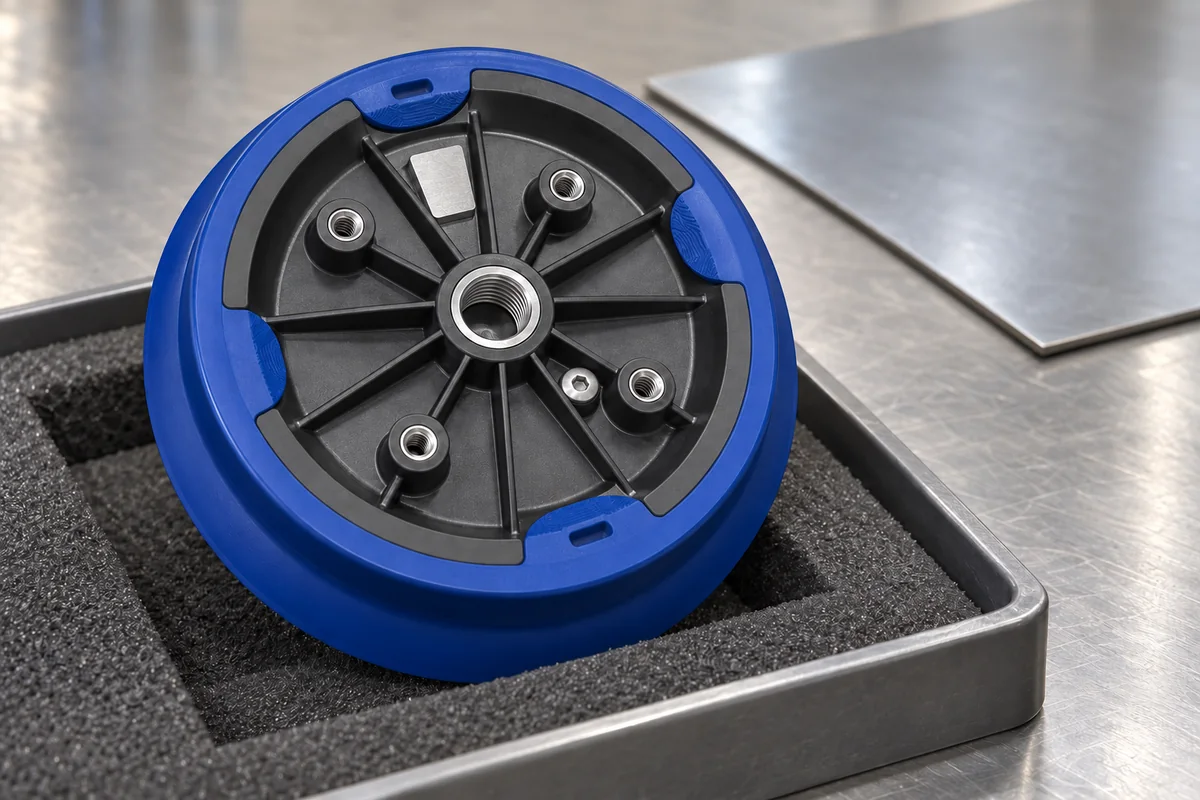
A modular assembly within a vacuum gripper head that creates suction to lift and manipulate objects.
Product Specifications

Technical details and manufacturing context for Vacuum Pad Assembly

Definition
The Vacuum Pad Assembly is a critical sub-component of a Gripper Head (Vacuum Pad/Mechanical Claw) system. It consists of the vacuum pad (or cup), its mounting hardware, and internal channels that connect to a vacuum source. Its primary role is to form a secure, airtight seal against the surface of a target object, enabling the gripper head to lift, hold, and transfer items through negative air pressure (vacuum).
Working Principle
When the vacuum system is activated, air is evacuated from the space between the pad and the object's surface, creating a pressure differential. Atmospheric pressure then exerts force on the object, pressing it against the pad and creating a holding force. The assembly releases the object by restoring atmospheric pressure to the pad cavity.
Common Materials
Polyurethane (PU), Silicone Rubber, Nitrile Rubber (NBR)
Technical Parameters
  • Diameter of the vacuum pad's sealing lip, determining the contact area and theoretical lifting force. (mm) Standard Spec
Components / BOM
  • Vacuum Pad / Cup
    Forms the airtight seal against the object surface. The flexible lip conforms to surface irregularities.
    Material: Polyurethane, Silicone, or Nitrile Rubber
  • Pad Holder / Body
    Rigid structure that houses the pad, provides the mounting interface, and contains the vacuum port.
    Material: Aluminum, Stainless Steel, or Engineering Plastic (e.g., POM)
  • Vacuum Port / Fitting
    Connection point for the vacuum hose or internal channel from the gripper head's manifold.
    Material: Brass, Stainless Steel, or Plastic
  • Mounting Hardware
    Screws, nuts, or quick-connect fittings used to secure the assembly to the gripper head.
    Material: Steel or Stainless Steel
Engineering Reasoning
0.8-1.2 bar absolute pressure (80-120 kPa)
0.65 bar absolute pressure (65 kPa) - vacuum loss threshold
Design Rationale: Bernoulli's principle failure due to air leakage exceeding 0.15 L/min at 1 bar differential, causing pressure equalization and suction loss
Risk Mitigation (FMEA)
Trigger Particulate contamination exceeding 50 μm diameter
Mode: Seal surface abrasion leading to 0.3 mm³/s leakage rate
Strategy: Integrated 40 μm sintered bronze filter with 0.8 bar bypass valve
Trigger Cyclic fatigue from 10⁶ compression cycles at 0.5 Hz
Mode: Elastomer bellows cracking at 2.5 MPa stress concentration points
Strategy: FKM fluorocarbon compound with 12% carbon black reinforcement and 3 mm minimum wall thickness

Industry Taxonomies & Aliases

Commonly used trade names and technical identifiers for Vacuum Pad Assembly.

Applied To / Applications

This component is essential for the following industrial systems and equipment:

Industrial Ecosystem & Supply Chain DNA

Complementary Systems
Downstream Applications
Specialized Tooling

Application Fit & Sizing Matrix

Operational Limits
pressure: Up to 0.8 bar vacuum, 6 bar max operating pressure
flow rate: 0-30 L/min per pad
temperature: -20°C to 80°C
slurry concentration: Not recommended for slurries >5% solids by volume
Media Compatibility
✓ Flat rigid surfaces (glass, metal sheets) ✓ Porous materials (cardboard, wood) with appropriate sealing ✓ Fragile items (electronics, packaged goods)
Unsuitable: High-temperature surfaces (>80°C) or environments with oil mist contamination
Sizing Data Required
  • Object weight (including safety factor)
  • Surface area and geometry of contact
  • Required lifting speed/cycle time

Reliability & Engineering Risk Analysis

Failure Mode & Root Cause
Loss of vacuum integrity
Cause: Pad material degradation due to chemical exposure, abrasion from rough surfaces, or fatigue from repeated compression cycles leading to micro-tears and air leakage.
Seal failure at interface
Cause: Improper mounting surface preparation (contaminants, unevenness), excessive side-loading forces causing misalignment, or seal material incompatibility with operating environment (temperature, humidity).
Maintenance Indicators
  • Audible hissing or air leakage sounds during operation indicating seal compromise
  • Visible deformation, cracking, or discoloration of the pad material suggesting material breakdown
Engineering Tips
  • Implement regular surface compatibility testing with actual workpieces to prevent chemical degradation and optimize pad material selection
  • Establish torque-controlled mounting procedures and alignment verification protocols to minimize uneven stress distribution and premature seal wear

Compliance & Manufacturing Standards

Reference Standards
ISO 1219-1:2012 (Fluid power systems and components - Graphical symbols and circuit diagrams) ANSI B40.1 (Pressure Gauges and Gauge Attachments) DIN 24342 (Hydraulic fluid power - Fittings - Dimensions and requirements)
Manufacturing Precision
  • Bore diameter: +/-0.05mm
  • Surface flatness: 0.08mm across contact area
Quality Inspection
  • Vacuum Leak Test (pressure decay method)
  • Material Hardness Test (Rockwell or Brinell scale)

Factories Producing Vacuum Pad Assembly

Verified manufacturers with capability to produce this product in China

✓ 92% Supplier Capability Match Found

P Procurement Specialist from United States Feb 16, 2026
★★★★★
"Impressive build quality. Especially the technical reliability is very stable during long-term operation."
Technical Specifications Verified
T Technical Director from United Arab Emirates Feb 13, 2026
★★★★★
"As a professional in the Machinery and Equipment Manufacturing sector, I confirm this Vacuum Pad Assembly meets all ISO standards."
Technical Specifications Verified
P Project Engineer from Australia Feb 10, 2026
★★★★★
"Standard OEM quality for Machinery and Equipment Manufacturing applications. The Vacuum Pad Assembly arrived with full certification."
Technical Specifications Verified
Verification Protocol

“Feedback is collected from verified sourcing managers during RFQ (Request for Quote) and factory evaluation processes on CNFX. These reports represent historical performance data and technical audit summaries from our B2B manufacturing network.”

6 sourcing managers are analyzing this specification now. Last inquiry for Vacuum Pad Assembly from UAE (1h ago).

Supply Chain Compatible Machinery & Devices

Heavy-Duty CNC Plasma Cutting Machine

Industrial machine for precision metal cutting using plasma arc technology

Explore Specs →
Automated Assembly Line System

Integrated production system for sequential component assembly operations

Explore Specs →
Automated Powder Coating System

Integrated industrial system for applying dry powder coatings to metal substrates.

Explore Specs →
Centrifugal Pump Impeller

Rotating component that transfers energy to fluid in centrifugal pumps.

Explore Specs →

Frequently Asked Questions

What materials are available for the vacuum pads in this assembly?

Our vacuum pad assemblies offer three material options: Polyurethane (PU) for durability and abrasion resistance, Silicone Rubber for high-temperature applications and food safety, and Nitrile Rubber (NBR) for oil resistance and general-purpose use.

How does the modular design benefit machinery manufacturing applications?

The modular design allows for easy replacement of individual components like pads, holders, or fittings without replacing the entire assembly. This reduces downtime, lowers maintenance costs, and enables customization for different object shapes and weights in automated handling systems.

What components are included in the vacuum pad assembly BOM?

The complete bill of materials includes: Mounting Hardware for secure attachment to machinery, Pad Holder/Body that supports the vacuum pad, Vacuum Pad/Cup that creates the suction seal, and Vacuum Port/Fitting for connecting to your vacuum system. All components are designed for compatibility and optimal performance.

Can I contact factories directly on CNFX?

CNFX is an open directory, not a transaction platform. Each factory profile provides direct contact information and production details to help you initiate direct inquiries with Chinese suppliers.

Get Quote for Vacuum Pad Assembly

Request technical pricing, lead times, or customized specifications for Vacuum Pad Assembly directly from verified manufacturing units.

Your business information is encrypted and only shared with verified Vacuum Pad Assembly suppliers.

Thank you! Your message has been sent. We'll respond within 1–3 business days.

Need to Manufacture Vacuum Pad Assembly?

Connect with verified factories specializing in this product category

Add Your Factory Contact Us
Previous Product
Vacuum Nozzle
Next Product
Vacuum Pump