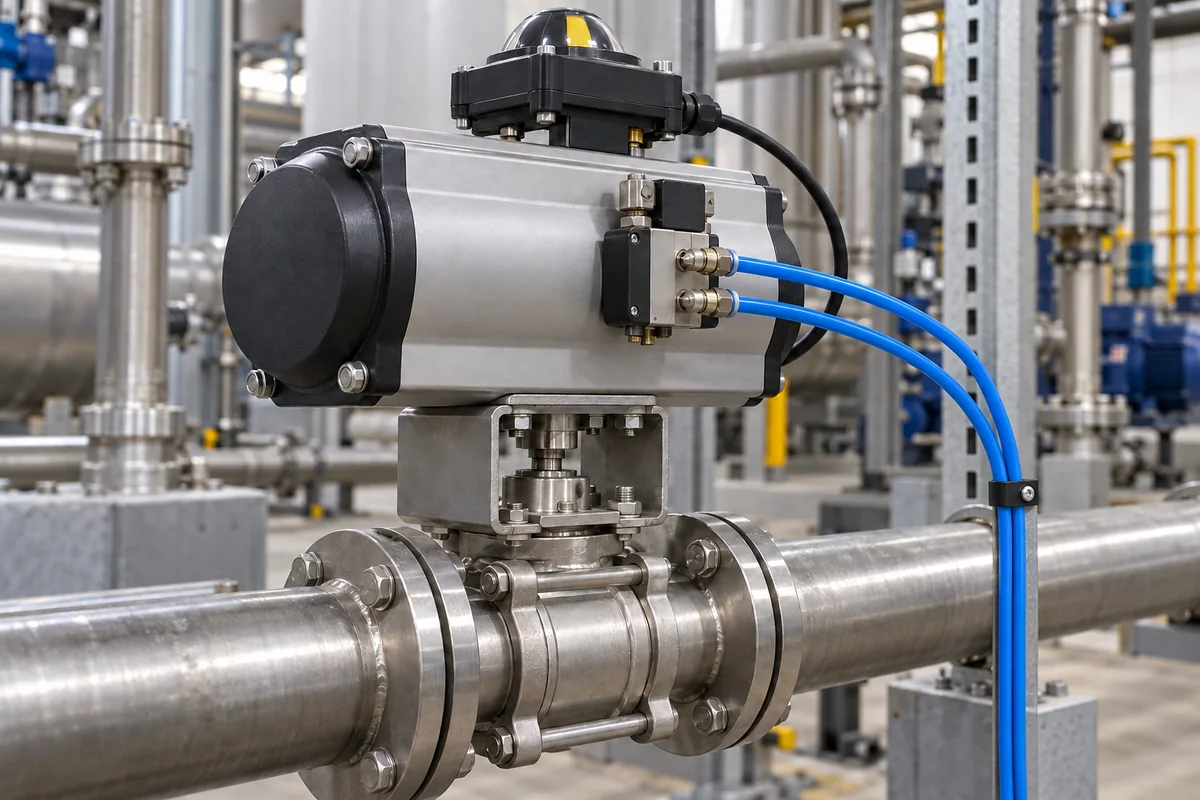
Valve actuator mounting: the ISO 5211 flange and stem drive, direct mount or bracket and coupling, and the NAMUR solenoid face
Fitting a quarter-turn actuator to its valve · ISO 5211 flange size against torque, square or keyed stem drive, direct mount or bracket and coupling, NAMUR face for the solenoid valve
An actuator that is strong enough can still fail to do its job if it is joined to the valve badly. Three interfaces decide whether it fits: the flange it bolts to, with a bolt circle and a reference torque set by ISO 5211; the drive that turns the valve stem, a square, flats or a key; and, on a pneumatic unit, the NAMUR face where the solenoid valve sits. When the valve's own top flange and stem match the actuator, it mounts directly; when they do not, a bracket and a coupling bridge the gap. This page reads those interfaces against the torque the actuator delivers.
The mechanical and pneumatic interfaces that join a quarter-turn valve actuator, electric or pneumatic, to a ball, butterfly or plug valve and to its pilot solenoid valve: ISO 5211 flange types and their reference torques, square, flat and keyed drives, direct mounting versus bracket and coupling kits, and the VDI/VDE 3845 and VDI/VDE 3847 NAMUR faces. Sizing a pneumatic actuator to the valve's torque, rack-and-pinion versus scotch-yoke and spring-return charts are covered on the Pneumatic actuator page. The solenoid valves themselves are covered on the Solenoid valve page, limit switch boxes on the Valve position indicator and limit switch box page, positioners on the Valve controller (valve positioner) page, and electric actuators working in a flow loop on the Liquid flow controller with electric valve actuator page. Hygienic regulating valves, valve-island-piloted skids, compressed-air circuits on production machines and air-over-oil intensifier cylinders each have their own pages. Multi-turn gate-valve actuators and their thrust bases are outside this page.
CNFX editorial research · Sources checked October 12, 2026 · 3 sources
ISO 5211 flange size read against the actuator's output torque
ISO 5211 fixes the flange that a part-turn actuator bolts to and gives each flange type a maximum torque it is meant to carry. Those torques assume bolts in tension at 290 MPa and a friction coefficient of 0.2 between the mating faces; the standard's own caution, as Tameson reproduces it, is to allow for extra torque from inertia and other factors when picking a flange. [1]
Holes sit off the centre lines: at 45° for F03 to F16 and 22.5° for F25 to F40, which have eight bolts. [1] An actuator can be drilled for two bolt circles: AOX's AOX-R electric range, 30 to 5,000 N·m, is drilled F04/05 on the 30 N·m model, F05/07 from 50 to 150 N·m, F10/12 from 200 to 1,000 N·m and F14/16/25 from 1,600 N·m up. [2]
Editorial calculation: the AOX-R-015 delivers 150 N·m, above the 125 N·m reference for F05 and within the 250 N·m for F07, so on a valve offering both it is the F07 circle that carries the full output; the AOX-R-100 delivers 1,000 N·m, twice the 500 N·m F10 reference and equal to the F12 value, and the 5,000 N·m AOX-R-500 is beyond F16's 4,000 N·m and needs the F25 face. [2][1] A smaller valve flange paired with a large actuator is the case where a bracket or an adapter flange appears.
Give the supplier the valve's top-flange type and bolt circle, the actuator's maximum output torque and whether the valve may see torque beyond the actuator's rating from a manual override or a stuck stem.
02
Square, flats or key: the stem drive and the torque it can transmit
ISO 5211 covers parallel and diagonal square drives, flat-head drives and single and two-key drives, and designates an attachment by flange, spigot and drive; Tameson's example, F07-Y-V-22, is an F07 flange with spigot and a single key drive of 22 mm. [1] The drive has its own torque ceiling, based on an allowable torsional stress of 280 MPa in the driven part. [1]
AOX lists the square output and its depth for each AOX-R model: 11 × 11 mm, 15.5 mm deep at 30 N·m; 14 × 14 mm, 18 mm deep at 50 and 80 N·m; 17 × 17 mm, 22.5 mm deep at 100 and 150 N·m; 22 × 22 mm, 26 mm deep from 200 to 400 N·m; and 27 × 27 mm, 32.5 mm deep from 600 to 1,000 N·m. From 1,600 N·m the drive is a bore of up to 60 mm, up to 133 mm deep. [2] The drive sleeve can be removed and machined to suit a valve stem. [2]
Editorial calculation: each AOX-R square sits at or under the ISO 5211 transmissible torque for its size, from the 17 mm square at 150 N·m (250 N·m limit) to the 27 mm square at 1,000 N·m, which is exactly the 1,000 N·m limit. [2][1] A valve stem with a 14 mm square cannot take the 22 mm drive of a 400 N·m actuator without a reducing insert or a coupling, and the insert does not raise the 125 N·m that the 14 mm square is rated to transmit.
Direct mounting or a bracket and coupling between actuator and valve
Tameson describes direct mounting as the actuator bolted straight onto the valve's ISO top flange, with no bracket and no drive coupling. Drive inserts make that direct fit; they come built into factory-made actuators or as separate units, and can be replaced at the distributor or by the user. [1]
Where the valve has no matching top flange, or its stem is too short, too long or the wrong shape, the actuator stands on a bracket bolted to the valve with a coupling joining the two shafts. Editorial note: the bracket and coupling then become part of the torque path, so ask for the coupling's drive dimensions at both ends and for the bracket's bolting to be rated to the actuator's output torque, not to the valve's operating torque.
AOX states that its AOX-R can be installed vertically or horizontally and has two external adjusting bolts as mechanical limits on its 90° travel. [2]
04
The NAMUR face for the solenoid valve: ¼-inch, ½-inch and the extended VDI/VDE 3847
On a pneumatic actuator the pilot solenoid valve bolts to a standard face rather than being piped. SAMSON describes the VDI/VDE 3845 NAMUR interface as two air ducts to the actuator and four tapped holes for mounting, in ¼-inch and ½-inch sizes named after the air ducts; the mounting holes are M5 for ¼ inch and M6 for ½ inch, and also take a coded screw that fixes which way round the solenoid valve goes. [3]
In that basic face the supply air and any external pilot supply are routed separately. The extended interface to VDI/VDE 3847, available in ¼ inch, adds ducts for supply air (port 1) and external pilot supply (port 9) so that all connections pass through one face, held by two M5 screws; it remains compatible with a 3845 face if ports 1 and 9 are sealed. [3] SAMSON's port numbering is 1 supply air, 2 actuator supply, 3 actuator exhaust and 9 external pilot supply. [3]
When a solenoid valve will not sit flush on the actuator, SAMSON fits a distance plate between them, in aluminium EN AW-6082-T6 or stainless steel 1.4404, and offers adapter plates from ¼-inch to ½-inch faces and from a NAMUR face onto a NAMUR rib. [3]
05
Send the valve's top flange, stem and pilot interface with the torque
Paste it into your enquiry below or into an email to a maker, then replace every bracket.
Valve: [type and size; top-flange type and bolt circle; stem drive and dimensions; stem height]
Actuator: [electric or pneumatic; maximum output torque; travel and limits]
Mounting: [direct or bracket and coupling; orientation]
Pilot valve: [NAMUR ¼ inch or ½ inch; VDI/VDE 3845 or 3847; supply routed separately or through the face]
Accessories: [switch box; positioner; manual override]
Documents: [assembly drawing with flange and drive designation]
Actuator and valve makers reviewed for mounting work
12 companies list this product among what they make. Company figures are quoted from each
company's own website; every card states where the relationship came from.
Lists JHA rack-and-pinion pneumatic actuators, double-acting and spring-return, with gear operators and declutchable manual overrides; states it follows ISO 5211 and NAMUR.
Lists electric rotary, explosion-proof and multi-turn valve actuators, pneumatic rotary and heavy-duty actuators, worm gears and pneumatic accessories.
Lists butterfly valves with in-house manual handles and with worm-gear, electric, pneumatic and hydraulic actuators that it states come from partner suppliers.
Explore company information and manufacturing capabilities, then discuss the scope of your project with a relevant supplier.
Share this page
Compiled and source-reviewed by the CNFX editorial team.
Each manufacturer above links to the page on that company's own website where the product is listed, with the date we checked it. How we source and review
· Page last updated 13 October 2026
Buyer questions
How much torque can an ISO 5211 F07 flange take?
ISO 5211 gives F07, 70 mm bolt circle and four M8 bolts, a maximum flange torque of 250 N·m, against 125 N·m for F05 and 500 N·m for F10. [1]
What does an ISO 5211 designation like F07-Y-V-22 mean?
F07 flange, with spigot, single key drive, 22 mm drive size, in Tameson's worked example. [1]
Why do actuators have two flanges such as F05/07?
So they fit valves with either bolt circle; AOX drills its 50–150 N·m AOX-R models F05/07 and its 200–1,000 N·m models F10/12. [2]
What is the difference between VDI/VDE 3845 and VDI/VDE 3847?
SAMSON says the 3845 face carries only the actuator supply and exhaust ducts, while the 3847 extended face adds supply air and external pilot supply, fixed by two M5 screws. [3]
Sources and what still needs a direct check
Sources checked 2026-10-12. The ISO 5211 dimensions and torques are as reproduced by Tameson, a valve and actuator distributor; the standard itself is the controlling document. AOX's figures are for its own AOX-R range; SAMSON describes its own solenoid-valve function blocks and its reading of VDI/VDE 3845 and 3847.