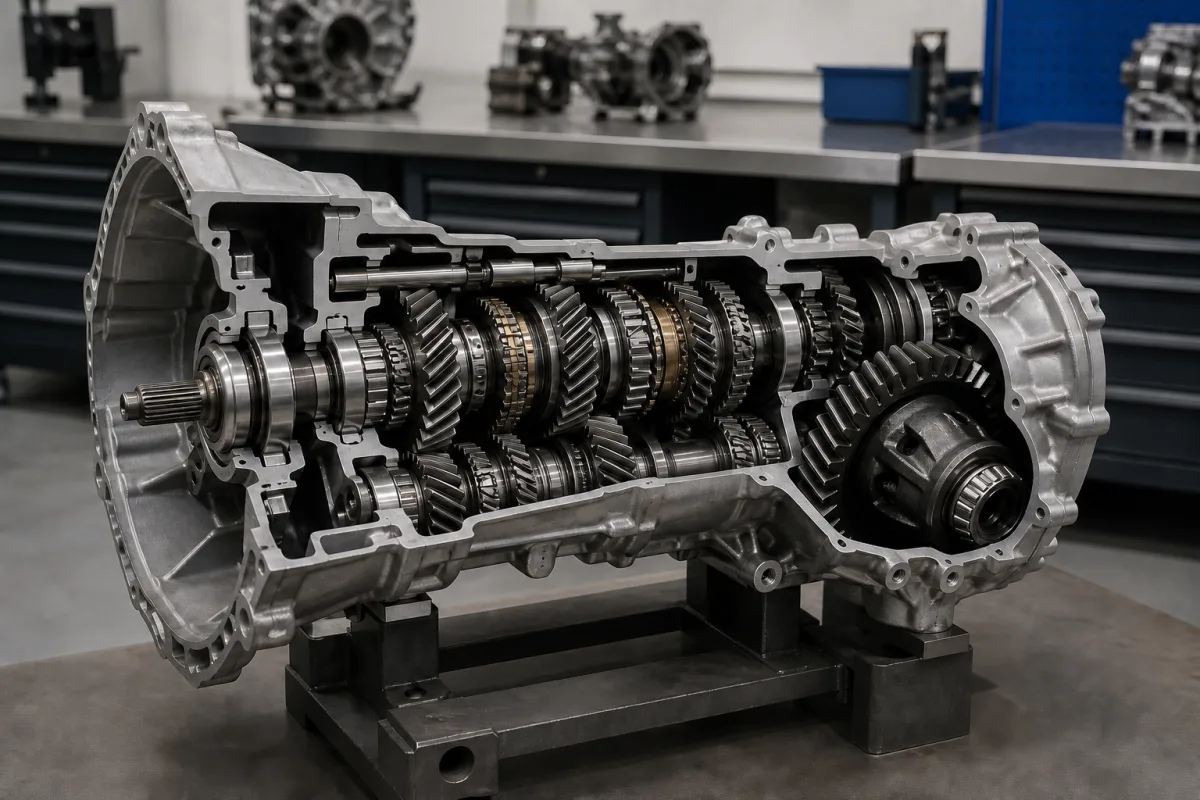
Manual transaxle for cars (gearbox with integrated final drive and differential)
Car manual transaxle · Gearbox with built-in final drive and differential: shaft layout, synchronizers, torque and speed ratings
A manual transaxle is a manually shifted gearbox that shares one case with the final drive and differential, so it drives the two axle half-shafts directly instead of feeding a separate rear axle. It is used in front-wheel-drive cars with transverse engines and in mid- or rear-engine cars. Ask three things first: which shaft layout and how many synchronized ratios the unit has, what input torque and engine speed it is rated for, and what differential and shift mechanism come with it.
Manually shifted transaxles for passenger, sports and custom cars: front-wheel-drive transverse units and mid- or rear-engine longitudinal units, with their synchronizers, final drive and differential. Transmissions and gearboxes for trucks, buses, vans and off-road vehicles, including AMT and torque-converter automatics and transfer cases, are covered on the Transmissions (vehicle gearboxes) page. Automatic and dual-clutch transaxles, industrial gear reducers and robot RV reducers are outside this page.
CNFX editorial research · Sources checked October 12, 2026 · 3 sources
A 1998 New Venture Gear patent for a compact six-speed manual transaxle explains why layout matters in front-wheel-drive cars: the engine and transaxle must be packaged in the engine compartment, so the axial length of the transaxle and its shaft centre distances are critical. The patent describes three-shaft transaxles with an input shaft and two output shafts, each with an output pinion meshing with a drive gear fixed to the differential case, and notes that placing both output shafts out of plane with the input shaft and differential increases centre distances, geartrain mass and cost, and the synchronizer capacity needed. [1]
The patented arrangement instead uses constant-mesh gearsets to give six forward speed ratios and a reverse between the input shaft and an output shaft, with all forward gears synchronized, through four synchronizer clutches; each clutch has a hub, a shift sleeve splined to slide on the hub, clutch rings fixed to the speed gears and synchronizers between sleeve and rings. [1]
Editorial note: ask the supplier for a section drawing showing the number of shafts, the position of the differential, the centre distances and which ratios share a synchronizer, because these set the case length and the space the transaxle takes beside a transverse engine. [1]
Give the supplier the vehicle layout (transverse front-drive or longitudinal mid/rear-engine), the engine's peak torque and speed, the bell housing and clutch interface, the gear and final drive ratios wanted, the differential type (open or limited-slip), the shift mechanism (cable or rod) and its mounting, the half-shaft interface, the oil specification and the case material.
02
Read the torque and speed ratings with their basis
TREMEC's 6-speed manual transaxle for mid-engine and custom rear-wheel-drive builds has six forward gears plus reverse, helical gears cut for torque capacity and lower gear noise, an aluminium case, a side-mounted cable shift mechanism, a mechanical limited-slip differential and no park lock. TREMEC gives it an estimated rating of 800 lb-ft of input torque and 1,000 horsepower, with input engine speed up to 8,600 rpm, and uses the mounting points and a case profile similar to its TR-9080 DCT so that factory Corvette components can be used. [2]
TREMEC explains that a transaxle's ratios differ from a conventional manual transmission because the transaxle combines the gearing of the transmission and the axle. [2] Editorial calculation: 800 lb-ft × 1.3558 = 1,085 N·m, and 1,000 hp × 0.7457 = 746 kW. The rating is stated as an estimate, so ask for the test basis (input torque in first gear, duty cycle, and the oil temperature) before matching it to an engine. [2]
03
Compare the synchronizer ring constructions
Synchronizers let a manual transaxle shift without clashing. A Hoerbiger patent on synchronizer rings describes the choices a buyer will meet in the specification.
The patent describes a blocker ring whose blocking teeth temporarily stop the selector sleeve engaging the shifting teeth until synchronization, with index cams bent axially by about 90°. [3] Editorial note: these are the claims of one patent, not a standard; use them to frame questions, and ask the supplier for its own synchronizer specification and shift-quality test results.
Choice
What the patent states
Ask the supplier
Ring position
External, internal and intermediate rings; single-, double- and triple-cone systems [3]
Cone count per gear.
Multi-cone for low gears
The patent links multi-cone systems to the low gears, where speed differences and required friction forces are larger [3]
Send the vehicle, engine and drivetrain data together
Paste it into your enquiry below or into an email to a maker, then replace every bracket.
Vehicle: [layout; front-drive transverse or mid/rear longitudinal; mass]
Engine: [peak torque; maximum speed; bell housing]
Ratios: [six or other; each ratio; final drive]
Differential: [open or limited-slip; half-shaft interface]
Shift: [cable or rod; pattern; mounting]
Synchronizers: [cone count per gear; lining]
Documents: [section drawing; torque rating basis; test results]
Explore company information and manufacturing capabilities, then discuss the scope of your project with a relevant supplier.
Share this page
Compiled and source-reviewed by the CNFX editorial team.
Each manufacturer above links to the page on that company's own website where the product is listed, with the date we checked it. How we source and review
· Page last updated 13 October 2026
Buyer questions
What is the difference between a transaxle and a transmission?
A transaxle combines the transmission and the axle gearing, including the final drive and differential, in one unit; TREMEC notes its ratios differ from a conventional manual transmission for that reason. [2]
Why do some manual transaxles use multi-cone synchronizers?
A Hoerbiger patent links multiple-cone systems to the low gears, where speed differences during synchronization and required friction forces are larger. [3]
How much torque can a manual transaxle handle?
It depends on the unit; TREMEC estimates 800 lb-ft (about 1,085 N·m) and 8,600 rpm input for its 6-speed manual transaxle. [2]
Sources and what still needs a direct check
Sources checked 2026-10-12. The New Venture Gear and Hoerbiger documents are US patents read on Google Patents; TREMEC describes its own transaxle.