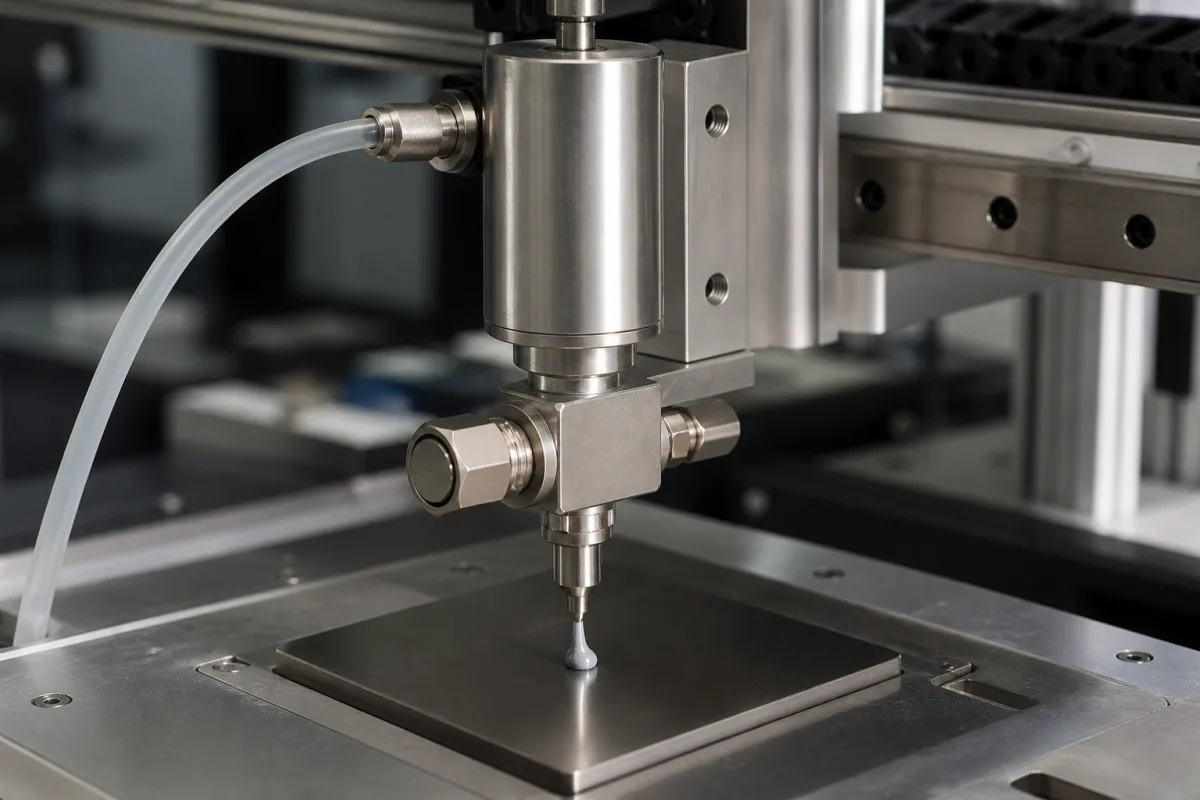
Dispensing heads for filled thermal pastes and gap fillers
The illustrated head is a stainless dispensing valve on a gantry axis, fed by a hose and laying a bead of grey paste on a plate. Thermal pastes and gap fillers are loaded with ceramic or metal particles to conduct heat, and those particles grind on whatever meters them. A dispensing-pump maker, a dispensing-equipment maker and an assembly-systems maker describe how they deal with that, and with two-component materials for battery packs.
Covers dispensing valves and metering heads for thermally conductive pastes, gels and gap fillers on electronics and battery assembly lines: wear from fillers, volumetric metering, wetted materials, one- and two-component dispensing, mixing and mixer change. The choice between needle and diaphragm dispensing valves is on the Dispensing valve page (3100); nozzles and orifice inserts on 5098; syringe barrels for thermal paste on 5097; underfill heating stages on 3511; precision metering pumps on 972; robotic body-shop adhesive application on 3212. Mud pump, diesel injector, waterjet check valve and beer valve assemblies share the name and are outside this page.
CNFX editorial research · Sources checked October 13, 2026 · 4 sources
Why filled pastes wear the dispenser, and what makers do about it
ViscoTec names the problem directly: thermal conductive pastes containing ceramic to metallic fillers, used among other places in e-mobility battery manufacture, need a robust rotor in the metering pump.
Atlas Copco's advice for battery lines points the same way: material supply needs a pump range covering different barrel sizes and material properties, naming abrasive, corrosive and filled materials.
ViscoTec lists gap fillers, solder pastes, flux agents and thermal pastes among the abrasive media its progressive cavity dispensers meter, with micro doses beginning at 1 µl.
Design choice
What the maker says
Source
Hardened stainless rotor in a soft elastomer stator
The sealing line between rotor and stator gives minimal shear and seals without valves, so abrasive material can be dosed volumetrically without increased wear
ViscoTec
Solid ceramic rotor
High hardness and wear resistance for long service life on highly abrasive materials, but less resistant to impacts and shocks
ViscoTec
Carbide (metal-matrix composite) rotor
Extreme hardness, longer service life, reduced maintenance and accuracy held over a longer period
ViscoTec
Wear-resistant fluid path for TIM
Designed to minimise downtime and total cost of ownership; wetted parts in stainless steel, FKM, UHMW, alloy steel, acetal and chrome
Graco progressive cavity pump 2010630
All three are equipment makers describing their own designs; wear life on a given paste should be confirmed on trials with that paste.
02
Volumetric metering on a real thermal gel
Graco pairs Parker Chomerics' Therm-a-Gap Gel 30 with its progressive cavity pump in a published material profile, which gives both the material and the dispensing figures.
At 20 g/min and a density of 3.25 g/cm³ the gel flows at 6.2 cm³/min; on a 0.30 cc/rev pump that is 20.5 rpm (Editorial calculation, assuming the density is in g/cm³ and the pump delivers its nominal displacement).
Item
Figure
Source
Material
One-component, fully cured dispensable gel; no mixing or curing
Graco material profile (Parker Chomerics data)
Thermal conductivity
3.5 W/m·K
Graco material profile
Density
3.25
Graco material profile
Flow rate
20 g/min at 90 psi
Graco material profile
Dispense speed
100 mm/s (4 in/s)
Graco material profile
Pump displacement
0.30 cc/rev (high-wear version)
Graco 2010630
Repeatability
±1% depending on material specification and shot size
Graco 2010630
Maximum operating temperature
167 °F
Graco 2010630
03
Two-component gap fillers: ratio, injection and the mixer
Atlas Copco explains why battery lines use 2K materials: temperature-sensitive cells must not be heated to cure, so the materials cure by reaction once mixed, and two components have to be conveyed, dosed, mixed and applied within the pot life.
Atlas Copco states there are no standards for the design of 2K dispensing systems and that the configuration has to be chosen for the individual process.
A one-component gel such as the Gel 30 above avoids the mixer altogether, at the cost of being fully cured before dispensing (editorial comparison).
Point (Atlas Copco)
Detail
Mixing ratios
From 1:1 up to 100:1
Mixing valve
Parallel injection for similar ratios, central injection for unequal ratios
Metering
Separate, flow-controlled regulation of the two metering units to hold the ratio despite different viscosities
Static mixer
A wearing part, replaced regularly because material hardens inside
Mixer change
Interrupts production; a mixer not seated within tolerance affects application quality; tool-free change that compensates for tolerances is the remedy named
Applications named
Cell bonding, cooling-ribbon and module bonding, thermal interface, fire protection coatings, lid sealing
04
What to give a dispensing valve supplier
Paste it into your enquiry below or into an email to a maker, then replace every bracket.
Give the material (one- or two-component, filler type, viscosity, density, mixing ratio and pot life), shot or bead sizes and repeatability required, dispense speed, container size it is fed from, cycle rate and shifts per day, and the part and gantry it mounts on. Ask for the metering principle, rotor and stator or wetted materials and their expected life on your paste, displacement per revolution, repeatability on your material, mixer type and change method for 2K, and a dispensing trial with your material.
Explore company information and manufacturing capabilities, then discuss the scope of your project with a relevant supplier.
Share this page
Compiled and source-reviewed by the CNFX editorial team.
Each manufacturer above links to the page on that company's own website where the product is listed, with the date we checked it. How we source and review
· Page last updated 13 October 2026
Buyer questions
Why do thermal gap fillers wear dispensing equipment?
They are filled with ceramic or metallic particles; ViscoTec recommends robust rotors such as solid ceramic or carbide for such pastes, and Atlas Copco advises supply pumps chosen for abrasive, corrosive and filled materials. [1][2]
How repeatable is volumetric dispensing of thermal paste?
Graco states ±1% repeatability for its progressive cavity pump, depending on material specification and shot size. [3]
What mixing ratios do 2K battery materials use?
Atlas Copco gives 1:1 up to 100:1, with parallel injection for similar ratios and central injection for unequal ones. [2]
What does a dispensable thermal gel look like on paper?
Graco's profile of Parker Chomerics Therm-a-Gap Gel 30 lists 3.5 W/m·K, density 3.25 and 20 g/min at 90 psi, dispensed at 100 mm/s. [4]
Sources and what still needs a direct check
Sources checked 2026-10-13. ViscoTec's page on dosing abrasive fluids, Atlas Copco's article on 2K dispensing in EV battery production, and Graco's progressive cavity pump page and thermal gel material profile.