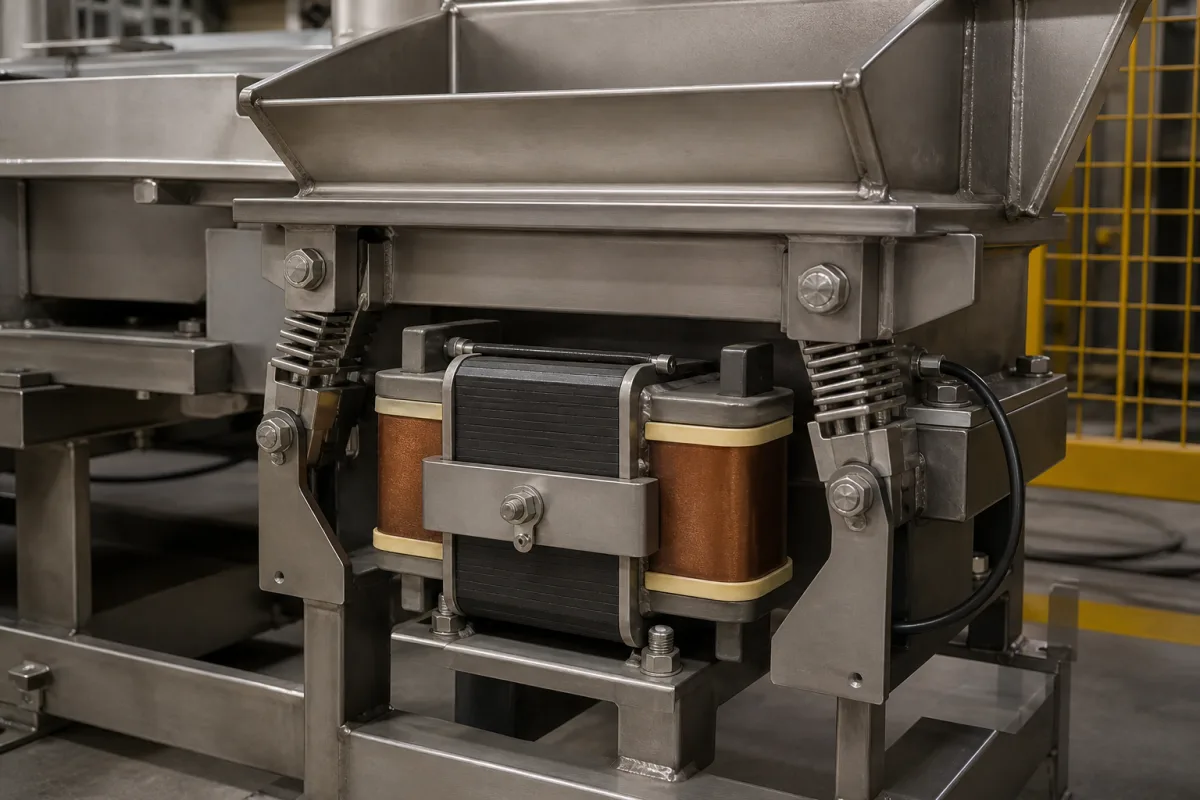
The electromagnet under a vibratory tray, and how it is tuned
The illustrated drive is the electromagnetic kind: a laminated E-core with two coils pulls an armature on the tray, and leaf-spring stacks at each end throw it back. Unlike an eccentric-mass motor, it has no rotating parts; its stroke comes from running a spring–mass system near resonance. That makes it sensitive to things a motor ignores: supply frequency, the air gap, the spring stack, and how much material has stuck to the tray. Two makers' service manuals give the settings.
Covers electromagnetic vibration drives for vibratory feeders and conveyors: half-wave rectified, full-wave AC and low-frequency controlled drives, natural frequency relative to the drive frequency, air gap, spring-stack tuning, stroke measurement, current readings and the effects of supply frequency and material build-up. Feeder capacity from tray width and the range of drive types are on Vibrating Feeder (7995); bowl feeders, orientation tooling and their springs on Vibratory Bowl Feeder (4186); geared two-shaft exciters on 3102; eccentric-rotating-mass motors in small devices are outside this page.
CNFX editorial research · Sources checked October 13, 2026 · 4 sources
Three ways to drive the magnet: half-wave, full-wave AC, or a 30 Hz control
The manuals describe three supply arrangements, each giving a different stroke rate and a different control.
The half-wave principle in Syntron's description gives one pull per mains cycle, which is why the stroke rate equals the supply frequency: 50 Hz × 60 = 3,000 vpm and 60 Hz × 60 = 3,600 vpm (Editorial calculation). Feed rate is set by the intensity of the magnetic pull, varied by the controller.
The stroke rate matters because acceleration rises with the square of frequency. For a sinusoidal motion, a 1.5 mm stroke at 50 Hz gives a peak acceleration of about 74 m/s² (7.5 g), while a 4.7 mm stroke at 30 Hz gives about 84 m/s² (8.5 g) (Editorial calculation, a = (2πf)²·stroke/2, assuming the stroke rate equals f): the low-frequency drive needs a stroke three times longer for a similar acceleration.
Drive
How it works (maker)
Stroke rate
Half-wave rectified (Syntron BF)
A separate controller with a rectifier passes one half of each sine wave; the magnet pulls the trough down and back during the power half-cycle and the leaf springs return it up and forward during the blocked half-cycle
3,000 vpm on 50 Hz (Syntron); 3,600 vpm on 60 Hz (Editorial calculation)
Full-wave AC (Eriez HS-8)
Operated from single-phase full-wave alternating current
Not stated in the manual
30 Hz control with permanent magnet (Eriez HD)
Pole pieces of a permanent magnet intermesh in the air gaps of an electromagnet whose polarity alternates; attraction and repulsion act in the same direction; runs only through a special Eriez 30 Hz control (40 Hz for the HD-36), not from DC
Set by the control frequency
The acceleration comparison is editorial and assumes sinusoidal motion at the stated frequencies; check the actual stroke frequency of a given drive with its maker.
02
Natural frequency, air gap and spring stacks: tuning a drive to its tray
Each maker tunes its drive to a natural frequency set against the supply and adjusts it with the spring stacks; the air gap sets how hard the magnet pulls.
Both Eriez manuals give the same rule for the normal side of the tuning curve: decrease spring stiffness to decrease tray displacement, increase it to increase displacement. If a change has the opposite effect, the springs are stiff enough that the unit runs on the other side of its tuning curve, and stiffness must be reduced until the rules hold again.
Syntron's minimum natural frequencies sit above the drive frequency, 4,000/3,600 = 1.11 and 3,500/3,000 = 1.17 (Editorial calculation). Eriez's rule that stiffer springs raise displacement on the normal side fits a system tuned below its drive frequency; the two makers appear to work on opposite sides of resonance, so one maker's tuning rule should not be applied to the other's drive (editorial reading).
Setting
Syntron F010 / BF
Eriez HS-8
Eriez HD-46 to HD-66
Natural frequency
Minimum 4,000 vpm on 60 Hz, 3,500 vpm on 50 Hz
Tuned for a 3.18 kg (7 lb) weight if supplied without a tray
Tuned to the tray supplied
Tray weight / stroke
Trough 2.72–5.45 kg; max amplitude 1.4–1.6 mm
Amplitude from 0.120 in (3.0 mm) with a 3.5 lb tray to 0.090 in (2.3 mm) with an 8 lb tray
3/16 in (4.7 mm) total stroke at full voltage for standard trays, less for larger ones
Air gap
Set by turning the adjustment screw until the washer is held, then ¾ turn more (BF)
Start with a 0.125 in (3.18 mm) gap bar; a larger gap raises current, a smaller one lowers it
0.093 in (2.4 mm) with the gap spacer
Spring tuning
Leaf springs in sizes etched on each spring
Add, remove or substitute leaves in the tuning stack
Change the number or thickness of fibreglass springs
Gap and spring values are model-specific; use the nameplate and the model's own manual.
03
In service: stroke stickers, clamp-meter ×1.7, gap striking, build-up and supply frequency
Once tuned, the drive's behaviour shifts with what is on the tray and what comes out of the socket.
The clamp-meter factor turns a field reading into the nameplate comparison: 1.3 A on the clamp meter is about 2.2 A, the full rating of a 115 V F010 (Editorial calculation). A reading near the limit after a tray change points back to tuning or gap rather than to the coil.
On the HD series, Eriez lists line voltage or frequency variation among causes of poor feeding and asks for the control's output frequency to be checked and set back to 30 Hz (40 Hz on the HD-36).
Check
What the manuals state
Stroke
Read with a deflection sticker on the side of the tray near the rear, at 25° from vertical on the HD, where a pair of printed circles just touch; compare with the amplitude on the serial plate (Eriez)
Current
On the F010, multiply a clamp-on meter reading by 1.7 because of the waveform, and read it at the controller; rated maximum 2.2 A for 115 V/50 Hz and 1.1 A for 230 V/50 Hz (Syntron)
Gap striking
A loud rapping noise means coil and armature are touching; it must not be allowed in regular operation (Eriez)
Material build-up
Deposits add dead weight and alter the natural frequency; remove daily, around hopper openings in particular (Syntron)
Supply frequency
Tuned for 50 or 60 Hz; unstable frequency, e.g. from engine-driven generators, causes higher spring stress, striking and high line current (Eriez)
Current, stroke and tray-weight figures are for the models named; other sizes have their own plates and tables.
04
What to give a supplier of electromagnetic drives
Paste it into your enquiry below or into an email to a maker, then replace every bracket.
Give the tray or bowl weight and centre of gravity, the material and feed rate, the supply voltage and frequency (and whether it can vary), the controller you will use, and whether wet or sticky material can build up. Ask for drive type and stroke rate, natural frequency and tuning side, air gap setting, spring stack configuration for your tray, rated stroke and current, the current-reading method, and what changes when the tray is replaced.
1 company lists this product among what they make. Company figures are quoted from each
company's own website; every card states where the relationship came from.
Suzhou Huibao Automation Equipment Co., Ltd.
TBC
Suzhou Huibao lists vibration drive bases and feeder controllers for bowl feeders, alongside linear feeders and complete bowl feeders. Drive type, frequency and tuning data TBC; location TBC.
Explore company information and manufacturing capabilities, then discuss the scope of your project with a relevant supplier.
Share this page
Compiled and source-reviewed by the CNFX editorial team.
Each manufacturer above links to the page on that company's own website where the product is listed, with the date we checked it. How we source and review
· Page last updated 13 October 2026
Buyer questions
Why does a half-wave feeder vibrate at 3,000 vpm on 50 Hz?
Syntron's BF instructions explain that the controller's rectifier passes one half of each sine wave, so the magnet pulls once per cycle; 3,000 vpm corresponds to 50 Hz. [3]
How is an electromagnetic drive tuned?
By changing the spring stack: Eriez adds, removes or substitutes leaves or fibreglass springs, decreasing stiffness to reduce displacement and increasing it to raise displacement on the normal side of the tuning curve. [1][2]
Why does a clamp meter read low on a feeder?
Syntron's F010 sheet says the reading must be multiplied by 1.7 because of the feeder's waveform, and taken at the controller. [4]
What does the air gap change?
In Eriez's HS-8 manual, increasing the gap increases current draw and decreasing it reduces current draw; a gap too small leads to gap striking. [1]
Sources and what still needs a direct check
Sources checked 2026-10-13. Two Eriez installation and operation manuals and two Syntron service and specification sheets distributed by Riley Automation.