Industry-Verified Manufacturing Data (2026)

Vibration Bowl

Based on aggregated insights from multiple verified factory profiles within the CNFX directory, the standard Vibration Bowl used in the Machinery and Equipment Manufacturing sector typically supports operational capacities ranging from standard industrial configurations to heavy-duty production requirements.

Technical Definition & Core Assembly

A canonical Vibration Bowl is characterized by the integration of Bowl Body and Spiral Track. In industrial production environments, manufacturers listed on CNFX commonly emphasize Stainless Steel construction to support stable, high-cycle operation across diverse manufacturing scenarios.

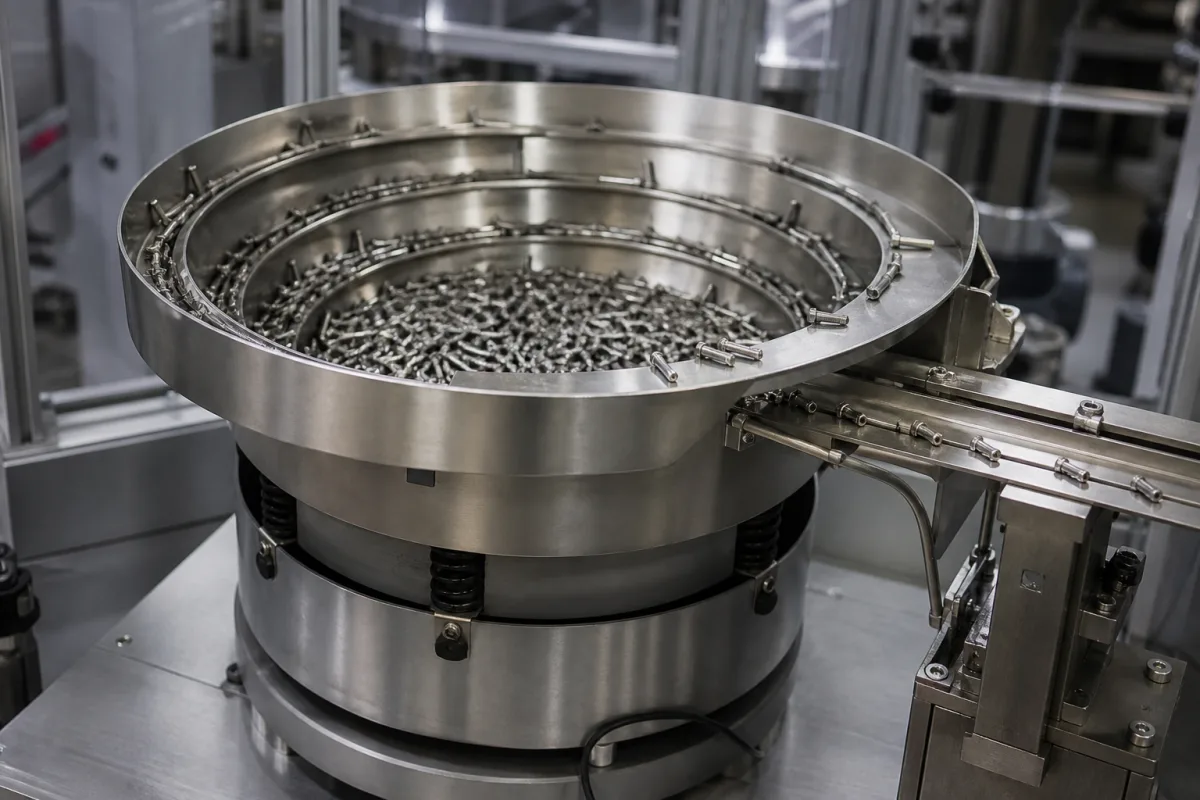
A bowl-shaped component of a vibratory feeder that uses controlled vibrations to orient and transport small parts along a track.
Product Specifications

Technical details and manufacturing context for Vibration Bowl

Definition
The vibration bowl is the core part of a vibratory feeder system, typically mounted on a base unit with electromagnetic or piezoelectric drives. It functions as the container and orientation mechanism that receives bulk components and, through controlled vibrations, moves them along a spiral track while aligning them into a specific orientation for downstream assembly or processing.
Working Principle
The bowl is attached to a base that generates controlled vibrations (typically via electromagnetic coils or piezoelectric actuators). These vibrations cause the bowl to oscillate in a helical pattern, creating a forward and upward motion that moves parts along the spiral track. Tooling (rails, wipers, gates) on the track's surface orients or rejects incorrectly positioned parts.
Common Materials
Stainless Steel, Aluminum Alloy, Polycarbonate
Technical Parameters
  • Bowl diameter, a primary size specification determining capacity and footprint. (mm) Customizable
Components / BOM
  • Bowl Body
    The main container that holds and transports parts via its internal spiral track.
    Material: Stainless Steel
  • Spiral Track
    The helical pathway inside the bowl along which parts are vibrated and oriented.
    Material: Stainless Steel
  • Orientation Tooling
    Custom rails, wipers, or gates attached to the track to correctly orient or reject parts.
    Material: Stainless Steel or Engineering Plastic
  • Mounting Flange
    Interface for attaching the bowl to the vibratory feeder base unit.
    Material: Steel or Aluminum
Engineering Reasoning
0.5-3.0 mm amplitude at 50-100 Hz frequency
4.2 mm amplitude at 120 Hz frequency (resonant frequency crossing)
Design Rationale: Resonance-induced structural fatigue exceeding yield strength of 6061-T6 aluminum (276 MPa) at bowl mounting points
Risk Mitigation (FMEA)
Trigger Electromagnetic coil current imbalance exceeding 15% differential between phases
Mode: Asymmetric vibration causing part jamming at orientation track entry
Strategy: Three-phase current monitoring with PID control maintaining <5% phase differential
Trigger Bowl-to-base mounting bolt torque degradation below 25 N·m specification
Mode: Progressive amplitude loss reaching 40% reduction at 0.3 mm amplitude
Strategy: Torque-to-yield bolts with 35 N·m preload and thread-locking compound

Industry Taxonomies & Aliases

Commonly used trade names and technical identifiers for Vibration Bowl.

Applied To / Applications

This component is essential for the following industrial systems and equipment:

Industrial Ecosystem & Supply Chain DNA

Complementary Systems
Downstream Applications
Specialized Tooling

Application Fit & Sizing Matrix

Operational Limits
pressure: Atmospheric only
feed rate: Up to 3000 parts/min
temperature: -20°C to 80°C
particle size: 0.1-25 mm
vibration frequency: 50-100 Hz
Media Compatibility
✓ Small metal components (screws, pins) ✓ Plastic injection molded parts ✓ Pharmaceutical tablets/capsules
Unsuitable: Highly abrasive slurries or corrosive liquids
Sizing Data Required
  • Part dimensions and weight
  • Required feed rate (parts per minute)
  • Bowl diameter and track configuration

Reliability & Engineering Risk Analysis

Failure Mode & Root Cause
Bowl liner fatigue cracking
Cause: Cyclic stress from vibration-induced flexing, material fatigue due to high-frequency oscillations, and stress concentration at mounting points or bowl geometry transitions.
Drive mechanism bearing failure
Cause: Inadequate lubrication, contamination ingress (dust, moisture), misalignment of drive components, and excessive loading from material buildup or unbalanced bowl.
Maintenance Indicators
  • Unusual or irregular vibration patterns (audible rattling, shaking, or changes in vibration frequency)
  • Visible cracks, deformation, or excessive wear on the bowl surface or mounting points
Engineering Tips
  • Implement regular alignment checks and balancing of the bowl assembly to minimize uneven stress distribution and reduce cyclic fatigue.
  • Establish a proactive lubrication schedule for drive components and inspect seals regularly to prevent contamination ingress, ensuring optimal bearing life.

Compliance & Manufacturing Standards

Reference Standards
ISO 1940-1:2003 (Mechanical vibration - Balance quality requirements for rotors in a constant (rigid) state) ANSI S2.19-1999 (Mechanical vibration - Balance quality requirements of rigid rotors) DIN 45669-1:2010 (Mechanical vibration - Evaluation of machine vibration by measurements on non-rotating parts)
Manufacturing Precision
  • Bowl concentricity: +/-0.05mm
  • Surface flatness: 0.2mm per 100mm diameter
Quality Inspection
  • Vibration amplitude test (operational frequency sweep)
  • Material hardness test (Rockwell C scale)

Factories Producing Vibration Bowl

Verified manufacturers with capability to produce this product in China

✓ 95% Supplier Capability Match Found

P Procurement Specialist from Brazil Jan 27, 2026
★★★★★
"Reliable performance in harsh Machinery and Equipment Manufacturing environments. No issues with the Vibration Bowl so far."
Technical Specifications Verified
T Technical Director from Canada Jan 24, 2026
★★★★★
"Testing the Vibration Bowl now; the technical reliability results are within 1% of the laboratory datasheet."
Technical Specifications Verified
P Project Engineer from United States Jan 21, 2026
★★★★★
"Impressive build quality. Especially the technical reliability is very stable during long-term operation."
Technical Specifications Verified
Verification Protocol

“Feedback is collected from verified sourcing managers during RFQ (Request for Quote) and factory evaluation processes on CNFX. These reports represent historical performance data and technical audit summaries from our B2B manufacturing network.”

11 sourcing managers are analyzing this specification now. Last inquiry for Vibration Bowl from UAE (1h ago).

Supply Chain Compatible Machinery & Devices

Hydraulic Press

Industrial machine using hydraulic pressure to compress, form, or assemble materials

Explore Specs →
Heavy-Duty CNC Plasma Cutting Machine

Industrial machine for precision metal cutting using plasma arc technology

Explore Specs →
Automated Assembly Line System

Integrated production system for sequential component assembly operations

Explore Specs →
Automated Powder Coating System

Integrated industrial system for applying dry powder coatings to metal substrates.

Explore Specs →

Frequently Asked Questions

What materials are vibration bowls typically made from?

Vibration bowls are commonly manufactured from stainless steel for durability, aluminum alloy for lightweight applications, or polycarbonate for corrosion resistance and visibility in part handling.

How does a vibration bowl orient and transport parts?

The bowl uses controlled vibrations to move parts along its spiral track, while orientation tooling ensures components are correctly positioned for downstream processes in automated systems.

What are the key components of a vibration bowl assembly?

Key components include the bowl body, spiral track for part movement, orientation tooling for positioning, and mounting flange for secure installation to vibratory feeder bases.

Can I contact factories directly on CNFX?

CNFX is an open directory, not a transaction platform. Each factory profile provides direct contact information and production details to help you initiate direct inquiries with Chinese suppliers.

Get Quote for Vibration Bowl

Request technical pricing, lead times, or customized specifications for Vibration Bowl directly from verified manufacturing units.

Your business information is encrypted and only shared with verified Vibration Bowl suppliers.

Thank you! Your message has been sent. We'll respond within 1–3 business days.

Need to Manufacture Vibration Bowl?

Connect with verified factories specializing in this product category

Add Your Factory Contact Us
Previous Product
Vibration Bearings
Next Product
Vibration Drive (e.g., Solenoid or ERM Motor)