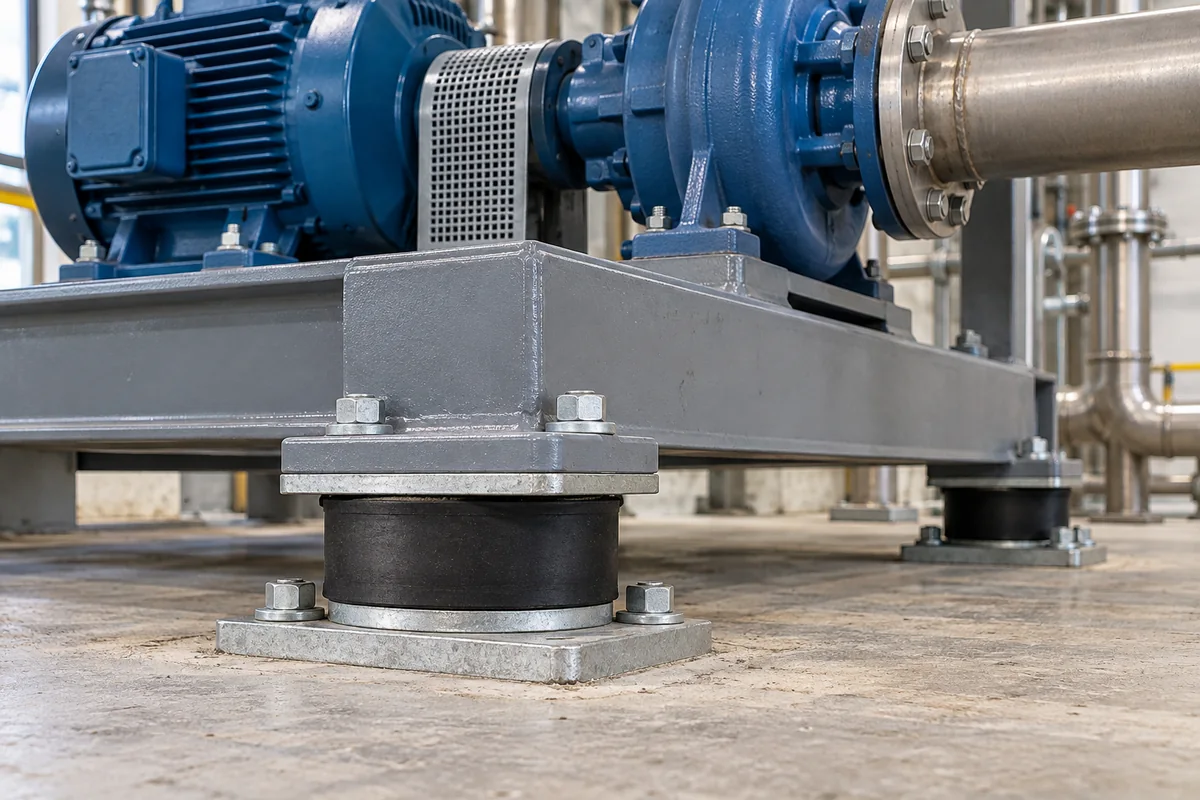
Bonded rubber vibration isolation mount for pump and motor baseframes
Bonded rubber-to-metal mounts under a pump or motor baseframe · natural frequency against running speed, load per mount and rubber hardness, creep and realignment
A pump set or motor on a steel baseframe can stand on four or more bonded rubber mounts: a block or profile of natural or synthetic rubber vulcanised between two metal plates, bolted to the frame above and the floor below. Whether it isolates anything depends on where its natural frequency sits against the running speed; whether it lasts depends on the load each mount carries for its rubber hardness, on shocks, and on oil, heat and creep. This page works through those three checks for compression mounts under rigid baseframes.
Bonded rubber-to-metal compression and shear mounts (cylindrical, bobbin, bell and profiled types, with or without fail-safe stops) used under pump, motor, fan and compressor baseframes. The choice between spring and elastomer isolators, housed spring mounts, hangers and isolation specifications for building services are covered on the Vibration isolators for machinery page. Inertia bases, flexible pipe connectors, engine mounts for vehicles and active isolation tables are outside this page.
CNFX editorial research · Sources checked October 12, 2026 · 3 sources
Natural frequency against running speed: about 80% attenuation from a 10 Hz mount at 1500 rpm, about 85% from 7 Hz at 1200 rpm
Paulstra's catalogue gives the attenuation of a rubber suspension as E% = 100 × (r² − 2)/(r² − 1), where r is the ratio of the exciting frequency to the suspension's natural frequency, and sets an attenuation above 50% as the requirement to aim past. [1] Its chart shows 80% attenuation at 1500 rpm for a natural frequency of 10 Hz. [1] Trelleborg states that its RA mount gives 75–85% isolation at normal speeds of about 1500 rpm and points to its RAEM or M-Series mounts for better isolation. [2]
Paulstra notes that the natural frequency of a rubber mount follows its dynamic stiffness, which can differ from the static stiffness depending on amplitude, frequency and elastomer, so the frequency stated at nominal load is an indication; for another load in the linear part of the curve it scales as f0 × √(nominal load / actual load). [1] Editorial calculation: a mount rated 10 Hz at its nominal load and run at half that load would sit near 10 × √2 ≈ 14 Hz, which at 1500 rpm gives r ≈ 1.77 and, by the same formula, about 53% attenuation, barely above Paulstra's 50% threshold. An underloaded mount isolates less, not more.
Load per mount and rubber hardness: 105–1300 kg per RA mount at 40 or 60 IRHD, shocks to 5 g
Trelleborg's RA mount works its rubber in shear and compression for vertical flexibility with horizontal stability, and its maximum load depends on size and on 40° or 60° IRH rubber. [2] Editorial calculation from the table below: the 40° IRH rating is 44–62% of the 60° IRH rating across these sizes.
The RA has an integral fail-safe device with a resilient stop, accepts occasional shock loads to 5 g relative to the supported weight in 60° IRH rubber and withstands shocks up to 2 g without plastic deformation, and has a domed cover against oil contamination. [2] Small cylindrical bobbin mounts sit at the other end of the range: AMC Mecanocaucho's diabolo mounts sold by RS run from the 129001, rated 4 daN in compression at 1.5 mm, to the 60 mm 129009, rated 150 daN in compression at 8 mm and 30 daN in shear at 10 mm. [3]
Editorial calculation: a 1,200 kg pump set on four mounts loads each to about 300 kg if the centre of gravity is central; that exceeds the RA 350's 250 kg in 40° IRH rubber but is within its 450 kg in 60° IRH, and Paulstra warns that when one size of mount is used with different rubber hardnesses there is a high risk of the mounts being interchanged, which may degrade the attenuation. [1]
Creep, heat and oil: realign the shafts at least two days after mounting, and treat 70 °C as abnormal
Paulstra estimates rubber creep as static deflection at time t = initial deflection × (1 + Cm × f(t)), with f(t) read from a curve measured on mounts compressed by 10% of their height at 30 °C and Cm a correction for the compound and hardness; it adds that creep also depends on the mount's shape. [1] Where alignment matters, it recommends aligning shafts at least two days after the machine has been mounted, to get past initial creep. [1]
Its standard mounts use natural rubber, and Paulstra lists as abnormal conditions temperatures above 70 °C, prolonged contact with corrosive liquids, acids or alkalis, oils and fuels, and corrosive gases such as ozone and chlorine, which can age the rubber and increase creep; special compounds are offered for these. [1] It also notes that an elastic suspension spreads the static load evenly where a machine on more than three rigid points would be unpredictably loaded, and, in its recommendations for STABIFLEX mounts, that all external connections must be flexible so as not to affect the performance of the mounting system. [1]
Editorial note: on a pump set this means flexible pipe connectors on suction and discharge and slack in cable and conduit runs; a rigid pipe bolted to an isolated baseframe carries the vibration around the mounts.
04
Data for a baseframe isolation mount enquiry
Paste it into your enquiry below or into an email to a maker, then replace every bracket.
Machine: [pump, motor, fan or compressor; running speed and any lower speeds passed through]
Mass: [total mass with frame and fluid; centre of gravity; number and position of mounts]
Target: [attenuation or natural frequency wanted]
Mount: [type; rubber compound and hardness; fail-safe stop; bolt size]
Loads: [shock in g; horizontal loads; pipe forces]
Environment: [temperature; oil, ozone or chemical exposure; indoor or outdoor]
1 company lists this product among what they make. Company figures are quoted from each
company's own website; every card states where the relationship came from.
Wuxi Aomeite Seal Technology Co. Ltd
Manufacturing site to be confirmed for the order
Lists custom rubber-to-metal bonded parts, linked from its menu as vibration isolation mounts, with natural or synthetic rubber bonded to steel or aluminium.
Explore company information and manufacturing capabilities, then discuss the scope of your project with a relevant supplier.
Share this page
Compiled and source-reviewed by the CNFX editorial team.
Each manufacturer above links to the page on that company's own website where the product is listed, with the date we checked it. How we source and review
· Page last updated 13 October 2026
Buyer questions
What natural frequency should a rubber mount have for a 1500 rpm pump?
Paulstra's chart gives 80% attenuation at 1500 rpm for a 10 Hz natural frequency, and it treats more than 50% attenuation as the requirement. [1]
Does rubber hardness change the load a mount can carry?
Yes. Trelleborg's RA 350 is rated 250 kg in 40° IRH rubber and 450 kg in 60° IRH; the RA 800 750 kg and 1300 kg. [2]
Why realign the pump after it has stood on its mounts?
Rubber creeps under load; Paulstra recommends aligning shafts at least two days after the machine is mounted. [1]
Can a lightly loaded mount isolate better?
No. Paulstra gives the natural frequency at another load as f0 × √(nominal/actual), so a lighter load raises the natural frequency and lowers attenuation. [1]
Sources and what still needs a direct check
Sources checked 2026-10-12. Attenuation, load scaling, creep, environment and installation guidance come from Paulstra's (Hutchinson) industry catalogue; RA mount loads, shock and isolation figures from Trelleborg's RA datasheet; bobbin mount loads from AMC Mecanocaucho's diabolo data sheet published by RS. Values apply to the products named.