Foundry sand compaction · Fill above 1 g, compact below 1 g, stroke and frequency, accelerometer control
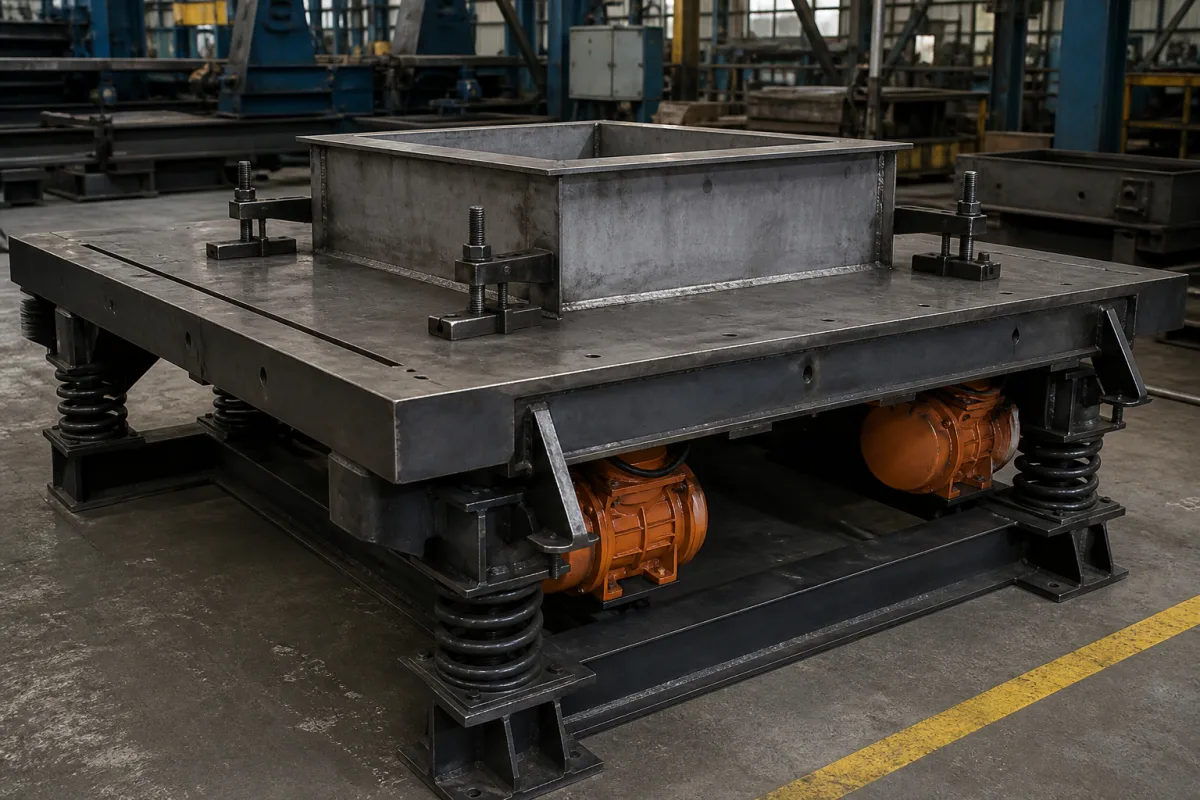
A vibration table for foundry sand compaction is a sprung steel platform driven by eccentric-weight vibration motors that shakes a moulding flask so dry sand flows around the pattern and packs firmly before pouring. Ask three things first: the acceleration range the table can deliver with your flask and sand loaded, whether it vibrates vertically only or also horizontally, and how acceleration is measured and controlled through the cycle.
Vibration compaction tables for foundry moulding flasks, including lost-foam (unbonded sand) compaction tables. Vibration test systems for shock and transport testing, anti-vibration laboratory tables, and tables for settling bulk materials in shipping containers are outside this page.
CNFX editorial research · Sources checked October 12, 2026 · 4 sources
Fill the pattern above 1 g, then compact below 1 g
US patent 4,454,906 (General Kinematics, filed 1982) describes vibrating the flask first at a frequency and stroke giving accelerations above gravity, so the sand 'fluidizes' and fills even dead-ended passages in a foam pattern, then reducing the stroke so acceleration falls below gravity to compact the sand in place before metal is poured. Its example uses 3600 strokes per minute and a 0.007 in stroke, giving 1.29 g, calculated as S × F² / 70,400 with S in inches and F in strokes per minute. [1]
Editorial calculation: 3600 strokes per minute is 60 Hz and 0.007 in is about 0.18 mm, so in metric units acceleration in g ≈ 0.00201 × f² × S, with f in Hz and S the stroke in mm; 0.00201 × 60² × 0.178 ≈ 1.29 g. Because acceleration rises with the square of frequency, the same stroke at 50 Hz gives about 0.89 g. [1]
For the compaction stage the patent reduces the stroke to 0.0045 in at the same frequency. Editorial calculation: its own formula gives about 0.83 g for that stroke (the patent text states 0.92 g); either way the stage runs below 1 g, as the patent requires. [1]
Give the supplier the flask size and weight, sand weight and type (bonded or unbonded), the pattern type, the acceleration and stroke wanted for each stage, cycle time, supply voltage and frequency, and how flasks reach and leave the table.
02
Measure and control the acceleration through the cycle
US patent 4,860,816 notes that "certain systems utilize a manual control to vary the speed of the motor to control acceleration", while others sensed table acceleration and controlled motor speed automatically. It describes a table on springs driven by a squirrel-cage motor with an eccentric weight, fed by an adjustable-frequency drive, with an accelerometer sensing sand movement and a programmable controller holding acceleration at a set point. Load cells under the base weigh the table, and the program runs multiple zones defined by time or by the amount of sand filled. [2]
Vulcan describes its lost-foam compaction system as applying vertical and/or horizontal vibration to dry, unbonded sand, with amplitude programmable from near zero to full capacity in each direction, vertical and horizontal motions phased through electronic feedback, and vibration parameters changeable in under 0.3 seconds during a cycle. Vulcan states the system mass is symmetric about the flask centreline so that parameters are uniform across the flask. [3]
Editorial note: a table with a single vertical exciter cannot provide the horizontal motion Vulcan describes; ask suppliers which directions their motor arrangement drives and whether that can be changed during the cycle. [3]
A 2023 laboratory study in Materials by Li and co-authors on lost-foam compound casting compacted loose dry sand around an EPS pattern on a vibration table running at 25 Hz, covered the box with plastic film, and poured with the sandbox under 0.03 MPa vacuum. [4] Editorial calculation: using the formula above, a ≈ 0.00201 × 25² × S, reaching 1 g at 25 Hz needs a stroke of about 0.8 mm, more than four times the 0.18 mm that gives 1.29 g at 60 Hz, so ask suppliers to state stroke and acceleration at the frequency you will run, under your loaded flask. [4][1]
03
One visible maker: ZDP tables from 500 mm to 3 m square
Xinxiang Dayong is the company shown below; its listing gives sizes, motor pairs and weights but no acceleration figure, so ask for one.
Xinxiang Dayong lists ZDP moulding vibration tables from 500 × 500 mm to 3000 × 3000 mm, with paired motors from 2 × 0.25 kW to 6 × 1.5 kW, an amplitude range given as 2–5 (no unit stated) and weights of 300–3200 kg, and describes three-dimensional vibration for complex castings.
04
Motors, deck, springs, drive, sensors and horizontal exciters
The first five rows follow the General Kinematics control patent; the horizontal exciters come from Vulcan.
Part
Role
Fix in the order
Vibration motors
Eccentric weights on a motor shaft create the force; speed sets frequency. [2]
Table size, load, frequency, stroke and acceleration for the quotation
Flask, sand and cycle data come from your moulding line. The patents and the Li study supply the frequency, stroke and acceleration examples in the middle column.
Field
What it means and published values
Ask the supplier for
Table size (mm)
Deck area for the largest flask.
Deck size and clamping.
Max load capacity (kg)
Flask, pattern and sand together.
Rated load.
Vibration frequency (Hz)
3600 strokes/min (60 Hz) in GK's example; 25 Hz in a laboratory lost-foam study. [1][4]
Range and drive.
Amplitude (mm)
0.007 in (≈0.18 mm) stroke for 1.29 g at 60 Hz. [1]
1 company lists this product among what they make. Company figures are quoted from each
company's own website; every card states where the relationship came from.
Xinxiang Dayong Vibration Equipment Co., Ltd.
Manufacturing site to be confirmed for the order
Lists ZDP moulding vibration tables from 500 × 500 mm to 3000 × 3000 mm with paired vibration motors.
Explore company information and manufacturing capabilities, then discuss the scope of your project with a relevant supplier.
Share this page
Compiled and source-reviewed by the CNFX editorial team.
Each manufacturer above links to the page on that company's own website where the product is listed, with the date we checked it. How we source and review
· Page last updated 13 October 2026
Buyer questions
What acceleration does a foundry compaction table need?
A General Kinematics patent fills the pattern above 1 g, e.g. 1.29 g at 3600 strokes per minute and 0.007 in stroke, then compacts below 1 g. [1]
How is acceleration calculated from stroke and frequency?
The patent gives g = S × F² / 70,400 with S in inches and F in strokes per minute; in metric, about 0.00201 × f² (Hz) × S (mm) (editorial conversion). [1]
How is a compaction table controlled?
A later patent uses an adjustable-frequency drive, an accelerometer and a programmable controller to hold acceleration at a set point in timed or sand-quantity zones. [2]
What frequency is used to compact sand on a lost-foam vibration table?
Examples range from 60 Hz (3,600 strokes per minute) in a patent to 25 Hz in a 2023 laboratory study, which also poured under 0.03 MPa vacuum; stroke must rise as frequency falls to reach the same acceleration. [1][4]
Sources and what still needs a direct check
Sources checked 2026-10-12. The two patents are General Kinematics inventions and describe their methods and examples, not universal settings; Vulcan describes its own system.