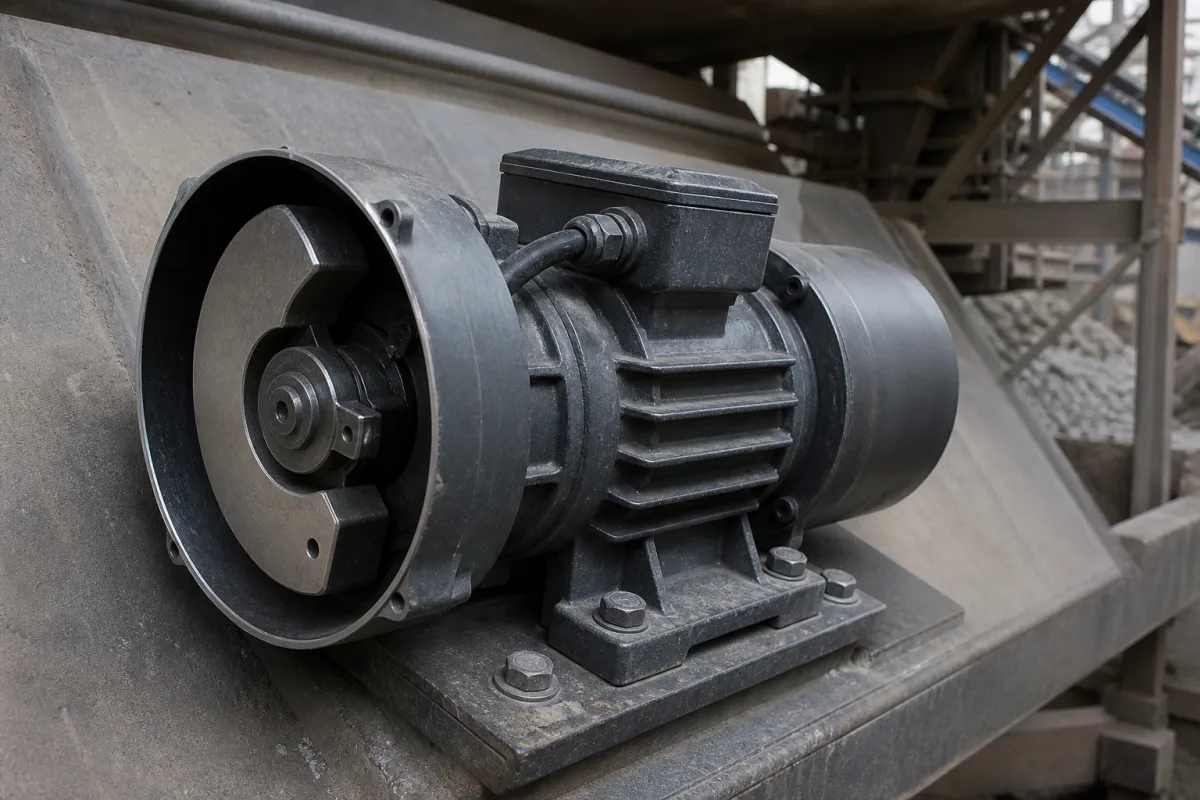
Industrial vibration motors (external electric vibrators) for vibrating feeders, screens, tables and bin discharge · centrifugal force in kN, static moment and eccentric-weight setting, poles and speed, power, twin-motor counter-rotation and self-synchronisation, IP rating, bin vibrator sizing, pneumatic alternatives
An industrial vibration motor, also called an external electric vibrator or motovibrator, is an induction motor carrying adjustable eccentric weights on its shaft under bolted covers; bolted to a feeder tray, screen deck, table, chute or hopper wall, it shakes the whole structure at the motor's speed. Ask three things first: how much centrifugal force (kN) and at what speed (poles) the machine needs, whether one motor or a counter-rotating pair drives it, and the enclosure, voltage and duty it must meet. Small coin and cylinder eccentric-rotating-mass motors used in phones and toys are a different product, covered on the vibration-motor-core page.
Industrial rotary electric vibrators (foot- or flange-mounted vibration motors and exciters) for vibrating feeders, screens, tables, compactors and chutes, and bin or hopper vibrators used as flow aids, with pneumatic motor-driven and impact vibrators compared as alternatives. Miniature eccentric-rotating-mass (ERM) and coin vibration motors for phones, toys and haptics (see vibration-motor-core), concrete poker vibrators, complete feeders and screens, and vibration isolators are outside this page except where compared.
CNFX editorial research · Sources checked October 11, 2026 · 5 sources
Size centrifugal force, eccentric setting, speed and power
Italvibras's 2019 general catalogue describes the MVSI foot-mounted motovibrator range with centrifugal force up to 30,000 kgf (300 kN), adjusted continuously and linearly by changing the position of the eccentric masses against a graduated scale that reads force as a percentage of maximum, with a patented system (ARS) to prevent setting errors. It lists 2, 4, 6 and 8 poles as standard (3,000/3,600, 1,500/1,800, 1,000/1,200 and 750/900 rpm at 50/60 Hz) and 10 and 12 poles on request, continuous S1 duty at full rated force and power, three-phase supply from 24 to 690 V, and inverter operation from 20 Hz up to rated frequency. [1]
Two MVSI rows show how speed changes the eccentric needed for a given force. The 2-pole MVSI 3/4000-S02 has a static moment of 387 kgmm and gives 3,890 kg (38.2 kN) at 50 Hz, weighing 96 kg and drawing up to 4,000 W; the 4-pole MVSI 15/4300-S02 has 1,720 kgmm for 4,326 kg (42.4 kN), weighing 123 kg and drawing up to 2,500 W. The catalogue notes that dynamic moment is twice the static moment. [1]
Editorial calculation: centrifugal force equals static moment × angular speed squared. At 3,000 rpm, ω = 2π × 3,000 ÷ 60 ≈ 314 rad/s, so 0.387 kg·m × 314² ≈ 38,200 N ≈ 38.2 kN; at 1,500 rpm, ω ≈ 157 rad/s, so 1.720 kg·m × 157² ≈ 42,400 N ≈ 42.4 kN — matching the table and showing why a 4-pole motor needs about 1,720 ÷ 387 ≈ 4.4 times the eccentric moment for similar force. [1]
OLI states that its electric vibrating motors reach up to 40,000 kg of centrifugal force, that force is calibrated by interchangeable eccentric masses, and that windings use F-class vacuum-impregnated insulation; its range includes long, flanged, stainless-shaft, DC and explosion-protected versions. [2]
Give the supplier the machine type (feeder, screen, table, bin), vibrating mass and required stroke or amplitude, the centrifugal force needed in kN at the eccentric setting you will run, speed or poles, supply voltage and frequency (and any inverter), duty, mounting (foot or flange, bolt pattern), ambient temperature, enclosure and hazardous-area certification, and quantity of motors.
02
Pair two motors for linear motion and check synchronisation
A 2018 Powder & Bulk Solids article by a Cleveland Vibrator Co. engineer explains that feeders, screeners and compaction tables built with two rotary electric vibrators need both to run at the same speed and counter-rotate: the direction does not matter as long as one turns clockwise and the other anticlockwise, and the counter-rotation is what produces linear motion. Correctly set-up vibrators sense each other and synchronise; unsynchronised units can apply destructive forces to the machine. [3]
If the two run the same way, material moves slowly and drifts to one side, motion at a fixed point is circular or elliptical rather than linear, and side-to-side motion is visible from the end of the unit; swapping two power leads on one vibrator reverses it. Both vibrators should start together from one controller, an inverter ramp should be as quick as possible, and soft starters should not be used. Rotation can be checked with one weight cover removed from each unit, and synchronisation with a strobe tachometer: when synchronised, both sets of weights appear to stop at the same strobe speed as mirror images. Poor bearing lubrication and loose mounting bolts reduce the ability to synchronise. [3]
Italvibras rates MVSI motors IP66 to IEC/EN 60529 and IK08 impact protection to IEC/EN 62262, with class F (155 °C) insulation (class H on request), ambient −20 to +40 °C, PTC thermistors at 130 °C as standard from frame size 70, and mounting in any position; housings are aluminium alloy up to size 60 and spheroidal-graphite iron above, finished with epoxy-polyester powder cured at 200 °C and salt-spray tested for 500 hours. [1]
03
Size bin and hopper vibrators, and compare pneumatic units
Cleveland Vibrator's sizing guide sizes rotary electric bin vibrators at one pound of vibratory force for every ten pounds of material in the sloped wall section, mounted at one-third of the height of the sloped wall; hoppers over 100 tons or with stubborn material may need two or more, and not more than three. It says 3,600 rpm units suit free-flowing to difficult-to-flow materials, while 1,800 rpm units give greater amplitude at the same force for stubborn materials. Material with 6% moisture or more calls for the next size up or two vibrators. [4]
The same guide notes that air vibrators are adjusted with an air regulator and electric vibrators with adjustable eccentrics; non-impacting types (air-cushioned piston, rotary electric, turbine, ball) give less intensity than impacting piston vibrators, so the next size up is used to match them; short bursts work better than continuous running; vibrators must not run against closed gates; and noise ranks from loudest to quietest as impact, ball, air-cushioned, rotary electric and turbine. [4]
Martin Engineering's Brute pneumatic motor-driven vibrators state the same rule of thumb against bin content, ask for mounting close to the outlet on a reinforced wall area, and quote force measured on a 10,000-pound (4,530 kg) test block, warning that force and frequency fall on a less rigid structure. Its CV2.8-A lists a maximum force of 22,886 N and a minimum of 4,048 N, with adjustable eccentrics and bearings needing lubrication after 500 hours. [5]
Editorial calculation: by the one-in-ten rule, 20,000 kg of material in the sloped section calls for about 2,000 kgf, or 2,000 × 9.81 ≈ 19.6 kN, of vibrator force. Confirm whether a supplier's rule counts the sloped section only or the whole bin, because the two sources differ. [4][5]
04
Compare what suppliers offer
The manufacturer card below states what the reviewed source shows.
When requesting quotations, ask each supplier for the force table at each eccentric setting, static moment, speed, power and current, weight, mounting drawing, enclosure and insulation class, hazardous-area certificates, and bearing lubrication interval.
05
Trace the vibration motor
This is a functional reference built from the sources cited; it is not one maker's design.
Fill the specification fields with values for your machine
A vibration motor quotation needs values for your machine. The table explains each field, gives published values where a reviewed source states them, and says what to obtain from the supplier.
Field
What it means and published values
Ask the supplier for
Centrifugal force (kN)
38.2 kN 2-pole, 42.4 kN 4-pole examples; range to 300 kN. [1]
The manufacturer below lists industrial vibration motors on its own website; each card links to the page reviewed. Confirm ratings, materials and approvals for your order.
Shenzhen Putian Vibration Motor Co., Ltd.
Manufacturing site to be confirmed for the order
Lists AC standard and micro vibration motors and DC vibration motors, including MVE-type motors.
Explore company information and manufacturing capabilities, then discuss the scope of your project with a relevant supplier.
Share this page
Compiled and source-reviewed by the CNFX editorial team.
Published product pages show what a company offers, not tested performance. Confirm the legal seller, factory and scope for your order. How we source and review
· Page last updated 13 October 2026
Buyer questions
How is a vibration motor's centrifugal force adjusted?
Italvibras MVSI motors adjust force continuously by repositioning the eccentric masses against a scale in percent of maximum; OLI uses interchangeable masses. [1][2]
Why do vibrating feeders use two counter-rotating motors?
Counter-rotation of two same-speed vibrators produces linear motion; same-direction rotation gives circular or elliptical motion and side drift. [3]
How big a bin vibrator is needed?
Cleveland's guide uses one pound of force per ten pounds of material in the sloped section, mounted at one-third of the slope height. [4]
Sources and what still needs a direct check
Sources checked 2026-10-11. Italvibras, OLI, Martin Engineering and Cleveland Vibrator are vibrator makers publishing their own data; the Powder & Bulk Solids article is by a vibrator maker's engineer. Values for your machine must come from the supplier's force tables and drawings.