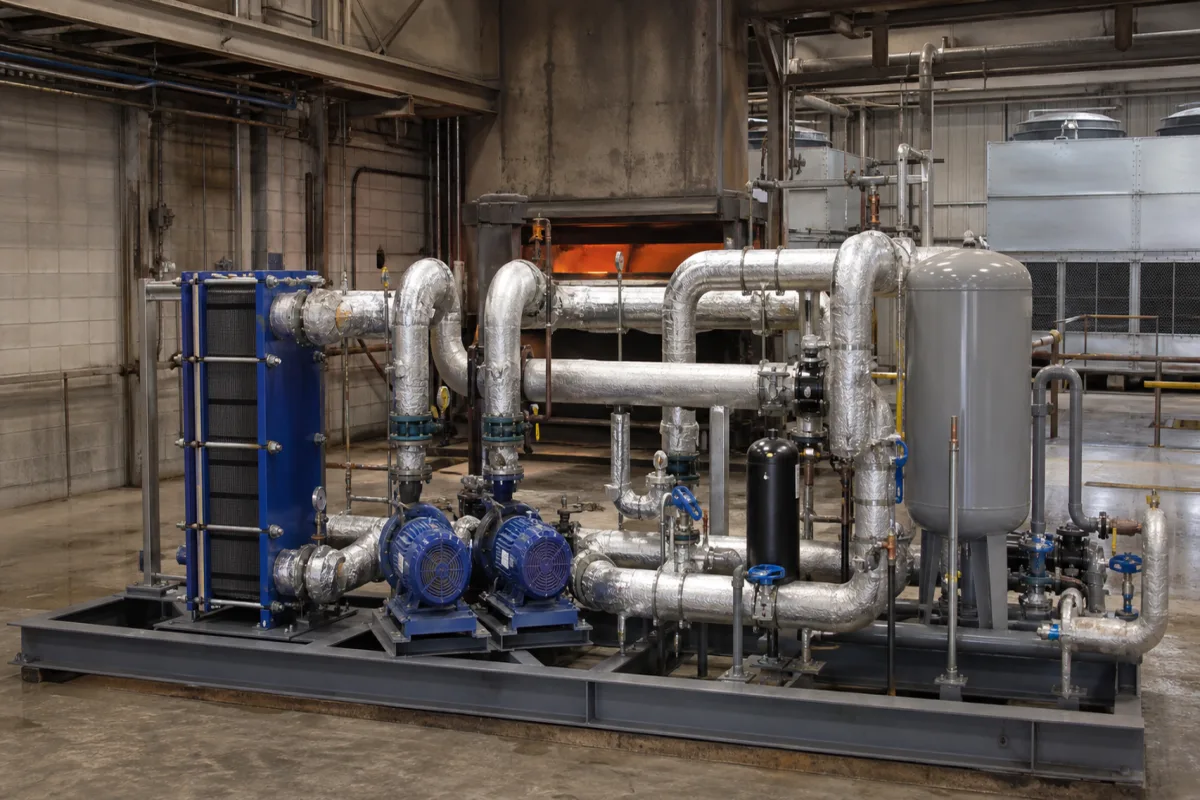
Water cooling system for induction equipment: a closed loop of clean water that carries heat to plant water through an exchanger
Closed-loop cooling water systems for induction heating and melting equipment · Plate or shell-and-tube exchangers to plant water, closed cooling towers, pump stations, and the hardness, conductivity, pH and pressure limits the equipment sets
This page covers cooling water systems for induction heating and melting equipment: a closed loop of clean water that runs through the power supply, capacitors and coils and gives up its heat to raw plant water, cooling-tower water or air through a plate or shell-and-tube exchanger or a closed cooling tower. Ask three things first: the temperature, pressure and flow the induction equipment needs, the water quality limits it sets for the loop, and how the loop is kept apart from the raw water.
Closed-loop and modified closed-loop cooling water systems for induction heating and melting equipment, including pump stations, plate and shell-and-tube heat exchangers, closed cooling towers, tanks and loop water treatment. Chillers that cool water through a refrigeration circuit are covered on the Chiller unit page, and plant-wide closed-loop cooling water systems for steel and metal plants on the Cooling system page. Data-centre liquid cooling, computer water-cooling kits and electronic heat sinks are outside this page.
CNFX editorial research · Sources checked October 12, 2026 · 4 sources
Water temperature, pressure and quality limits set by the induction equipment
Ajax Tocco states that its induction equipment needs cooling water between 75 °F and 105 °F, because water that is too cold causes condensation that can short-circuit electrical components and water that is too warm lets equipment overheat, and that pressure should stay constant between 30 and 70 psig, since brief pressure drops de-energise the equipment. It reports that hardness above 100 ppm CaCO₃ and suspended particles above 10 ppm impede flow and cooling through mineral build-up, that pH should be held between 7.0 and 7.5, and that dissolved oxygen drives corrosion and biological growth. [1]
The two makers differ on fill water. Ajax Tocco fills its closed loops with deionised or distilled water for low conductivity, which it calls essential for cooling solid-state power supplies; UltraFlex recommends clean distilled water but says never to use deionised water, which it states damages aluminium, copper and bronze fittings, and treats conductivity that is too low as unsuitable. [1][3]
UltraFlex states that up to 80% of problems with induction heating equipment trace to water, recommends isolated loops with plant water kept out of its equipment, allows a 30% non-conductive ethylene glycol mix and phosphate-based inhibitors, rules out carbon steel in the loop and keeps stainless steel away from the power supply to avoid galvanic corrosion with aluminium, and asks for quarterly pH and conductivity checks and a full water change at least once a year. [3]
Editorial calculation: 75–105 °F is about 24–41 °C and 30–70 psig about 2.1–4.8 bar gauge.
Below 7.0 or above 7.5; stop and flush below 4.0 or above 9.0. [3]
Give the supplier the heat load of the power supply and coils, the flow and pressure each circuit needs, the inlet temperature window, the metals in the equipment's water circuits, the raw water or cooling-tower water available and its summer temperature, and the space for the skid.
02
Open, closed or modified closed loop, and the exchanger that separates it from raw water
Ajax Tocco states that open loops expose the water to air in the reservoir, bringing oxygen to ferrous parts and losing water by evaporation, so for induction systems it uses them only as a secondary circuit where a heat exchanger is already in place; in a closed loop the water does not meet air and keeps its quality. It lists plate-exchanger systems, shell-and-tube systems in which raw water never contacts the system water, closed tank systems with a plate exchanger and a large reservoir for thermal expansion, and side-mount systems fixed to the power supply with a tank, sight gauge, low-level sensor, stainless pump and stainless plate exchanger. [1][2]
Ajax Tocco describes a plate exchanger as embossed plates bolted in a frame with gaskets, the number of plates set by the cooling needed, taking less floor space than shell-and-tube, easy to clean and easy to extend, and states that it can be three or more times as efficient as a conventional shell-and-tube exchanger. [2]
Hengyang lists a closed cooling tower for its induction melting furnaces, in which pure water or another working fluid runs through a copper coil while spray water outside it carries the heat away, without a cooling pond. [4] Editorial note: with a closed cooling tower, the summer wet-bulb temperature at the site decides whether the loop can stay inside the 75–105 °F window Ajax Tocco gives; ask the supplier for the approach temperature at your design day.
03
Send the heat load, water limits and raw-water source together
Paste it into your enquiry below or into an email to a maker, then replace every bracket.
Load: [kW from power supply; kW from coils]
Circuits: [flow; pressure; inlet temperature window]
Water: [fill water; conductivity; hardness; pH; glycol]
Metals: [aluminium; copper; brass; stainless]
Rejection: [plant water; cooling tower; closed tower; dry cooler]
Skid: [pumps duty/standby; tank; space]
11 companies list this product among what they make. Company figures are quoted from each
company's own website; every card states where the relationship came from.
Chengdu Duolin Electric Co., Ltd.
Manufacturing site to be confirmed for the order
Lists closed-type and DI water cooling systems for its induction heating equipment and asks for softened or distilled water.
Explore company information and manufacturing capabilities, then discuss the scope of your project with a relevant supplier.
Share this page
Compiled and source-reviewed by the CNFX editorial team.
Each manufacturer above links to the page on that company's own website where the product is listed, with the date we checked it. How we source and review
· Page last updated 13 October 2026
Buyer questions
What water temperature does induction equipment need?
Ajax Tocco states its induction equipment needs 75–105 °F; colder water causes condensation that can short electrical parts and warmer water lets equipment overheat. [1]
What conductivity should induction cooling water have?
UltraFlex recommends below 50 µS/cm and says deionised water should not be used; Ajax Tocco fills closed loops with deionised or distilled water for low conductivity. [3][1]
Why use a closed loop instead of open cooling water?
In a closed loop the water does not meet air, so it neither picks up oxygen nor evaporates, and raw water never contacts the system water in the exchanger. [1][2]
Sources and what still needs a direct check
Sources checked 2026-10-12. Ajax Tocco and UltraFlex state the water requirements of their own induction equipment; Hengyang describes its own cooling system.