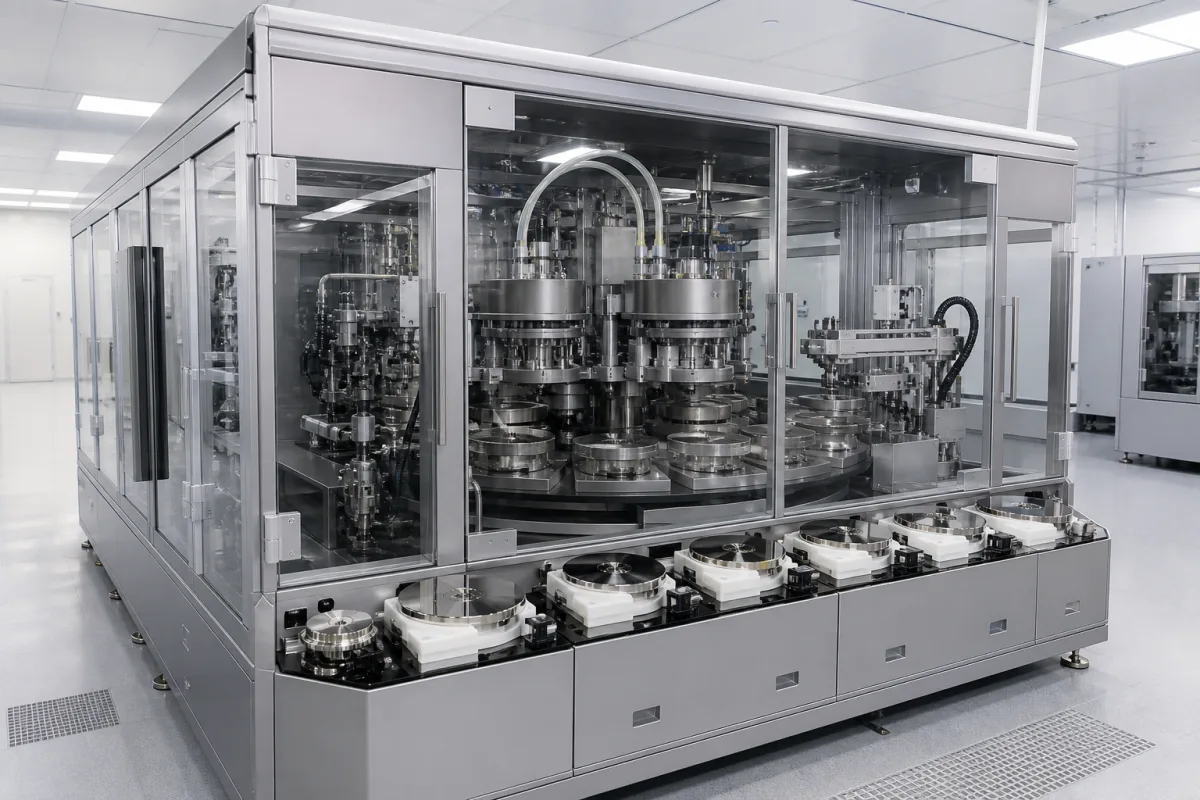
Hard drive platter polishing machine: double-side planetary polishers for NiP-aluminium and glass disk substrates
Double-side planetary polishing of NiP-plated aluminium and glass disk substrates · carrier, sun gear and ring gear speeds, load per batch, slurry chemistry and the multi-stage sequence that reaches sub-0.2 nm roughness
A hard drive platter polishing machine finishes the substrate that the magnetic layers are later sputtered on: an aluminium-magnesium disk plated with nickel-phosphorus, or a glass disk. Unlike a lens polisher working one curved surface, it is a flat double-side machine. Disks sit in thin carriers between an upper and a lower plate faced with polishing pads, and a sun gear and ring gear drive the carriers in planetary motion while slurry flows between the plates, so both faces of a whole batch are polished together. Roughness targets are a fraction of a nanometre, which puts the weight on gear speeds, load, slurry chemistry and the number of polishing stages.
Double-side planetary polishing machines for hard disk drive substrates (NiP-plated aluminium alloy and glass), with their carriers, sun and ring gears, padded upper and lower plates, slurry supply and the staged polishing sequence. Polishing machines for spherical and aspherical optical lenses are covered on the Precision optical lens polishing machine page; lens grinding, texturing and sputtering of the finished disk are outside this page.
CNFX editorial research · Sources checked October 12, 2026 · 3 sources
42 NiP disks per run at 230 kg: ring gear 8.9 rpm, sun gear 3.6 rpm, plates 16.5 and 5.5 rpm
Komag's US 6,149,696 records the settings of its slurry trial on a SpeedFam International model 9B-14 planetary polisher: 42 disks per run, slurry flow 500 ml/min, ring gear 8.9 rpm, sun gear 3.6 rpm, bottom plate 16.5 rpm, top plate 5.5 rpm and a normal load of 230 kg. Removal rate was taken from NiP thickness before and after polishing on seven disks from each of two runs. [1]
The slurry decides the result on that machine. A commercial colloidal silica slurry with an alkaline etchant removed about 0.01 µm/min of NiP and left about 0.31 nm RMS; Komag's formulation, colloidal silica with additives drawn from HNO3, H2O2 and Al(NO3)3, reached about 0.1 µm/min, which the patent calls about ten times higher at the same silica content, with a finish of about 0.2 nm RMS. The patent states that the lowest Ra then obtained with commercial slurries on NiP was about 0.5 nm, and gives silica content of about 2 to 40 wt.% (11 wt.% in its example), particle size from about 50 to 80 nm and pH of about 1.5 to 3.5. [1]
Editorial calculation: 230 kg spread over 42 disks is about 5.5 kg, or roughly 54 N, per disk, shared between its two faces; at 0.1 µm/min a 10-minute cycle removes about 1 µm of NiP per face, against about 0.1 µm with the 0.01 µm/min slurry. [1]
Give the supplier the substrate (NiP-aluminium or glass), diameter and thickness, disks per batch, required roughness and removal, and ask for the plate, carrier and gear speeds and the load the machine can hold.
02
Cerium oxide, then acidic 5–20 nm silica, then alkaline 30–100 nm silica: Hoya's three stages to Ra 0.11 nm
Hoya's US 11,682,424 claims magnetic-disk substrates of glass or aluminium alloy with Ra of 0.11 nm or less on both main surfaces, measured by AFM with a carbon-nanofiber probe tip, and prefers three polishing passes on a double-side polishing apparatus whose upper and lower plates carry annular resin polishing pads. [2]
For glass, the first polishing uses cerium oxide particles with d50 of 0.1 to 1.5 µm. The second, a mirror polish, uses colloidal silica with d50 of 5 to 20 nm at acidic pH, preferably 1 to 4, removing preferably 1 to 5 µm of total thickness from both faces. The third uses colloidal silica with d50 of 30 to 100 nm at alkaline pH, preferably 11 to 13, removing 0.05 to 1 µm; Hoya places the alkaline step last because it polishes more slowly and more precisely, and prefers the third-stage particle size at two or more times that of the second. Chemical strengthening of glass may sit between the first and second polishing but is not essential. [2]
Before polishing, glass blanks are ground on a double-side grinding apparatus with a planetary gear mechanism, the edge held in a holding hole of a carrier between upper and lower plates. [2]
Editorial calculation: taking the midpoints of the preferred ranges, about 0.53 µm for the third stage against 3 µm for the second, the final alkaline pass removes roughly one-sixth as much material as the mirror polish before it.
Ask how many polishing stations or machines the sequence uses, the slurry for each stage with particle size and pH, removal per stage, and how roughness is measured.
03
Floating the disk on a slurry film: Hitachi's non-contact double-side polishing at 100 r/min
Hitachi's US 5,364,655 sets a substrate in a carrier hole between upper and lower plates in temperature-controlled polishing liquid; as plate speed rises, hydrodynamic pressure lifts the disk off the plates and fine free abrasive in the flowing liquid polishes it without contact. In its example the plates turn in opposite directions at 100 r/min with the carrier stopped, using commercial colloidal silica of 20 to 40 nm grain size held at 293 K, supplied near a plate shaft and split into two layers by the carrier. [3]
The patent gives the targets it was written against: earlier double-side polishing of NiP-plated aluminium gave 0.001 to 0.003 µm Ra and 0.005 to 0.020 µm Rmax, while stable head flying below 0.08 µm needed less than 1 nm Ra, flatness under 1 µm and runout under 1 µm, for disks then spinning at 5000 or 7000 r/min or more instead of 3600 r/min. The plate surface itself is specified at 0.001 µm Ra or less with 1 µm flatness. [3]
Editorial calculation: 0.001 µm is 1 nm, so the earlier 1 to 3 nm Ra range already sat at or above the less-than-1 nm target, and Komag's later 0.2 nm RMS and Hoya's 0.11 nm Ra are roughly one-fifth to one-ninth of that 1 nm threshold. [1][2]
04
Carriers, gears, plates and slurry on a disk-substrate polisher
Element
Published detail
Ask for
Carrier
Holds each disk in a hole between the plates [3][2]
Carrier material, thickness, disks per carrier
Sun and ring gears
Sun 3.6 rpm, ring 8.9 rpm in Komag's run [1]; carrier stopped in Hitachi's example [3]
500 ml/min [1]; held at 293 K, fed near a plate shaft [3]
Flow, temperature control, filtration
Abrasive by stage
CeO2 0.1–1.5 µm, silica 5–20 nm, silica 30–100 nm for glass [2]; silica 50–80 nm for NiP [1]
Stage count and slurry per stage
05
Substrate, batch and finish data for a disk-substrate polishing machine
Paste it into your enquiry below or into an email to a maker, then replace every bracket.
Substrate: [NiP-plated aluminium or glass; diameter; thickness]
Batch: [disks per carrier; carriers per run]
Finish: [Ra or RMS target; measurement method; flatness]
Removal: [per stage; total]
Stages: [number; abrasive, particle size and pH per stage]
Machine: [plate diameter; plate, sun and ring gear speeds; load range]
Slurry: [flow; temperature control; filtration]
Handling: [loading and unloading; cleaning between stages]
Explore company information and manufacturing capabilities, then discuss the scope of your project with a relevant supplier.
Share this page
Compiled and source-reviewed by the CNFX editorial team.
Each manufacturer above links to the page on that company's own website where the product is listed, with the date we checked it. How we source and review
· Page last updated 13 October 2026
Buyer questions
How are hard disk substrates polished?
On double-side polishers: disks in carriers between padded upper and lower plates, driven by sun and ring gears, with slurry between the plates; Komag's example ran 42 disks per batch on a SpeedFam 9B-14. [1][2]
What roughness do disk substrates reach?
Hoya claims Ra of 0.11 nm or less on glass or aluminium alloy substrates; Komag reports about 0.2 nm RMS on NiP with its slurry. [2][1]
Why three polishing stages?
Hoya uses cerium oxide, then acidic fine colloidal silica, then a slower, more precise alkaline colloidal silica pass with a removal of 0.05 to 1 µm. [2]
Can a disk be polished without touching the plates?
Hitachi's patent lifts the disk on a hydrodynamic film of colloidal silica slurry at 100 r/min plate speed so that free abrasive polishes it without contact. [3]
Sources and what still needs a direct check
Sources checked 2026-10-12. Three granted US patents from disk and substrate makers: Komag on NiP slurry with full machine settings, Hoya on the three-stage sequence for sub-0.11 nm substrates, and Hitachi on non-contact double-side polishing.