Industry-Verified Manufacturing Data (2026)

Multi-Axis Robotic Arm

Based on aggregated insights from multiple verified factory profiles within the CNFX directory, the standard Multi-Axis Robotic Arm used in the Machinery and Equipment Manufacturing sector typically supports operational capacities ranging from standard industrial configurations to heavy-duty production requirements.

Technical Definition & Core Assembly

A canonical Multi-Axis Robotic Arm is characterized by the integration of End effector and Servo motors. In industrial production environments, manufacturers listed on CNFX commonly emphasize Aluminum alloy construction to support stable, high-cycle operation across diverse manufacturing scenarios.

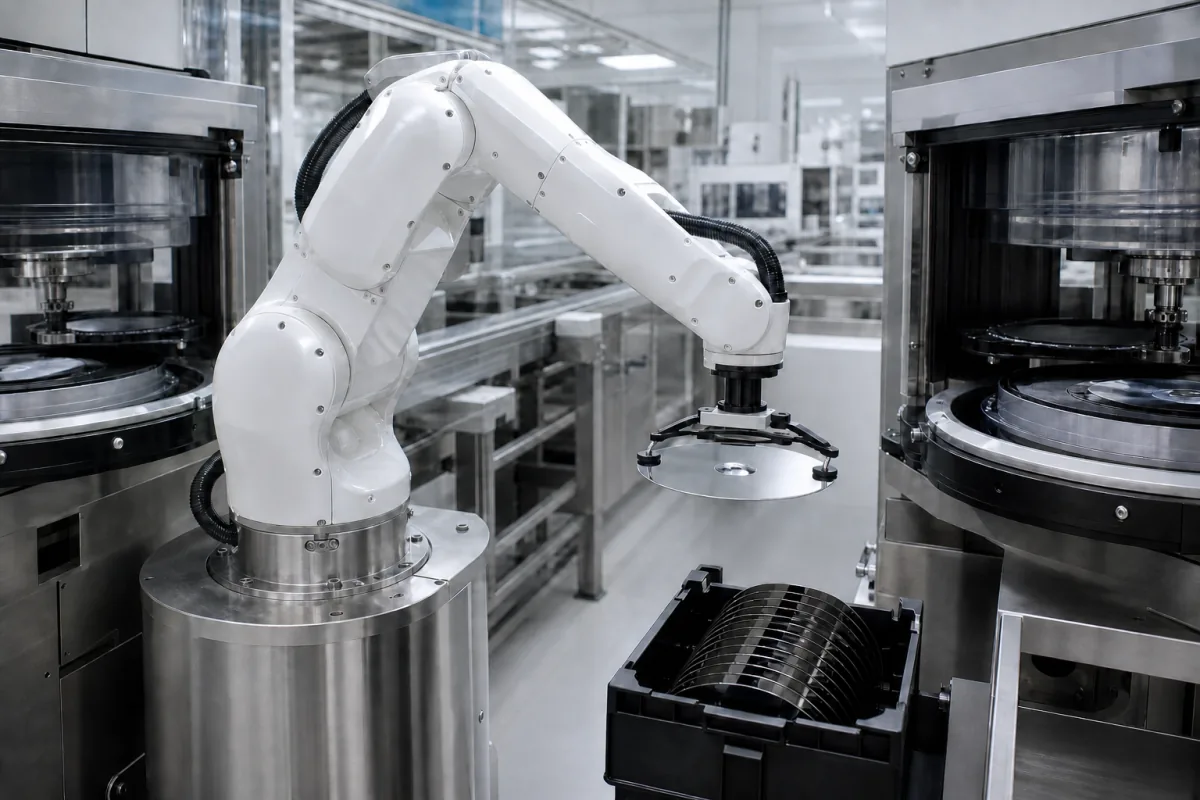
A precision robotic manipulator with multiple degrees of freedom used for automated handling and positioning of hard drive platters during polishing operations.
Product Specifications

Technical details and manufacturing context for Multi-Axis Robotic Arm

Definition
A multi-axis robotic arm is a critical component within the Automated Computer Hard Drive Platter Polishing Machine, responsible for the precise transfer, orientation, and positioning of hard drive platters between various polishing stations. It enables automated workflow by handling delicate platters with micron-level accuracy, ensuring consistent contact with polishing surfaces while minimizing human intervention and contamination risks.
Working Principle
The robotic arm operates through coordinated servo motors at each joint, controlled by a programmable logic controller (PLC) or robotic controller. It receives positional data from the machine's central system, executes programmed trajectories to pick platters from input trays, positions them against polishing heads with specific pressure and angle parameters, and transfers them to subsequent stations or output buffers.
Common Materials
Aluminum alloy, Stainless steel, Carbon fiber composite
Technical Parameters
  • Positioning accuracy for platter handling (mm) Standard Spec
Components / BOM
  • End effector
    Specialized gripper or vacuum cup for securely holding hard drive platters without causing surface damage
    Material: Polymer composite
  • Servo motors
    Provide precise rotational movement at each joint with feedback control
    Material: Copper windings, steel housing
  • Reduction gears
    Increase torque and improve positioning accuracy of joint movements
    Material: Hardened steel
Engineering Reasoning
0.1-1.5 μm positioning accuracy, 0.5-5.0 N force control range, 0.01-0.5 m/s velocity range
Positioning error exceeding 2.0 μm RMS, joint backlash exceeding 15 arcseconds, servo motor temperature exceeding 85°C
Design Rationale: Harmonic drive gear tooth deformation under cyclic loading (Young's modulus 210 GPa steel), encoder interpolation error due to thermal expansion (coefficient 11.7×10⁻⁶/°C aluminum), bearing preload loss from lubricant degradation
Risk Mitigation (FMEA)
Trigger Servo amplifier current saturation at 15 A continuous rating
Mode: Permanent magnet demagnetization in brushless DC motor (NdFeB magnets losing 0.12% flux density per °C above 80°C)
Strategy: Integrated liquid cooling jacket maintaining winding temperature below 65°C with 0.3 L/min ethylene glycol flow
Trigger Absolute encoder glass scale contamination exceeding 5 μm particulate accumulation
Mode: Moiré fringe pattern distortion causing 12-bit interpolation error
Strategy: IP67-rated sealed encoder housing with positive nitrogen purge at 0.2 bar above ambient

Industry Taxonomies & Aliases

Commonly used trade names and technical identifiers for Multi-Axis Robotic Arm.

Applied To / Applications

This component is essential for the following industrial systems and equipment:

Industrial Ecosystem & Supply Chain DNA

Complementary Systems
Downstream Applications
Specialized Tooling

Application Fit & Sizing Matrix

Operational Limits
humidity: 20-80% non-condensing
pressure: Atmospheric (sealed joints for slurry protection)
temperature: 15-35°C (operating), 5-45°C (storage)
vibration tolerance: < 0.5g RMS at mounting base
slurry concentration: Up to 30% solids by weight
Media Compatibility
✓ DI water-based polishing slurries ✓ Cerium oxide abrasive media ✓ Proprietary chemical-mechanical planarization (CMP) fluids
Unsuitable: Chloride-containing or highly acidic environments (risk of corrosion to precision components)
Sizing Data Required
  • Maximum platter diameter (mm)
  • Required positioning accuracy (μm)
  • Cycle time per platter (seconds)

Reliability & Engineering Risk Analysis

Failure Mode & Root Cause
Gear backlash and wear
Cause: Inadequate lubrication, contamination ingress, or excessive cyclic loading leading to pitting, spalling, and increased clearance in reduction gears or drive trains.
Encoder or resolver drift/failure
Cause: Electrical noise, thermal stress, mechanical shock/vibration, or contamination causing loss of positional accuracy or feedback signals.
Maintenance Indicators
  • Audible grinding, clicking, or irregular whining from joints during motion
  • Visual misalignment or 'jitter' in end-effector positioning during programmed cycles
Engineering Tips
  • Implement condition-based lubrication with high-purity greases rated for robotic applications, using automated dispensers to prevent under/over-lubrication.
  • Install vibration monitoring sensors on critical axes and conduct regular thermal imaging scans to detect early-stage electrical or mechanical anomalies.

Compliance & Manufacturing Standards

Reference Standards
ISO 9283:1998 - Manipulating industrial robots - Performance criteria and related test methods ANSI/RIA R15.06 - Industrial Robots and Robot Systems - Safety Requirements CE Marking - Machinery Directive 2006/42/EC
Manufacturing Precision
  • Positioning Accuracy: +/-0.05mm
  • Repeatability: +/-0.02mm
Quality Inspection
  • Laser Tracker Calibration Test
  • Dynamic Load Capacity Verification Test

Factories Producing Multi-Axis Robotic Arm

Verified manufacturers with capability to produce this product in China

✓ 92% Supplier Capability Match Found

P Procurement Specialist from United States Jan 23, 2026
★★★★★
"The technical documentation for this Multi-Axis Robotic Arm is very thorough, especially regarding technical reliability."
Technical Specifications Verified
T Technical Director from United Arab Emirates Jan 20, 2026
★★★★★
"Reliable performance in harsh Machinery and Equipment Manufacturing environments. No issues with the Multi-Axis Robotic Arm so far."
Technical Specifications Verified
P Project Engineer from Australia Jan 17, 2026
★★★★★
"Testing the Multi-Axis Robotic Arm now; the technical reliability results are within 1% of the laboratory datasheet."
Technical Specifications Verified
Verification Protocol

“Feedback is collected from verified sourcing managers during RFQ (Request for Quote) and factory evaluation processes on CNFX. These reports represent historical performance data and technical audit summaries from our B2B manufacturing network.”

15 sourcing managers are analyzing this specification now. Last inquiry for Multi-Axis Robotic Arm from Turkey (1h ago).

Supply Chain Compatible Machinery & Devices

Heavy-Duty CNC Plasma Cutting Machine

Industrial machine for precision metal cutting using plasma arc technology

Explore Specs →
Automated Assembly Line System

Integrated production system for sequential component assembly operations

Explore Specs →
Automated Powder Coating System

Integrated industrial system for applying dry powder coatings to metal substrates.

Explore Specs →
Centrifugal Pump Impeller

Rotating component that transfers energy to fluid in centrifugal pumps.

Explore Specs →

Frequently Asked Questions

What materials are used in this multi-axis robotic arm?

This robotic arm is constructed from high-strength aluminum alloy, corrosion-resistant stainless steel, and lightweight carbon fiber composite materials for optimal durability and precision.

What applications is this robotic arm designed for?

Specifically engineered for automated handling and precise positioning of hard drive platters during polishing operations in machinery and equipment manufacturing environments.

What are the key components in this robotic arm's bill of materials?

The BOM includes a specialized end effector for platter handling, precision reduction gears for accurate movement control, and high-torque servo motors for multi-axis positioning.

Can I contact factories directly on CNFX?

CNFX is an open directory, not a transaction platform. Each factory profile provides direct contact information and production details to help you initiate direct inquiries with Chinese suppliers.

Get Quote for Multi-Axis Robotic Arm

Request technical pricing, lead times, or customized specifications for Multi-Axis Robotic Arm directly from verified manufacturing units.

Your business information is encrypted and only shared with verified Multi-Axis Robotic Arm suppliers.

Thank you! Your message has been sent. We'll respond within 1–3 business days.

Need to Manufacture Multi-Axis Robotic Arm?

Connect with verified factories specializing in this product category

Add Your Factory Contact Us
Previous Product
Multi-axis Positioning Arm
Next Product
Multi-Leaf Collimator