Gamma sterilization irradiators · Cobalt-60 source rack and pool storage, concrete irradiation cell, product conveyor and carriers, dose set by activity, time, distance and density, dosimetry, and US NRC 10 CFR 36 safety design rules
A gamma sterilization processing line is a cobalt-60 irradiator with its product handling: a shielded concrete irradiation cell, a source rack raised from a storage pool to expose product, a conveyor that carries pallets or boxes in carriers past the sources and back out, and a control and safety system, used to sterilise medical devices and treat packaging, ingredients and food. Ask three things first: what product volume, density and minimum and maximum dose the line must deliver, what source activity, cell and conveyor design achieve it, and what licensing, safety interlocks and dosimetry the regulator requires.
Industrial gamma irradiators using cobalt-60 for sterilisation and radiation processing, with their cell, source rack, product conveyor and controls. Electron-beam and X-ray irradiators, ethylene oxide sterilisers, steam autoclaves and tunnel sterilizers (see tunnel sterilizer) are outside this page.
CNFX editorial research · Sources checked October 11, 2026 · 5 sources
The International Irradiation Association (iia) fact sheet on gamma irradiation says about 250 large commercial gamma irradiators in about 50 countries process more than 400 million cubic feet of product a year, about half of it medical products for sterilisation. It explains that product must receive enough dose for the effect but less than a dose that damages it, and that dose is set by the cobalt-60 activity in curies, the time product stays exposed as set by conveyor speed, the source-to-product distance, and the package size and density, with dosimetry used to confirm the dose. [1]
Cobalt-60 is made by neutron activation of cobalt-59, encapsulated in stainless steel pencils and emits two photons of 1.17 and 1.33 MeV per decay, giving high penetration suited to large packages, pallets and dense products. [1]
Editorial note: give the supplier your product mix by box size and density, the minimum sterilising dose and maximum acceptable dose for each product, and annual volume, so they can model dose uniformity and throughput for the proposed source loading and conveyor path.
Give the supplier the products, box or pallet sizes and densities, minimum and maximum dose per product, annual volume and shift pattern, carrier type (pallet or tote), initial and future source activity, building and warehouse layout, segregation of irradiated and non-irradiated goods, dosimetry system, control and reporting integration, licensing jurisdiction and service needs.
02
Check the cell, source storage and safety design
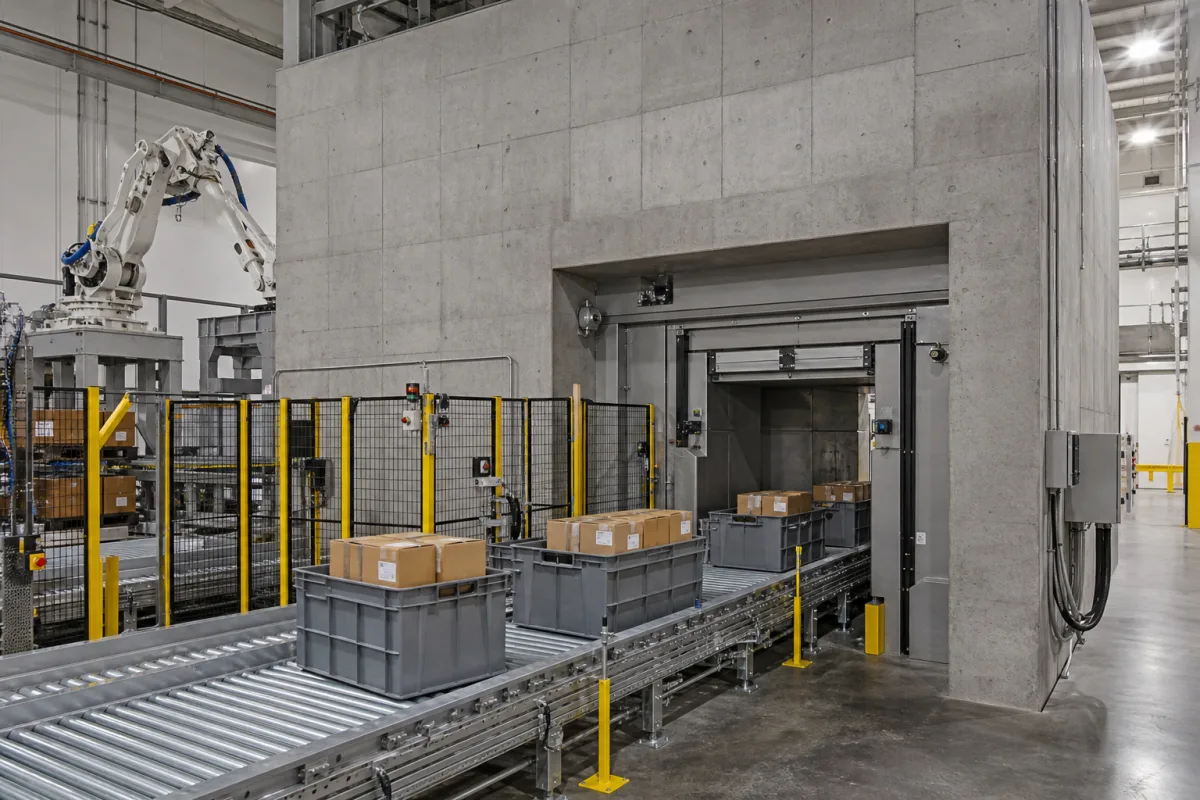
The iia lists features shared by gamma irradiator designs: a concrete irradiation cell inside a warehouse that separates incoming from irradiated product; a source rack hoisted to an irradiation position and passively lowered to storage; a conveyor moving pallets or boxes in aluminium carriers into and out of the cell with loading and unloading stations; an automated control system integrated with safety systems; and source storage in a water pool under the cell, with a few designs using a dry storage pit. [1]
US NRC rules in 10 CFR 36 require, for panoramic irradiators, a door or barrier at each entrance that prevents source exposure while open and returns the sources if opened, keyed to the source control; heat and smoke detectors that automatically shield the sources; a remotely operated fire-extinguishing system; a radiation monitor that stops conveyors if a loose source moves toward the product exit; a guard so products cannot hit the source rack; and automatic return of the sources to the shielded position if power is lost for more than 10 seconds. [2]
They limit dose rate to 0.02 mSv (2 mrem) per hour 30 cm or more outside the radiation-room walls with sources exposed and 30 cm over the pool edge with sources shielded, require pools to have no outlets more than 0.5 m below normal low water level, require shielding-wall heating to be evaluated above 2 × 10¹⁷ Bq (5 million curies), and require daily checks of pool water for contamination. [2]
Editorial calculation: 1 curie is 3.7 × 10¹⁰ Bq, so a 3 million curie loading is 1.11 × 10¹⁷ Bq, below the 2 × 10¹⁷ Bq level at which 10 CFR 36 requires a wall-heating evaluation; ask the designer to state the maximum design activity of the cell, not only the initial loading. [2]
03
Find gamma irradiator manufacturers
CNFX has not yet reviewed a gamma irradiator designer's own listing for this page. The carrier design, source activity and licensing jurisdiction in your specification decide which designers can quote.
04
Size source activity, replenishment and carrier design for throughput
The IAEA's 2008 publication on radiation sterilization of health care products links source activity to output: 1 MCi of cobalt-60 emits about 15 kW, and with 30% of the emitted energy usefully absorbed by product in the commercial irradiators it describes, a 1 MCi irradiator processes about 0.65 t of product per hour at a 25 kGy minimum dose, or about 4 t/h at 4 kGy. Activity falls by about 12% a year (half-life about 5.27 years), so operators lengthen irradiation time by about 1% a month to hold the dose and add new pencils to the rack at regular intervals; it gives a pencil useful life of 20 years. [3]
The IAEA defines the dose uniformity ratio (DUR) as maximum over minimum dose in a container, rising with product density and container size, and sets the principle that the measured DUR must be smaller than the product's dose limit ratio (upper over lower dose limit). It cites containers of 60 cm × 50 cm × 150 cm and whole pallets of 120 cm × 100 cm × 150 cm. Irradiating from more than one side, by rotating containers or moving them around the source, reduces depth variation. [3]
Editorial calculation: at about 12% decay a year, a 1 MCi loading falls to about 1 × 0.88 = 0.88 MCi after one year, so ask the supplier to state throughput at the start and end of each replenishment cycle, not only at initial loading. [3]
Carrier design
How it moves product
Trade-off stated by the IAEA
Product overlap (totes)
Totes of a few hundred kg on roller conveyors, four rows, two levels [3]
Helps dose uniformity, relatively high energy use; more complex transport [3]
Source overlap (carriers)
Longer carriers in four or more rows at one level, can hang from a ceiling track [3]
Plan the cobalt-60 supply, source life and return path
Nordion, a supplier of cobalt-60 sealed sources (its C-188 model is double encapsulated), states that approximately 30% of single-use medical devices worldwide are sterilised with gamma, and that approximately 50% of global cobalt-60 supply is produced in CANDU reactors in Ontario, with other producers in India, China, Russia and Argentina. It reports that supply was under pressure from 2018 through 2023 and that it anticipated meeting 100% of customers' requirements from 2024. [4]
On its sustainability page Nordion estimates that installed cobalt-60 is about 70% of licensed capacity across a network of nearly 300 gamma irradiation facilities, says sources stay active in the field for roughly 20 years, and reports recycling more than 99% of returned cobalt-60 into new sources from 2019 to 2021. It also states that a 5 MCi gamma facility uses 15 times less electrical power and produces 12 times less greenhouse gas than a large-scale industrial X-ray facility, a comparison based on its own estimate over a 20-year operating life using California grid emissions. [5]
Editorial calculation: with the 5.27-year half-life given in the IAEA publication, [3] a source loaded today keeps 0.5^(20 ÷ 5.27) ≈ 7% of its activity after 20 years, which is why replenishment loads and the end-of-life return route belong in the supply agreement alongside the irradiator. Ask the source supplier for the replenishment schedule needed to hold your design activity, shipping container approvals, and the take-back terms. [5]
Activity, carrier, dose map and interlocks to put in the tender
The regulatory values here (shielding dose rate, power-loss return, wall-heating threshold) come from 10 CFR 36; dose uniformity and throughput depend on your product densities, so ask for a dose map rather than a single figure.
Explore company information and manufacturing capabilities, then discuss the scope of your project with a relevant supplier.
Share this page
Compiled and source-reviewed by the CNFX editorial team.
Each manufacturer above links to the page on that company's own website where the product is listed, with the date we checked it. How we source and review
· Page last updated 13 October 2026
Buyer questions
What sets the dose in a gamma irradiator?
The cobalt-60 activity, the time product is exposed (conveyor speed), the source-to-product distance and the package size and density. [1]
What happens if power fails?
Under 10 CFR 36, sources at a panoramic irradiator must return to the shielded position if power is lost for more than 10 seconds. [2]
Where are cobalt-60 sources stored when not in use?
In a water pool under the irradiation cell in the designs the iia describes, with a few designs using a dry storage pit instead. [1]
How much product can a 1 MCi cobalt-60 irradiator sterilise?
The IAEA gives about 0.65 t per hour at a 25 kGy minimum dose, and about 4 t/h at 4 kGy, assuming 30% of the emitted energy is absorbed by product. [3]
How long do cobalt-60 sources stay in service?
Nordion says roughly 20 years; at the 5.27-year half-life that leaves about 7% of the initial activity, so replenishment and return terms belong in the supply contract. [5][3]
Sources and what still needs a direct check
Sources checked 2026-10-11. The iia fact sheet is an industry association overview and Nordion's pages are a cobalt-60 source supplier's own statements; 10 CFR 36 applies to irradiators licensed in the US, and other countries have their own regulators. Design and licensing for your site must follow the applicable regulator and the supplier's dose modelling.