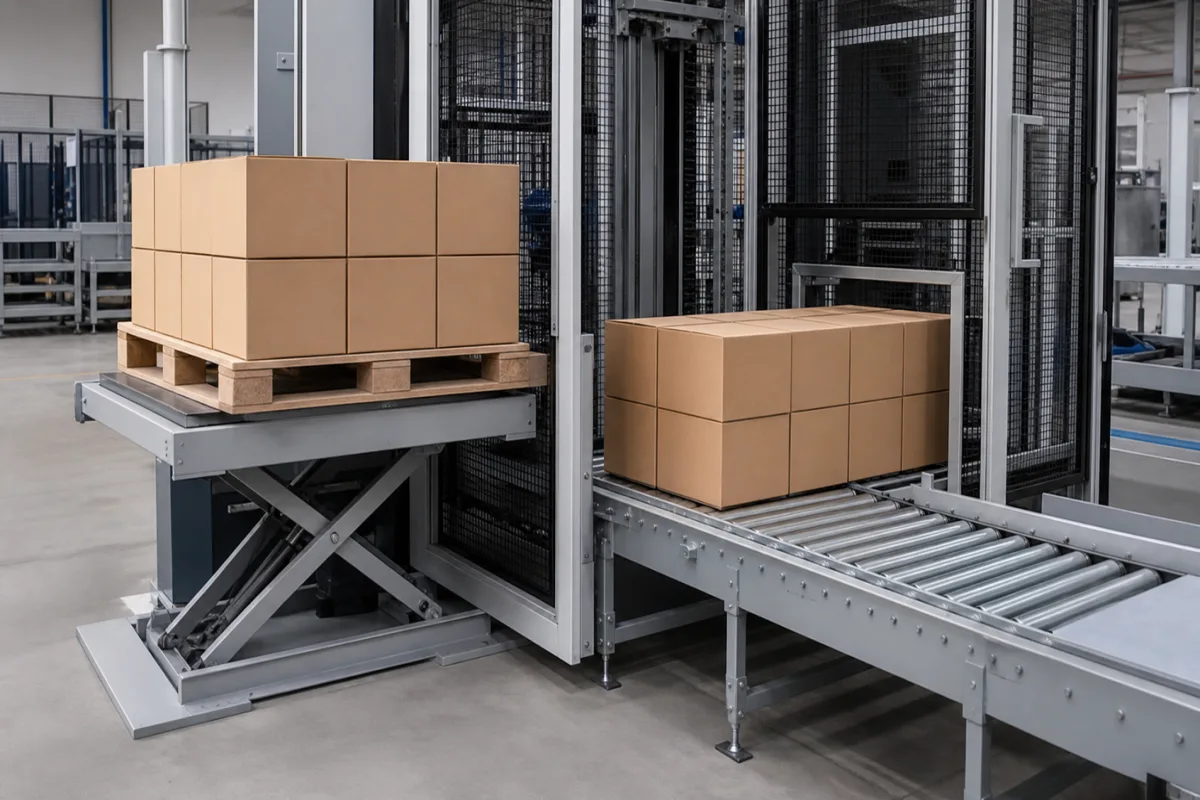
Product loading/unloading station for a tote-type gamma irradiator: the conveyor lanes, tote tipping, pallet levelers and barcode routing outside the shielding door
Outside the shield of a tote-type gamma irradiator · two conveyor lanes for unprocessed and processed totes · tilting up to 90° · pallet levelers with 24 in of travel
In a batch tote irradiator of the kind described here, operators break the pallet down into tote boxes at a station outside the shield, the totes go in through the door, and when they come back the cases are taken out and re-palletised. The station decides how fast that happens and how reliably irradiated and unirradiated product stay apart, so a buyer has to define the lanes, the tote handling, the pallet positioning and the routing logic.
Loading and unloading stations outside the biological shield of tote-type gamma irradiators: in-feed and out-feed conveyor lanes for unprocessed and processed totes, cross-transfer carriages, tote tilting units, pallet levelers and turntables at the operator position, and the barcode or tracking logic that routes a tote to unloading or back into the cell. The irradiator as a whole is covered on the Gamma sterilization processing line page, the source rack inside the cell on the Radiation source rack for a pool-type cobalt-60 irradiator page, and dosimeters on the Dose monitoring system for gamma sterilisation page. Conveyors inside the shield and pallet-carrier irradiators without totes are outside this page.
CNFX editorial research · Sources checked October 13, 2026 · 3 sources
Two conveyor lanes, a cross-transfer carriage and tote tilting up to 90°: the loading and unloading component in SteriGenics' batch irradiator
SteriGenics' US patent 6,051,185 (2000) divides the material handling of its batch tote irradiator into three parts: the source pass conveyors inside the cell, a tote interchange at the shielding door, and a product loading and unloading component outside the cell. A full batch is 21 tote boxes cycled through 21 dwell positions inside. [1]
The loading and unloading component has two conveyor lanes: one carries totes with product to be processed to the interchange for loading into the cell, the other carries totes with processed product from the interchange into position for manual unloading. A pneumatically driven free-roller cross-transfer carriage at the end of the lanes moves totes from one lane to the other, and both lanes can be tilted through any angle up to 90° by a driven shaft so that operators can load or unload product more easily; the totes are then rotated back to vertical to wait for the next interchange. [1]
During interchange, pneumatically driven devices bridge the gap across the shielding door, removing totes of processed product from the cell while placing totes of unprocessed product in it for the next batch. [1]
Specify the tote size and maximum loaded weight, the number of lanes, whether tilting is needed and to what angle, and how processed and unprocessed totes are physically separated at the station.
02
Routing a tote to the unloading station after 2, 3 or 5 cycles: barcode readers at the maze outlet
BINE High-Tech's poster at the IAEA's 2017 International Conference on Applications of Radiation Science and Technology describes a dose increase system for its BFT gamma irradiators: a joint roller, a stopper and a barcode reader inside the maze, and a barcode on every tote. [2]
The master time is set so that one cycle delivers a dose that divides evenly into each required dose. In the poster's example, products needing 10, 15 and 25 kGy are processed together with one cycle giving 5 kGy, so their totes need 2, 3 and 5 cycles. When a tote reaches the maze outlet its barcode is read; if its finished cycles are fewer than its total, it goes onto the joint roller and back into the radiation room, and if they are equal it is moved to the unloading station. [2]
The authors state the problem it addresses in China: product kinds that differ, each in small quantity and with its own dose, which otherwise forces the user to empty the source pass and change the master time between products. [2] Totes therefore reach the unloading station individually, as each completes its cycles.
State whether totes of different doses are mixed in one run, how each tote is identified, and what the station does with a tote whose dose count or barcode cannot be read.
03
Pallet levelers at the operator position: 2,000 or 4,000 lb, 9-3/16 in to 33-3/16 in, on a 43-5/8 in turntable
Breaking a pallet down into totes, and building it back up, is done at the pallet. Southworth's Powered PalletPal levelers raise a pallet on a turntable so the operator works from the near side at a set height, with foot-controlled height adjustment, hydraulic units on 115 V and pneumatic units on shop air at 80 psi and 15 cfm. [3]
Editorial calculation: both models travel 24 in, about 610 mm. Southworth offers one-touch auto leveling for applications where box dimensions stay constant from load to load. [3]
Editorial calculation: a full 2,000 lb pallet holds the weight of about 4.4 of the patent's 450 lb totes; tote count per pallet depends on the cases' size and density, not weight alone. [3][1]
Give pallet size, maximum pallet weight and stack height, so leveler capacity and travel can be matched, and say whether the leveler must sit in a guarded area beside the tote lanes.
04
Data for an irradiator loading/unloading station
Paste it into your enquiry below or into an email to a maker, then replace every bracket.
Irradiator: [tote or carrier type; batch or continuous; totes per batch]
Totes: [inside size; maximum loaded weight]
Lanes: [unprocessed in; processed out; cross transfer; tilting angle]
Segregation: [physical separation of processed and unprocessed product; marking]
Routing: [barcode or RFID; dose cycles per product; reject handling]
Pallets: [size; weight; stack height; leveler capacity and travel; turntable]
Operators: [manual or robotic case transfer; working height; guarding]
Explore company information and manufacturing capabilities, then discuss the scope of your project with a relevant supplier.
Share this page
Compiled and source-reviewed by the CNFX editorial team.
Each manufacturer above links to the page on that company's own website where the product is listed, with the date we checked it. How we source and review
· Page last updated 13 October 2026
Buyer questions
How are processed and unprocessed totes handled at an irradiator's loading station?
In SteriGenics' US patent 6,051,185 one conveyor lane takes unprocessed totes to the door and a second brings processed totes out for manual unloading, with a cross-transfer carriage between them. [1]
Why tilt the tote boxes at the loading station?
The same patent tilts both lanes through any angle up to 90° so operators can load and unload product from the totes more easily, then returns them to vertical. [1]
How does a tote know when to go to unloading?
In BINE High-Tech's dose increase system a barcode reader at the maze outlet compares finished and total cycles; a tote moves to the unloading station only when they are equal. [2]
What pallet leveler suits a tote loading station?
Southworth's Powered PalletPal hydraulic models are rated 2,000 or 4,000 lb and travel from 9-3/16 in to 33-3/16 in on a 43-5/8 in turntable. [3]
Sources and what still needs a direct check
Sources checked 2026-10-13. SteriGenics International's US patent on a batch tote gamma irradiator (loading and unloading component, totes), BINE High-Tech's IAEA conference poster on barcode routing of totes, and Southworth Products' specifications for powered pallet levelers.