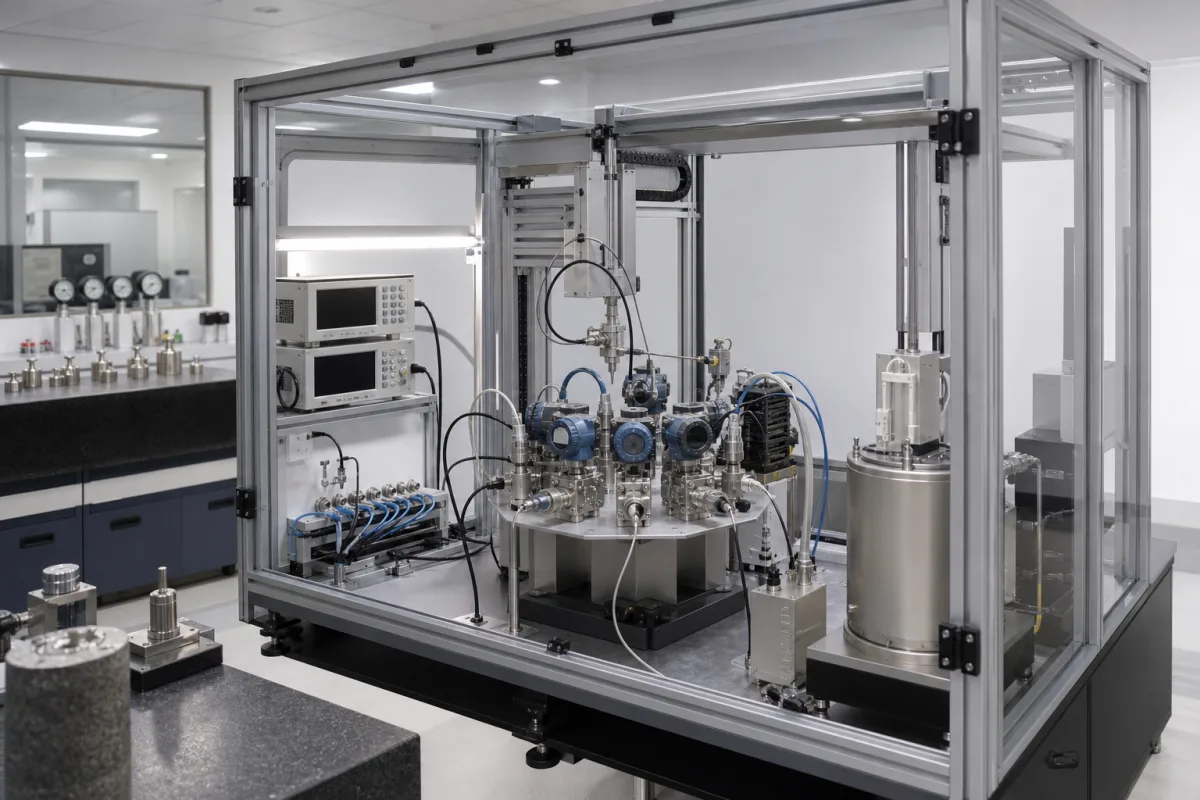
Automated batch calibration system for pressure sensors on the production line: multi-port manifolds in a temperature chamber
End-of-line calibration of pressure sensors in batches · multi-port manifolds inside an environmental chamber, chamber soak time versus calibration time, and ramped temperature-pressure profiles that fit compensation polynomials
Pressure sensing devices that carry their own temperature compensation are conventionally calibrated individually after production, at set pressures at each of two or more temperatures. An automated industrial calibration system for that job puts 25 or more sensors on a shared pressure manifold, closes them in an environmental chamber, steps or ramps temperature and pressure against a reference transducer, and stores coefficients or pass/fail records for each unit. In DunAn Microstaq's published example, bringing the units to each temperature takes about 1.5 hours, against about 10 minutes for the calibration sequence itself.
Automated production-line systems that calibrate and verify batches of pressure sensors, transducers and sensor-bearing controllers: multi-port pressure manifolds, environmental chambers, reference pressure transducers, data acquisition and the sequencing software that writes calibration results to each unit. Reference instruments such as multifunction calibrators, dry-block calibrators and deadweight testers are covered on the Calibration equipment page; portable load-cell and 4–20 mA loop checkers on the Portable calibration module for load cells and 4–20 mA loops on production lines page; gauge block and micrometer sets on the Dimensional calibration kit page; CMM artefacts on the CMM test sphere and step gauge artefacts page; cleanroom particle and climate monitoring networks on the Cleanroom environmental monitoring system page.
CNFX editorial research · Sources checked October 12, 2026 · 3 sources
25 sensors on one five-by-five manifold: 14.5 hours for the batch instead of about 79 hours one at a time
DunAn Microstaq's US 10,563,896 describes calibrating the pressure sensors inside superheat controllers. Done individually, each unit is soaked at two calibration temperatures and a verification temperature, about 1.5 hours each (1.0 to 2.0 hours depending on the chamber), while the calibration sequence and storing the results take about 10 minutes; calibrating and verifying 25 units this way takes approximately 79 hours. [1]
The patented manifold has five fluid conduits with five fittings each, so up to 25 units are pressurised from one gas source, with a pressure transducer at the manifold outlet; each fitting is a male connector with an O-ring that seals against the unit's inlet. Enclosed in an environmental chamber with a computer, data acquisition modules, power supplies and a relay board, the 25 units are calibrated and verified in about 14.5 hours, including both calibration temperatures and the wait between them. Two or more manifolds can be joined for 50 or more units, limited by the gas supply volume the stand can deliver. [1]
The example sequence calibrates at about −38 °C with about 60 psi and then about 200 psi, then repeats both pressures at about 40 °C, records pass or fail per unit at each point, and verifies at room temperature at five pressure points in the example. The patent gives working ranges of about −40 to 0 °C and 25 to 125 °C for the two temperatures, and about 0 to 80 psi and 20 to 700 psi for the two pressures. [1]
Editorial calculation: 79 / 14.5 ≈ 5.4 times faster for the batch, or about 35 minutes of stand time per unit (14.5 h × 60 / 25) against about 3.2 hours (79 / 25) individually. Three soaks of about 1.5 hours already account for 4.5 hours of each individual calibration, which is why loading more units per chamber run pays off. [1]
Ralston Instruments sells benchtop manifolds on the same principle: its Quick-test manifolds calibrate 2 or 4 pressure devices at once to 5000 psi (350 bar), the Quick-test XT versions to 10,000 psi (700 bar), with tool-free ports that switch between NPT, BSPP, flare and metric threads, unused ports capped by hand, and manifolds that can be daisy-chained with hoses inside an environmental chamber. [3]
State the sensor type and process connection, the number of units per chamber run, the calibration and verification temperatures and pressures, and the gas supply available; ask the supplier for the soak time its chamber needs at full load.
02
Ramping chamber temperature and pressure through one continuous run: Infineon's alternative to stepped soaks
Infineon's US 11,187,607 starts from the stepped method: groups of sensors are brought to one exactly defined temperature, measured at set pressures, removed, and the next group loaded, then the cycle repeated at the next temperature, with a waiting time each time. [2]
Its apparatus instead lets the chamber temperature rise or fall strictly monotonically during one or more time intervals, while the pressure rises or falls monotonically within sub-intervals, and at a series of discrete times records a data record holding the reference pressure, the sensor's own pressure reading and the temperature from its compensation device. Sensors are loaded once and removed once; the patent reports that in experiments this ran approximately eight times faster than the three-step stepped method without reducing calibration accuracy. [2]
The records feed a calibration polynomial in pressure and temperature solved for its coefficients; the patent's example includes third-order pressure and second-order temperature terms, and its claimed embodiments use at least third order in both, noting that higher orders improve accuracy but need more data records. It names simple MEMS pressure sensors with pronounced non-linearity in temperature and pressure as particularly suited, and corrects for the sensor's delayed response with an additive or multiplicative term. [2]
Editorial calculation: a polynomial with every combination of pressure up to third order and temperature up to third order has 4 × 4 = 16 coefficients, so each sensor needs at least 16 independent data records, and in practice more for a least-squares fit; a ramped run collects records continuously instead of at a handful of fixed points.
Ask which polynomial order the system fits, how many data records it collects per sensor, the chamber ramp rate, the reference transducer used, and how dynamic lag between reference and sensor is handled.
03
Manifold, chamber, reference transducer and controls in published batch-calibration designs
Part
Published detail
What to specify
Pressure manifold
5 conduits × 5 fittings = 25 units; O-ring male fittings [1]; 2 or 4 quick-test ports to 350 or 700 bar [3]
Ports per manifold, connection type, maximum pressure
Environmental chamber
Holds manifolds; soak about 1.5 h per temperature in the example [1]; temperature ramped strictly monotonically [2]
Temperature range, ramp rate, soak time at full load
Reference pressure sensor
Transducer at manifold outlet [1]; high static accuracy and fast dynamic response [2]
Range, uncertainty, calibration certificate
Pressure regulation
Gas source at set pressures [1]; monotonic ramps within sub-intervals [2]
Pressure points or ramp profile, medium
Data acquisition and control
Computer, data acquisition modules, relay board, power supplies [1]
Channels, unit communication, result storage
Calibration model
At least third-order polynomial in pressure and temperature [2]
Polynomial order, coefficients written to each unit
04
Sensor, batch size and temperature-pressure plan for a batch calibration system
Paste it into your enquiry below or into an email to a maker, then replace every bracket.
Sensors: [type; output or interface; process connection]
Batch: [units per chamber run; units per shift]
Calibration points: [temperatures; pressures; or ramp profile]
Verification: [temperature; number of pressure points; pass limits]
Reference: [transducer range and uncertainty]
Chamber: [range; ramp rate; soak time at full load]
Gas supply: [medium; pressure; volume]
Data: [coefficients written to unit; record format; traceability]
Explore company information and manufacturing capabilities, then discuss the scope of your project with a relevant supplier.
Share this page
Compiled and source-reviewed by the CNFX editorial team.
Each manufacturer above links to the page on that company's own website where the product is listed, with the date we checked it. How we source and review
· Page last updated 13 October 2026
Buyer questions
How much time does calibrating sensors in batches save?
DunAn Microstaq's patent reports about 14.5 hours to calibrate and verify 25 units on one manifold, against approximately 79 hours one at a time, because chamber soaks of about 1.5 hours dominate. [1]
Can temperature be ramped rather than held at fixed steps?
Infineon's patent ramps chamber temperature and pressure monotonically and records reference and sensor values continuously, reporting roughly eight times the speed of a stepped three-temperature method without loss of accuracy. [2]
How many devices fit on a benchtop calibration manifold?
Ralston's Quick-test manifolds take 2 or 4 devices, to 350 bar or, in XT versions, 700 bar, and can be daisy-chained inside an environmental chamber. [3]
Sources and what still needs a direct check
Sources checked 2026-10-12. Two granted US patents from sensor and controller makers describe the batch and ramped methods with their own timings; Ralston's announcement gives port counts and pressure ratings for commercial benchtop manifolds.