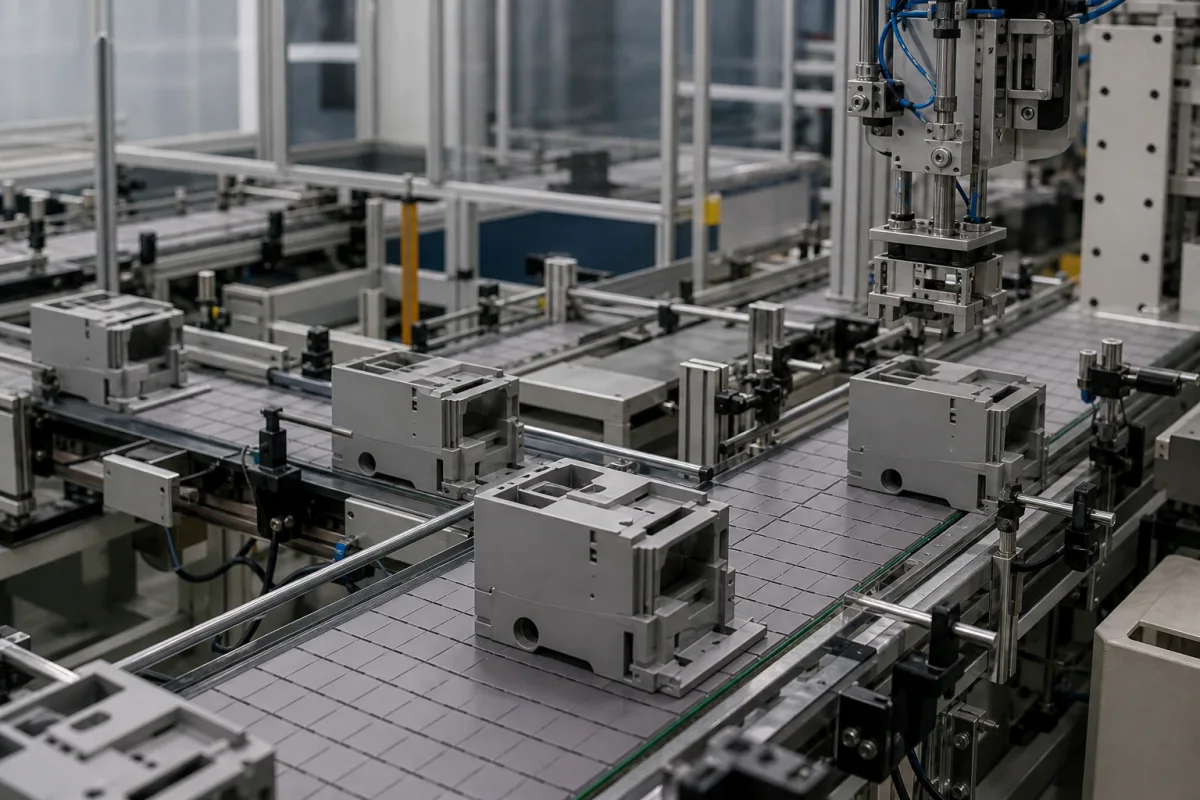
Automated small-part assembly conveyor (plastic flexible-chain line with stops and pick stations)
Plastic-chain conveyors for automated small-part assembly cells: chain width and type, line load and speed, guide rails, and stoppers that hold parts at pick positions
In an automated assembly cell, small parts such as electric motor housings ride on a narrow plastic chain or modular plastic belt between guide rails, are stopped and held at each robot or press station, and are released to the next. The conveyor is sized by the chain and the stop, not only by belt length. Ask three things first: the chain width and top surface the parts need (plain, friction, cleated, conductive), the total load on the line and its speed, and how each station stops and locates the part and with what lateral force.
Automated conveyors for small-part assembly and handling cells: plastic flexible-chain and modular plastic belt lines with guide rails, curves and inclines, and the stoppers and sensors that hold parts at stations. Conveyor systems as a plant-wide category are covered on the Conveyor systems page; heavy workpiece-carrier roller lines for cabinets are covered on the cabinet assembly transport line page. Conveyor chains sold alone, PCB conveyors and telescopic loading conveyors are outside this page.
CNFX editorial research · Sources checked October 12, 2026 · 3 sources
Dorner's FlexMove brochure lists aluminium-frame flexible chain conveyors in seven widths (44, 63, 83, 103, 150, 180 and 260 mm), lengths from 0.6 to 29.8 m, loads up to 272 kg and speeds up to 76 m/min, with curves from 15° to 180° and inclines or declines from 5° to 90°. [1]
Its plastic chain types include standard low-friction and friction-top inserts, and specialty conductive, cleated, roller-top and magnet-top chains; guiding is by fully adjustable single or double rails, in single, double or multi-lane structures. [1] Ask for conductive chain where parts or electronics are sensitive to static, and friction-top or cleated chain where parts must climb.
Machine Design's 2013 report on FlexLink's X65 describes a 65 mm wide plastic-chain conveyor up to 120 ft long that can carry 330 lb in total, moving 22 lb products horizontally and 4.4 lb products vertically, or up to 6.6 lb on individualised pallets of 100 × 128 mm, at up to 395 fpm. [2] Editorial calculation: 120 ft ≈ 36.6 m, 330 lb ≈ 150 kg and 395 fpm ≈ 120 m/min (× 0.3048). [2]
Give the supplier the part drawings and masses, parts per minute, the layout with curves, inclines and level changes, the number of lanes, each station's function and cycle time, how parts are stopped and located, the positioning accuracy needed, the controls interface, supply voltage, and any static, cleanroom or washdown requirement.
02
Stop and locate parts at each station
IAI's EC-ST15 is an electric stopper cylinder for conveyor lines without an air supply. IAI rates it for workpieces up to 50 kg, with a maximum collision speed of 40 m/min for a 9 kg workpiece; its chart limits the thrust (lateral) load from the conveyor to 500 N or less, with the contact point within 50 mm. [3]
The datasheet lists a 50 mm stroke, a 25 mm aluminium rod, positioning repeatability of ±0.15 mm, an ambient range of 0–40 °C at 85% RH or less without condensation, IP20, and a mass of 5.06 kg (5.36 kg with brake). [3]
On the conveyor side, the X65 report states that it can place loads within 0.3 mm of the target location. [2] Editorial note: a stopper holds the part against a moving chain, so ask the supplier for the friction force the chain applies to a stopped part at your load and confirm it stays under the stopper's lateral limit.
03
Published chain-conveyor and stopper data
Item
Published data
Source
Flexible chain conveyor range
44–260 mm wide; 0.6–29.8 m long; up to 272 kg; up to 76 m/min
1 company lists this product among what they make. Company figures are quoted from each
company's own website; every card states where the relationship came from.
Vitrans Automation Equipment Co.,Ltd
Manufacturing site to be confirmed for the order
Lists flexible chain conveyor systems, pallet conveying systems and belt conveying systems for production and assembly lines.
Explore company information and manufacturing capabilities, then discuss the scope of your project with a relevant supplier.
Share this page
Compiled and source-reviewed by the CNFX editorial team.
Each manufacturer above links to the page on that company's own website where the product is listed, with the date we checked it. How we source and review
· Page last updated 13 October 2026
Buyer questions
How wide are plastic flexible-chain conveyors?
Dorner lists FlexMove in seven widths from 44 to 260 mm. [1]
How accurately can a chain conveyor place parts?
Machine Design reports FlexLink's X65 places loads within 0.3 mm of the target location. [2]
Can a stopper work without compressed air?
Yes; IAI's EC-ST15 electric stopper is rated for workpieces up to 50 kg on conveyor lines without an air source. [3]
Sources and what still needs a direct check
Sources checked 2026-10-12. Dorner and IAI are makers describing their own conveyors and stoppers; the FlexLink X65 figures come from a Machine Design product report. Ratings depend on chain type and configuration.