Industry-Verified Manufacturing Data (2026)

Industrial Electromagnetic Vibration Testing System

Based on aggregated insights from multiple verified factory profiles within the CNFX directory, the standard Industrial Electromagnetic Vibration Testing System used in the Manufacture of Other Electrical Equipment sector typically supports operational capacities ranging from standard industrial configurations to heavy-duty production requirements.

Technical Definition & Core Assembly

A canonical Industrial Electromagnetic Vibration Testing System is characterized by the integration of Moving Coil Assembly and Permanent Magnet Assembly. In industrial production environments, manufacturers listed on CNFX commonly emphasize Aluminum Alloy construction to support stable, high-cycle operation across diverse manufacturing scenarios.

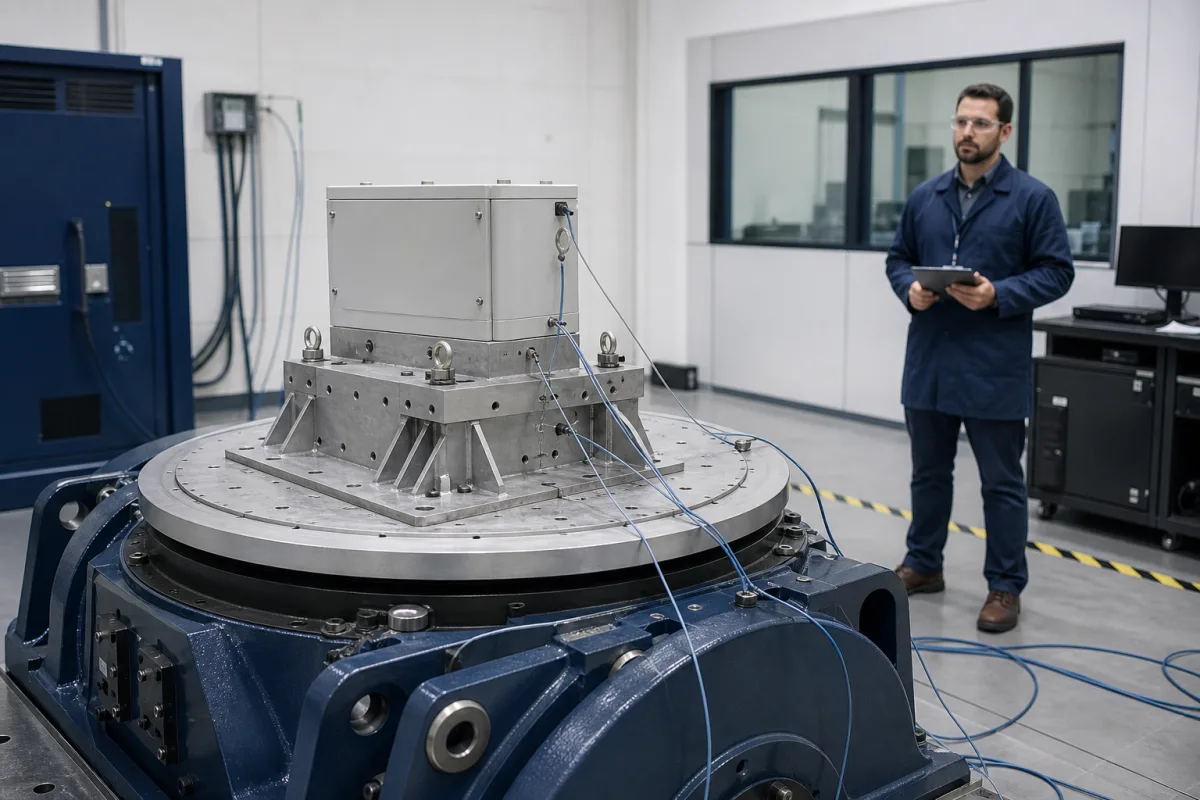
Standalone electromagnetic vibration test machine for product durability validation

Product Specifications

Technical details and manufacturing context for Industrial Electromagnetic Vibration Testing System

Definition
An industrial-grade electromagnetic vibration testing system that generates controlled mechanical vibrations to simulate real-world operating conditions. It is used to validate product durability, identify structural weaknesses, and ensure reliability under stress. The system provides precise, repeatable vibration profiles for quality assurance testing across various industries. It helps manufacturers meet regulatory requirements and improve product lifespan through accelerated life testing.
Working Principle
Uses electromagnetic force generated by a moving coil within a magnetic field to produce controlled mechanical vibrations. An amplifier drives the coil based on input signals, creating precise vibration patterns that are transmitted to the test specimen through a mounting table.
Common Materials
Aluminum Alloy, Stainless Steel, Copper Windings, Neodymium Magnets
Technical Parameters
  • Maximum electromagnetic force output (kN) Per Request
  • Operational vibration frequency spectrum (Hz) Per Request
Components / BOM
  • Moving Coil Assembly
    Generates electromagnetic force through current flow in magnetic field
    Material: Copper windings, aluminum former
  • Permanent Magnet Assembly
    Provides static magnetic field for coil interaction
    Material: Neodymium magnets, steel housing
  • Vibration Table
    Platform for mounting test specimens
    Material: Aluminum alloy
  • Power Amplifier
    Amplifies control signals to drive moving coil
    Material: Electronic components, aluminum housing
  • Cooling System Optional
    Dissipates heat from moving coil during operation
    Material: Aluminum fins, copper pipes
Engineering Reasoning
0-2000 Hz frequency, 0-50 g acceleration, 0-25 mm displacement
Coil temperature exceeding 155°C (Class F insulation limit), armature displacement exceeding 25 mm (mechanical stop), acceleration exceeding 50 g (structural yield point)
Design Rationale: Joule heating in electromagnetic coils exceeding insulation thermal rating (155°C for Class F), Lorentz force-induced mechanical stress exceeding material yield strength (typically 250 MPa for structural steel), resonant frequency excitation beyond damping capacity
Risk Mitigation (FMEA)
Trigger Power amplifier harmonic distortion exceeding 3% THD at full load
Mode: Armature overheating leading to permanent magnet demagnetization (Curie temperature 310°C for NdFeB magnets)
Strategy: Implement active harmonic filtering with 5th and 7th order notch filters, install temperature sensors with 85°C cutoff threshold
Trigger Bearing lubrication failure (oil film thickness < 1 μm)
Mode: Armature guide bearing seizure causing coil-to-pole rubbing
Strategy: Install dual-redundant oil mist lubrication system with 0.5 bar pressure monitoring, implement vibration monitoring with 4.5 mm/s RMS alert threshold

Industry Taxonomies & Aliases

Commonly used trade names and technical identifiers for Industrial Electromagnetic Vibration Testing System.

Industrial Ecosystem & Supply Chain DNA

Complementary Systems
Downstream Applications
Specialized Tooling

Application Fit & Sizing Matrix

Operational Limits
pressure: Atmospheric (non-pressurized system)
max force: Up to 50 kN (depending on model)
temperature: 10°C to 40°C (operating ambient)
displacement: Up to 51 mm peak-to-peak
max acceleration: Up to 100 g (depending on payload)
vibration frequency: 5 Hz to 3000 Hz
Media Compatibility
✓ Electronics enclosures ✓ Automotive components ✓ Aerospace assemblies
Unsuitable: Corrosive chemical exposure environments
Sizing Data Required
  • Maximum test payload mass (kg)
  • Required acceleration spectrum (g vs. frequency)
  • Required displacement amplitude (mm)

Reliability & Engineering Risk Analysis

Failure Mode & Root Cause
Coil overheating and insulation degradation
Cause: Excessive current due to prolonged high-amplitude operation or inadequate cooling, leading to thermal breakdown of electromagnetic coil insulation and reduced magnetic field strength.
Bearing wear and mechanical misalignment in the vibration exciter assembly
Cause: Continuous cyclic loading and fatigue from high-frequency vibrations, combined with inadequate lubrication or contamination ingress, causing premature bearing failure and shaft misalignment.
Maintenance Indicators
  • Unusual audible humming, buzzing, or grinding noises from the exciter unit during operation, indicating potential coil issues or mechanical wear.
  • Visible excessive vibration or erratic motion patterns in the test specimen or system structure, suggesting control system instability or mechanical component failure.
Engineering Tips
  • Implement a strict thermal management protocol, including regular inspection of cooling systems (fans, heat sinks, or liquid cooling circuits) and monitoring of coil temperatures with infrared thermography during operation.
  • Establish a preventive maintenance schedule for the exciter assembly, focusing on bearing lubrication with manufacturer-specified greases, alignment checks using laser alignment tools, and periodic replacement of wear components before failure.

Compliance & Manufacturing Standards

Reference Standards
ISO 5348:1998 - Mechanical vibration and shock - Mechanical mounting of accelerometers IEC 60068-2-6:2007 - Environmental testing - Part 2-6: Tests - Test Fc: Vibration (sinusoidal) ASTM E1876-15 - Standard Test Method for Dynamic Young's Modulus, Shear Modulus, and Poisson's Ratio by Impulse Excitation of Vibration
Manufacturing Precision
  • Shaker table flatness: ≤0.05 mm/m
  • Frequency accuracy: ±0.5% of set value
Quality Inspection
  • Vibration profile verification test (sine sweep and random)
  • Electromagnetic interference (EMI) compliance test

Factories Producing Industrial Electromagnetic Vibration Testing System

Verified manufacturers with capability to produce this product in China

✓ 97% Supplier Capability Match Found

P Procurement Specialist from Canada Jan 19, 2026
★★★★★
"Standard OEM quality for Manufacture of Other Electrical Equipment applications. The Industrial Electromagnetic Vibration Testing System arrived with full certification."
Technical Specifications Verified
T Technical Director from United States Jan 16, 2026
★★★★★
"Great transparency on the Industrial Electromagnetic Vibration Testing System components. Essential for our Manufacture of Other Electrical Equipment supply chain."
Technical Specifications Verified
P Project Engineer from United Arab Emirates Jan 13, 2026
★★★★★
"The Industrial Electromagnetic Vibration Testing System we sourced perfectly fits our Manufacture of Other Electrical Equipment production line requirements."
Technical Specifications Verified
Verification Protocol

“Feedback is collected from verified sourcing managers during RFQ (Request for Quote) and factory evaluation processes on CNFX. These reports represent historical performance data and technical audit summaries from our B2B manufacturing network.”

19 sourcing managers are analyzing this specification now. Last inquiry for Industrial Electromagnetic Vibration Testing System from USA (12m ago).

Frequently Asked Questions

What industries commonly use this electromagnetic vibration testing system?

This system is specifically designed for the manufacture of other electrical equipment, including components like transformers, relays, switches, and control panels that require durability validation through vibration testing.

What are the key specifications to consider when selecting this vibration testing system?

Key specifications include armature mass (kg), frequency range (Hz), maximum acceleration (g), maximum displacement (mm), maximum force (kN), and maximum velocity (m/s). These determine the system's capability to simulate real-world vibration conditions for your specific products.

How does the cooling system in this vibration tester improve performance?

The integrated cooling system maintains optimal operating temperatures for the copper windings and power amplifier during extended testing cycles, ensuring consistent performance, preventing overheating, and extending the equipment's lifespan while maintaining accurate test results.

Can I contact factories directly on CNFX?

CNFX is an open directory, not a transaction platform. Each factory profile provides direct contact information and production details to help you initiate direct inquiries with Chinese suppliers.

Get Quote for Industrial Electromagnetic Vibration Testing System

Request technical pricing, lead times, or customized specifications for Industrial Electromagnetic Vibration Testing System directly from verified manufacturing units.

Your business information is encrypted and only shared with verified Industrial Electromagnetic Vibration Testing System suppliers.

Thank you! Your message has been sent. We'll respond within 1–3 business days.

Need to Manufacture Industrial Electromagnetic Vibration Testing System?

Connect with verified factories specializing in this product category

Add Your Factory Contact Us
Previous Product
Industrial Electromagnetic Relay Coil Assembly
Next Product
Precision Current Shunt Resistor