Industry-Verified Manufacturing Data (2026)

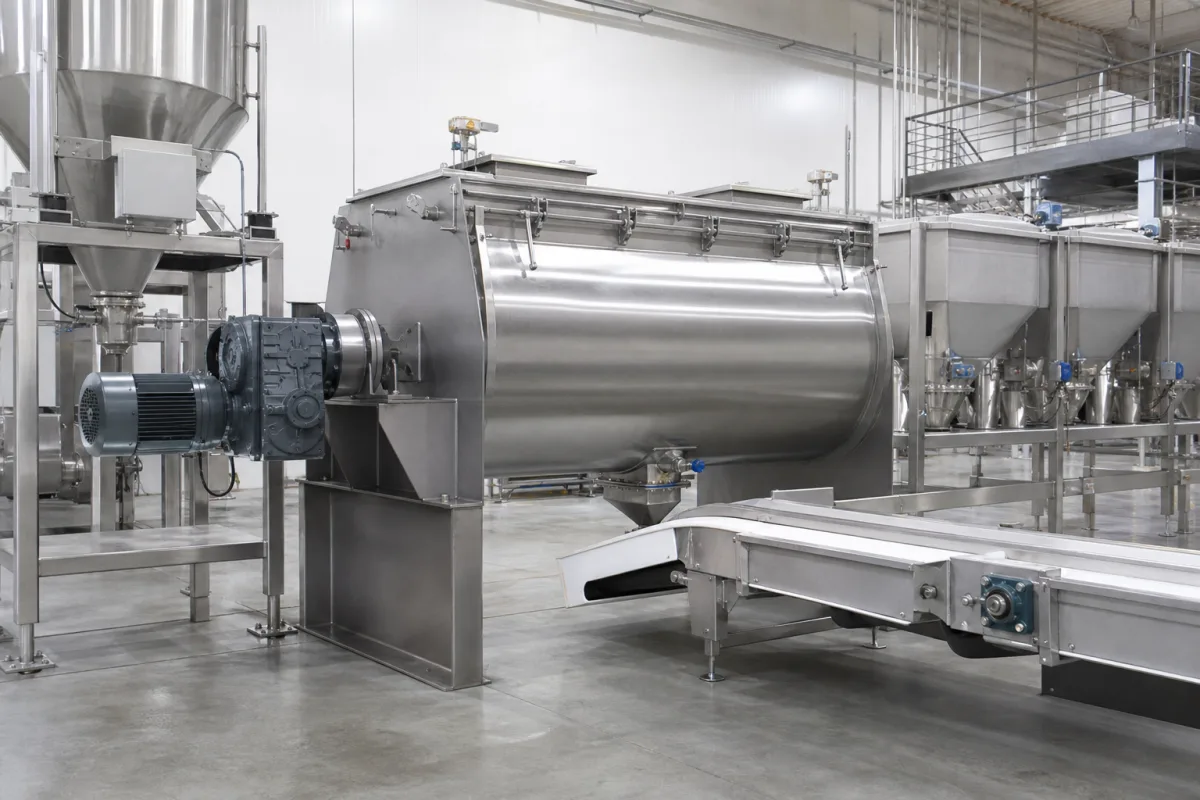
Automated Food Ingredient Blending and Mixing System

Based on aggregated insights from multiple verified factory profiles within the CNFX directory, the standard Automated Food Ingredient Blending and Mixing System used in the Manufacture of Other Food Products sector typically supports operational capacities ranging from standard industrial configurations to heavy-duty production requirements.

Technical Definition & Core Assembly

A canonical Automated Food Ingredient Blending and Mixing System is characterized by the integration of Central Mixing Vessel and Precision Weigh Scale Module. In industrial production environments, manufacturers listed on CNFX commonly emphasize Stainless Steel 316L construction to support stable, high-cycle operation across diverse manufacturing scenarios.

Industrial-scale automated system for precise blending of multiple food ingredients.

Product Specifications

Technical details and manufacturing context for Automated Food Ingredient Blending and Mixing System

Definition
A fully integrated production line designed for the controlled blending of dry, liquid, and semi-solid food ingredients. It ensures batch-to-batch consistency, precise recipe adherence, and hygienic processing for manufacturers of sauces, dressings, bakery pre-mixes, and seasoning blends. The system integrates material handling, weighing, sequencing, and mixing modules into a coordinated workflow, reducing manual labor and contamination risks while optimizing production throughput for B2B food manufacturing.
Working Principle
Ingredients are conveyed from storage silos or hoppers to precision weigh scales, then sequentially or simultaneously discharged into a central mixing vessel where mechanical agitation ensures homogeneous blending before transfer to downstream packaging or processing.
Common Materials
Stainless Steel 316L, Food-Grade Polyurethane, Sanitary-Grade Silicone
Technical Parameters
  • Maximum volume per mixing cycle (liters) Standard Spec
  • Homogeneity achieved within specified time (percent) Standard Spec
Components / BOM
Engineering Reasoning
0.5-3.0 bar mixing pressure, 20-80°C ingredient temperature, 30-70% relative humidity
Mixing pressure exceeding 3.5 bar causes seal failure, ingredient temperature below 15°C triggers viscosity-induced motor overload, relative humidity above 85% initiates hygroscopic ingredient clumping
Design Rationale: Seal failure due to elastomer compression set at 3.5 bar (Hooke's law elastic limit), motor overload from increased viscosity following Arrhenius equation below 15°C, clumping from moisture adsorption exceeding BET monolayer capacity at 85% RH
Risk Mitigation (FMEA)
Trigger Ingredient particle size distribution exceeding 100-500 μm specification range
Mode: Segregation-induced blend inhomogeneity with RSD > 5%
Strategy: Install inline laser diffraction particle analyzer with 1 μm resolution and automated feed rate adjustment
Trigger Screw conveyor wear reducing flight height below 85% of original 50 mm dimension
Mode: Volumetric efficiency drop below 90% causing underfeeding
Strategy: Implement capacitive proximity sensors monitoring flight height with 0.1 mm precision and predictive maintenance scheduling

Industry Taxonomies & Aliases

Commonly used trade names and technical identifiers for Automated Food Ingredient Blending and Mixing System.

Industrial Ecosystem & Supply Chain DNA

Complementary Systems
Downstream Applications
Specialized Tooling

Application Fit & Sizing Matrix

Operational Limits
pressure: Up to 3 bar (max system pressure)
flow rate: 100-5000 L/hr (per mixing line)
batch size: 50-5000 L capacity
temperature: 5°C to 80°C (operating range)
mixing accuracy: ±0.5% by weight
slurry concentration: Up to 70% solids by weight
Media Compatibility
✓ Powdered ingredients (flours, spices, additives) ✓ Liquid food additives (oils, syrups, flavorings) ✓ Granular materials (sugar, salt, grains)
Unsuitable: Highly corrosive acidic media (pH <2.0) or abrasive slurries with >70% solids
Sizing Data Required
  • Required batch volume (L) and production rate (batches/hour)
  • Number of distinct ingredients to be blended simultaneously
  • Required mixing precision (% tolerance by weight) and homogeneity specifications

Reliability & Engineering Risk Analysis

Failure Mode & Root Cause
Bearing fatigue and contamination failure
Cause: Ingredient abrasives (e.g., salt, sugar crystals) infiltrating bearing seals, combined with cyclic loading from start-stop operations and potential misalignment from agitator imbalance.
Seal degradation and leakage
Cause: Chemical attack from acidic or caustic ingredients, thermal cycling during cleaning processes (CIP/SIP), and mechanical wear from shaft runout or improper gland packing tension.
Maintenance Indicators
  • Unusual high-frequency vibration or rhythmic knocking from the mixer drive assembly, indicating potential bearing failure, imbalance, or foreign object ingress.
  • Visible product leakage at shaft seals or flange gaskets, or audible hissing/whistling suggesting seal failure and cross-contamination risk.
Engineering Tips
  • Implement a predictive maintenance program using vibration analysis and ultrasonic testing to detect early bearing wear and misalignment, complemented by strict seal integrity checks after each cleaning cycle.
  • Upgrade to food-grade, chemically resistant seals and bearings, and establish a rigorous lubrication schedule with compatible, high-purity greases to prevent washout and contamination.

Compliance & Manufacturing Standards

Reference Standards
ISO 22000:2018 - Food safety management systems ANSI/NSF 2-2020 - Food equipment CE - Machinery Directive 2006/42/EC
Manufacturing Precision
  • Ingredient proportioning accuracy: +/- 0.5% by weight
  • Mixing uniformity: 95% homogeneity across batch
Quality Inspection
  • Cleanability verification (ATP swab testing)
  • Material composition verification (XRF analysis)

Factories Producing Automated Food Ingredient Blending and Mixing System

Verified manufacturers with capability to produce this product in China

✓ 96% Supplier Capability Match Found

P Project Engineer from Australia Jan 17, 2026
★★★★★
"Great transparency on the Automated Food Ingredient Blending and Mixing System components. Essential for our Manufacture of Other Food Products supply chain."
Technical Specifications Verified
S Sourcing Manager from Singapore Jan 14, 2026
★★★★★
"The Automated Food Ingredient Blending and Mixing System we sourced perfectly fits our Manufacture of Other Food Products production line requirements."
Technical Specifications Verified
P Procurement Specialist from Germany Jan 11, 2026
★★★★★
"Found 13+ suppliers for Automated Food Ingredient Blending and Mixing System on CNFX, but this spec remains the most cost-effective."
Technical Specifications Verified
Verification Protocol

“Feedback is collected from verified sourcing managers during RFQ (Request for Quote) and factory evaluation processes on CNFX. These reports represent historical performance data and technical audit summaries from our B2B manufacturing network.”

6 sourcing managers are analyzing this specification now. Last inquiry for Automated Food Ingredient Blending and Mixing System from UAE (1h ago).

Frequently Asked Questions

What materials are used in the construction of this blending system?

The system is constructed with Stainless Steel 316L, Food-Grade Polyurethane, and Sanitary-Grade Silicone components to ensure food safety, durability, and compliance with hygiene standards.

How does the system ensure precise ingredient blending?

It uses a Precision Weigh Scale Module with gram-level accuracy and a Programmable Logic Controller to automate ingredient dosing, mixing times, and sequences for consistent batch quality.

What is the maximum production capacity of this system?

The system handles batches up to [kg] capacity with a throughput of [batches/hour], featuring multiple ingredient feed stations and adjustable mixing parameters for various production needs.

Can I contact factories directly on CNFX?

CNFX is an open directory, not a transaction platform. Each factory profile provides direct contact information and production details to help you initiate direct inquiries with Chinese suppliers.

Get Quote for Automated Food Ingredient Blending and Mixing System

Request technical pricing, lead times, or customized specifications for Automated Food Ingredient Blending and Mixing System directly from verified manufacturing units.

Your business information is encrypted and only shared with verified Automated Food Ingredient Blending and Mixing System suppliers.

Thank you! Your message has been sent. We'll respond within 1–3 business days.

Need to Manufacture Automated Food Ingredient Blending and Mixing System?

Connect with verified factories specializing in this product category

Add Your Factory Contact Us
First Product
Next Product
Food-Grade Sanitary Diaphragm Valve Core