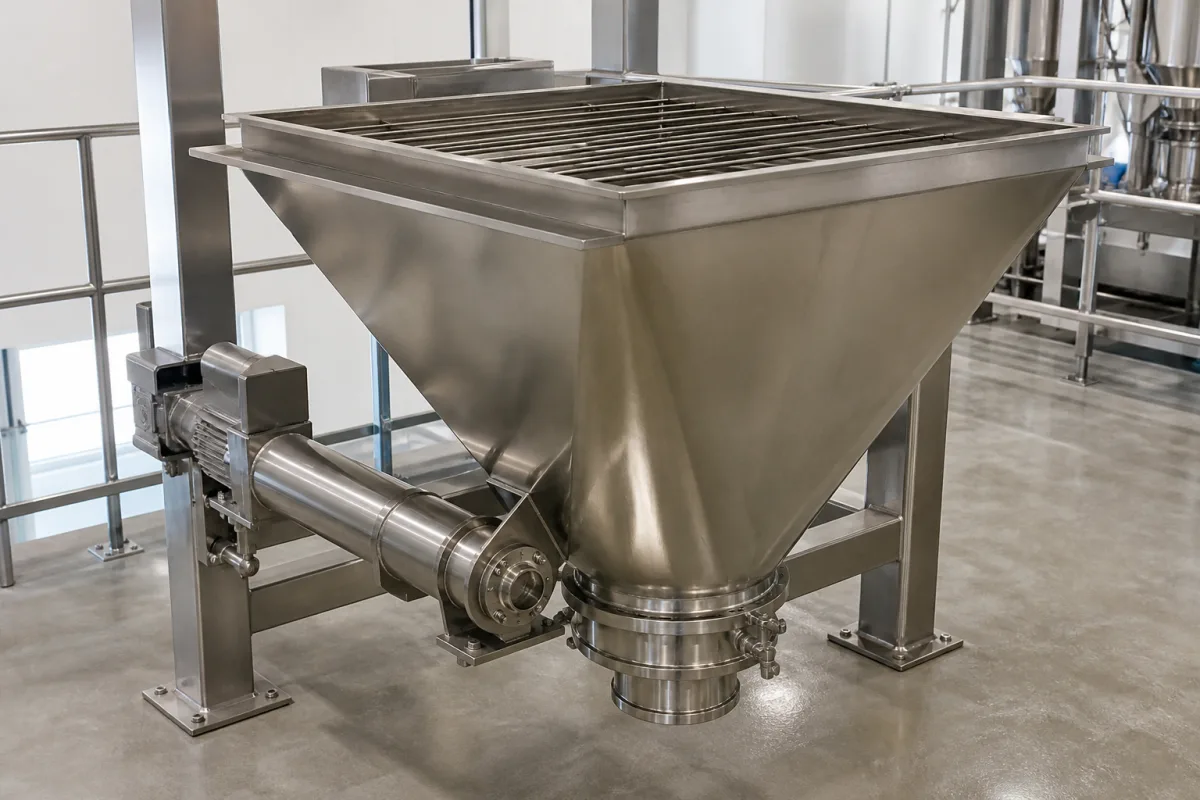
Agitated ingredient feed hopper for a screw feeder: paddle-massaged flexible walls, internal stirrers and spiral agitators against bridging
The hopper and trough directly above a feed screw, and how they keep cohesive food powders moving into it · flexible walls massaged by paddles, internal stirrers, a spiral agitator turning at ½ to 2 rpm, and a polyurethane limit of 50 °C
Between a wide extension hopper and a narrow feed screw, the cross-section of an ingredient feed hopper shrinks until a cohesive powder can span it and stop. Whatever moves the powder at that point decides whether every screw flight fills with the same weight. Two families dominate: a flexible trough squeezed from outside by paddles, and a rigid trough with blades turning inside it; patents add spiral, inclined and hemispherical variants.
The feed hopper and screw trough mounted directly above an ingredient feed screw, and the agitation that keeps powders flowing into the screw: paddle-massaged flexible walls, internal stirring blades, spiral and inclined agitators, and hopper and trough shapes. Refill timing, weighing and accuracy of loss-in-weight feeders are covered on the Powder feeder with loss-in-weight control page; screw pitch, drawdown and drive on the Screw feeder page; silos and storage hoppers designed from flow properties on the Bulk storage hopper (bins and silos) page; hygienic bag-tip hoppers on the Ingredient hopper page; and outlet slide gates on the Hopper discharge gate page.
CNFX editorial research · Sources checked October 12, 2026 · 5 sources
Flexible polyurethane trough massaged by paddles, or a stainless trough with internal blades
Walter Folkl and Andy Kovats of Brabender Technologie explain that the screw trough converges from the extension hopper into the screw, every dry ingredient has a minimum bridging dimension, and the narrowing trough eventually reaches it, so an agitation device is built into the trough. [1]
The authors add that a wedge-shaped trough bottom exposes more screw length than a spherical or conical one, so flights fill completely before the screw tube; that the stirred trough is sized to reduce the volume of its dead zones; and that an extension hopper with vertical sides above it needs no extra stirring, since it does not converge. Their rule of thumb sizes the extension hopper for four minutes of storage at maximum feed rate and minimum bulk density. [1]
Stephen Moksnes's 1992 patent for Accurate Inc. describes the same paddle principle on flexible vinyl hoppers designed for mass flow, first in, first out: the paddle stroke is set small for heavy materials that segregate easily and large for light materials, so the movement carries through the whole hopper. It gives two objections to internal stirrers, that they push and compact material ahead of the blade so dense and loose portions alternate into the flights, and to hopper vibration, that it segregates mixed particle sizes. It also notes a drawback of paddles: their sliding against the vinyl wears and weakens the walls, which its rotary design is meant to avoid. [2]
Flexible wall with external paddles
Internal stirring
Trough
Flexible material, with polyurethane named; wedge-shaped on two sides, near vertical on the other two [1]
Metal, with stainless steel named, curved at a constant radius around the blades [1]
How bridges are stopped
Metal paddles push the two wedge sides in and out; a restriction followed by a void collapses forming bridges [1]
Blades sweep down into the screw on one side and up on the other [1]
Dead zones
Wall movement reaches the ingredient from inlet to screw on both wedge faces [1]
Circular motion leaves two unagitated zones at the top of the trough [1]
Where it is the choice
The authors' first choice in their general guidance, with the exceptions listed opposite [1]
Cohesive ingredients that solidify under compression; ingredients above 50 °C, where polyurethane becomes too soft [1]
Name the ingredient, its temperature on arrival and whether it packs under its own head, and ask to witness a feed test on your sample in each trough type.
02
Spiral, inclined and hemispherical: agitators for powders that arch over the outlet
Frank Hyer's 1989 powder feeder patent for Hyer Industries targets powders that compact, are cohesive and damp vibration strongly, where temporarily stable bridges above the outlet collapse intermittently and the feed surges. [3]
Its agitator is a tapered helix of convolutions in close, non-touching proximity to the hopper wall, extending down through the outlet to a cross-piece column cutter and turned in the direction that lifts and dilates the powder. In the tested embodiment the frustoconical wall slopes at 75° from horizontal; agitator speed may be ½ to 10 rpm and, in frequent applications, ½ to 2 rpm. The hopper feeds a vibratory pan rather than a screw, and the patent says the pan needs a uniform, minimal head load under the outlet to feed without surges. [3]
Kubota's 2014 patent reviews other layouts. A conical or pyramidal hopper saves height, but its shrinking cross-section causes bridging and ratholes in adhesive, compressible powders; a vertical agitator hung from the top cures that but must be lifted out, with its motor, every time the hopper is cleaned at a product change. In its main embodiment, its own design places a stirring part in the chute on a shaft perpendicular to a plane inclined at 45° to the screw line, with two stirring members at 90° to each other; a version with separate motors lets the screw and agitator run at different speeds. [4]
K-Tron's 1994 patent starts from a semi-cylindrical hopper whose horizontal agitator, driven from the feed-screw motor, leaves a rectangular opening that a bridging material spans across its short side until someone breaks it by hand. A conical hopper with a round opening avoids that but needs a separate vertical-shaft motor on the cover; K-Tron's answer is a hemispherical lower hopper with a round discharge opening that a horizontally driven agitator can still sweep. [5]
Ask which agitator the supplier fits for your ingredient, its speed range and drive, and how it is removed for cleaning between products.
03
Details to give a supplier of an agitated feed hopper
Paste it into your enquiry below or into an email to a maker, then replace every bracket.
Ingredient: [name; bulk density; particle size; cohesive, aerating or segregating; temperature]
Feed: [feed rate range; volumetric or loss-in-weight; screw or vibratory tray]
Hopper and trough: [volume; shape; flexible or stainless; extension hopper]
Agitation: [external paddles, internal stirrer, spiral or other; speed range; separate drive]
Cleaning: [product changes per shift; tool-free removal; wash method]
Test: [witness test on your sample]
Explore company information and manufacturing capabilities, then discuss the scope of your project with a relevant supplier.
Share this page
Compiled and source-reviewed by the CNFX editorial team.
Each manufacturer above links to the page on that company's own website where the product is listed, with the date we checked it. How we source and review
· Page last updated 13 October 2026
Buyer questions
Why do ingredient feed hoppers need agitation?
The trough converges into the screw, and when the cross-section reaches an ingredient's minimum bridging dimension the flow stops unless an agitation device breaks the bridge. [1]
When is a stainless trough with an internal stirrer used instead of a flexible one?
For cohesive ingredients that solidify under compression and for ingredients above 50 °C, where polyurethane becomes too soft. [1]
How fast does a spiral hopper agitator turn?
Hyer's patent gives ½ to 10 rpm, and ½ to 2 rpm in frequent applications, in a hopper with walls at 75°. [3]
What is the drawback of a vertical agitator hung from the hopper lid?
Kubota's patent notes it must be lifted out, with its motor, every time the hopper is cleaned at a product change. [4]
Sources and what still needs a direct check
Sources checked 2026-10-12. One trade-press article by two Brabender Technologie sales engineers compares trough agitation types; four patents, from Accurate, Hyer Industries, K-Tron and Kubota, describe specific hopper and agitator designs and the problems they were meant to solve.