Editorial Technical Reference

Automated Trailer Assembly System

This page explains how Automated Trailer Assembly System is classified within Manufacture of Trailers and Semitrailers. Technical values and manufacturer relationships are research references; confirm the current specification and supplier evidence for each order.

Technical Definition & Core Assembly

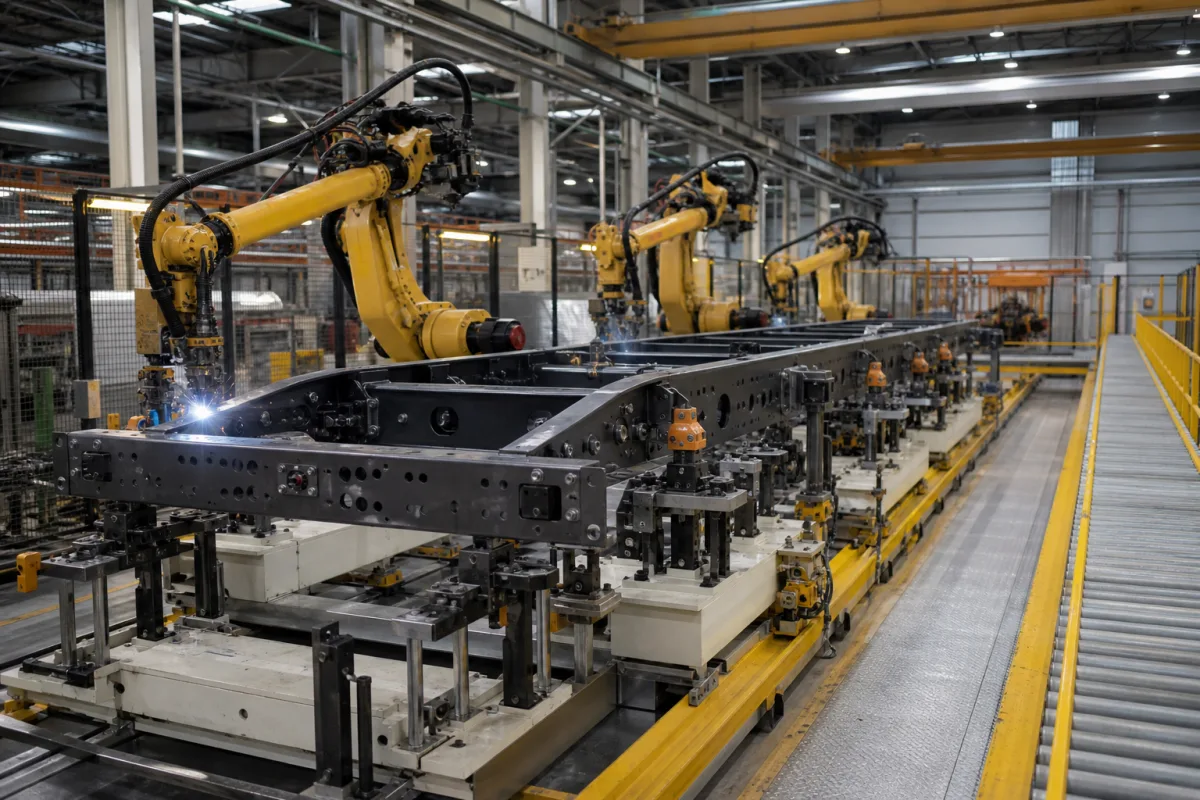
Integrated production line for automated assembly of trailer and semitrailer structures

Representative product image. Confirm appearance and specifications with the manufacturer.

Product Specifications

Technical details and manufacturing context for Automated Trailer Assembly System

Definition
The Automated Trailer Assembly System is a coordinated industrial system designed for the automated assembly of trailers and semitrailers. It integrates frame assembly, component integration, and structural joining operations into a single, high-volume production line. The system enables consistent quality control throughout the assembly sequence, reduces manual labor requirements, and improves production efficiency and structural integrity. It is suitable for manufacturers seeking to automate their assembly processes for trailers and semitrailers, particularly those producing a range of vehicle lengths and payload capacities. The system operates through automated stations that sequentially assemble components using robotic positioning, precision welding, and automated fastening, all controlled by a central PLC. Key parameters include a maximum assembly length of 6000–12000 meters, a system cycle time of 15–30 minutes, a welding speed of 0.5–1.5 cm/min, a payload capacity of 2000–5000 tons, positioning repeatability of ±0.1 mm, and system power consumption of 50–120 kW. The system requires an operating pressure of 0.6–0.8 MPa, an operating temperature of 0–45 °C, relative humidity of 20–80% (non-condensing), an ingress protection rating of IP54–IP65 (IEC 60529), a control voltage of 24 V DC ±10% (IEC 61131-2), and a main power supply of 380–480 V AC, three-phase, 50/60 Hz (IEC 60038). The system footprint, including buffer zones and conveyors, ranges from 500 to 1500 m². The frame material grade is S355J2+N (EN 10025-2). These values are reference ranges and must be verified for the specific model and application with the legal manufacturer or supplier. The system is listed in a neutral directory and is not manufactured or sold by the directory operator.
Working Principle
The system operates through a sequence of automated stations. Each station performs specific assembly tasks: robotic positioning aligns components, precision welding joins structural elements, and automated fastening secures connections. A central PLC coordinates the entire process, controlling the sequence, timing, and quality checks. The system handles high-strength steel and aluminum alloys, using welding consumables as needed. It is designed for high-volume production with consistent quality. The working principle relies on precise control of robotic movements, welding parameters, and fastening torques, all monitored by sensors and feedback loops. The system can accommodate trailers up to 12000 meters in length, with a cycle time of 15–30 minutes per complete assembly. The welding speed ranges from 0.5 to 1.5 cm/min, and the payload capacity is up to 5000 tons. The positioning repeatability is ±0.1 mm, ensuring accurate assembly. The system operates within specified environmental conditions, including temperature, humidity, and power supply requirements. These parameters are reference values and must be confirmed for the actual model.
Common Materials
High-strength steel, Aluminum alloys, Welding consumables
Technical Parameters
ParameterTypical rangeNotes & selection driver
Maximum Assembly LengthRequired6000–12000 metersMaximum trailer length the system can accommodate
System Cycle TimeRequired15–30 minutesTime required for complete assembly cycle
Welding SpeedRequired0.5–1.5 cm/minMaximum automated welding travel speed
Payload CapacityRequired2000–5000 tonsMaximum component weight handling capacity
Positioning Repeatability±0.1 mmRobotic positioning system repeatability
System Power Consumption50–120 kWTotal electrical power requirement
Operating Pressure0.6–0.8 MPaFor pneumatic clamping and positioningISO 5208
Operating Temperature0–45 °CFor control cabinets and drives
Relative Humidity20–80 %Non-condensing
Ingress Protection RatingIP54–IP65For electrical enclosuresIEC 60529
Control Voltage24 ±10% V DCFor PLC and sensorsIEC 61131-2
Main Power Supply380–480 V ACThree-phase, 50/60 HzIEC 60038
System Footprint500–1500 Including buffer zones and conveyors
Frame Material GradeS355J2+NStructural steel for trailer framesEN 10025-2

Ranges are indicative industry figures for RFQ preparation, not a supplier commitment. Confirm every value and standard with the legal manufacturer before ordering.

Components / BOM

Industry Taxonomies & Aliases

Commonly used trade names and technical identifiers for Automated Trailer Assembly System.

Industrial Ecosystem & Supply Chain Structure

Complementary Systems
Downstream Applications
Specialized Tooling

Application Fit & Sizing Matrix

Operational Limits
pressure: N/A (mechanical assembly system)
other spec: Maximum trailer length: 16m, Maximum assembly weight: 15,000 kg, Cycle time: 30-45 minutes per trailer
temperature: 5°C to 40°C (operating environment)
Media Compatibility
✓ Steel frame structures ✓ Aluminum trailer bodies ✓ Composite panel assemblies
Unsuitable: Explosive or hazardous material handling environments
Sizing Data Required
  • Maximum trailer dimensions (LxWxH)
  • Annual production volume requirement
  • Material types and thickness specifications

Reliability & Engineering Risk Analysis

Failure Mode & Root Cause
Conveyor belt misalignment and tracking failure
Cause: Improper tensioning, worn tracking sensors, or accumulation of debris on rollers causing belt drift, leading to premature wear, product jams, and potential motor overload.
Robotic end-effector calibration drift or mechanical wear
Cause: Vibration from repeated high-precision movements, thermal expansion in the assembly environment, or gradual wear in joints and grippers, resulting in misaligned fastening, part damage, or incomplete assemblies.
Maintenance Indicators
  • Unusual grinding or screeching noises from conveyor drives or robotic joints, indicating bearing failure, lack of lubrication, or mechanical obstruction.
  • Inconsistent or failed part placement detected by vision systems or sensors, signaling calibration loss, actuator wear, or sensor fouling that requires immediate correction to prevent defective assemblies.
Engineering Tips
  • Implement predictive maintenance using vibration analysis and thermal imaging on critical components like servo motors and gearboxes to detect early wear patterns before failure.
  • Establish a routine calibration and alignment protocol for robotic arms and vision systems, using laser alignment tools and automated calibration sequences to maintain precision and reduce drift-induced errors.

Indicative industry ranges for design and RFQ preparation. Confirm the exact figures and applicable standard with the manufacturer before specifying.

Compliance & Manufacturing Standards

Applicable Standards
ANSI/RIA R15.06 - Industrial Robots and Robot Systems Safety CE Marking - Machinery Directive 2006/42/EC

Quoted from the published standard.

Manufacturing Precision
  • Frame Alignment: +/- 1.5mm over 10m length
  • Welding Seam Penetration: Minimum 80% of material thickness
Quality Inspection
  • Laser Alignment Verification
  • Load Cycle Endurance Testing

Manufacturers of Automated Trailer Assembly System

Manufacturer profiles associated with Automated Trailer Assembly System.

Sourcing Automated Trailer Assembly System from China?
Tell us your specification and target quantity — we will match it against manufacturer records and come back with the factories that fit.
Request manufacturers We manufacture this

Manufacturer listings support early research and capability understanding. They are not certification, ranking, or transaction guarantees.

Technical documentation
Request current drawings, revision history, and a signed specification sheet.
Manufacturing capability
Verify equipment lists, process limits, capacity, and representative production evidence.
Inspection readiness
Confirm test methods, calibrated equipment, sampling plans, and traceable reports.
Supplier transparency
Check the legal entity, factory address, ownership, certifications, and direct contacts.

CNFX does not score or rank suppliers. Buyers must verify all claims and documents with the legal manufacturer before ordering.

Frequently Asked Questions

What is the maximum trailer length the system can handle?

The system can accommodate trailers with a maximum assembly length ranging from 6000 to 12000 meters, as listed in the reference parameters. However, the exact maximum length for a specific configuration must be verified with the legal manufacturer or supplier, as it may depend on the system layout and component specifications.

What materials can the system process?

The system is designed to handle high-strength steel and aluminum alloys, which are commonly used in trailer and semitrailer frames. Welding consumables are also used during the assembly process. The specific material grades and compatibility should be confirmed with the manufacturer for the intended application.

What are the electrical requirements for the system?

The system requires a main power supply of 380–480 V AC, three-phase, 50/60 Hz, and a control voltage of 24 V DC ±10%. The total power consumption ranges from 50 to 120 kW. These values are reference ranges and must be verified for the specific model, as they may vary based on the configuration and optional equipment.

What environmental conditions are required for operation?

The system operates within an ambient temperature range of 0–45 °C and relative humidity of 20–80% (non-condensing). The electrical enclosures have an ingress protection rating of IP54–IP65. These conditions are specified as reference values and should be confirmed with the manufacturer to ensure proper operation in the intended facility.

Data Basis

Editorial classification, named public sources where available, and source-reviewed manufacturer records.

Preliminary Technical Classification
This page supports structured research, RFQ preparation, and supplier evaluation. It does not replace buyer-led supplier qualification, standards review, or technical approval.
Buyer enquiry

Request manufacturing insight for Automated Trailer Assembly System

Ask for use case, specification boundaries, supplier type, and RFQ preparation information for this product.

Where it goes
Straight to the CNFX editorial desk, and to the manufacturer if this product is linked to a claimed profile. Nothing is broadcast to a supplier list.
Your details stay here
We do not sell or rent enquiry data, and we do not add you to a mailing list. Used only to answer this request.
No commission, no middleman
CNFX is a directory. We take no cut of any order and never negotiate on a supplier's behalf.
What we don't claim
A listing is not an endorsement. Qualify every supplier and verify every figure yourself before ordering.

Your business information is used only to process this request.

Thank you! Your message has been sent. We'll respond within 1–3 business days.
Sorry, we couldn't send your message. Please try again, or email us at contact@cnfx.com.

Need to Manufacture Automated Trailer Assembly System?

Compare manufacturer profiles with relevant product and process capability.

Get QuotesChat