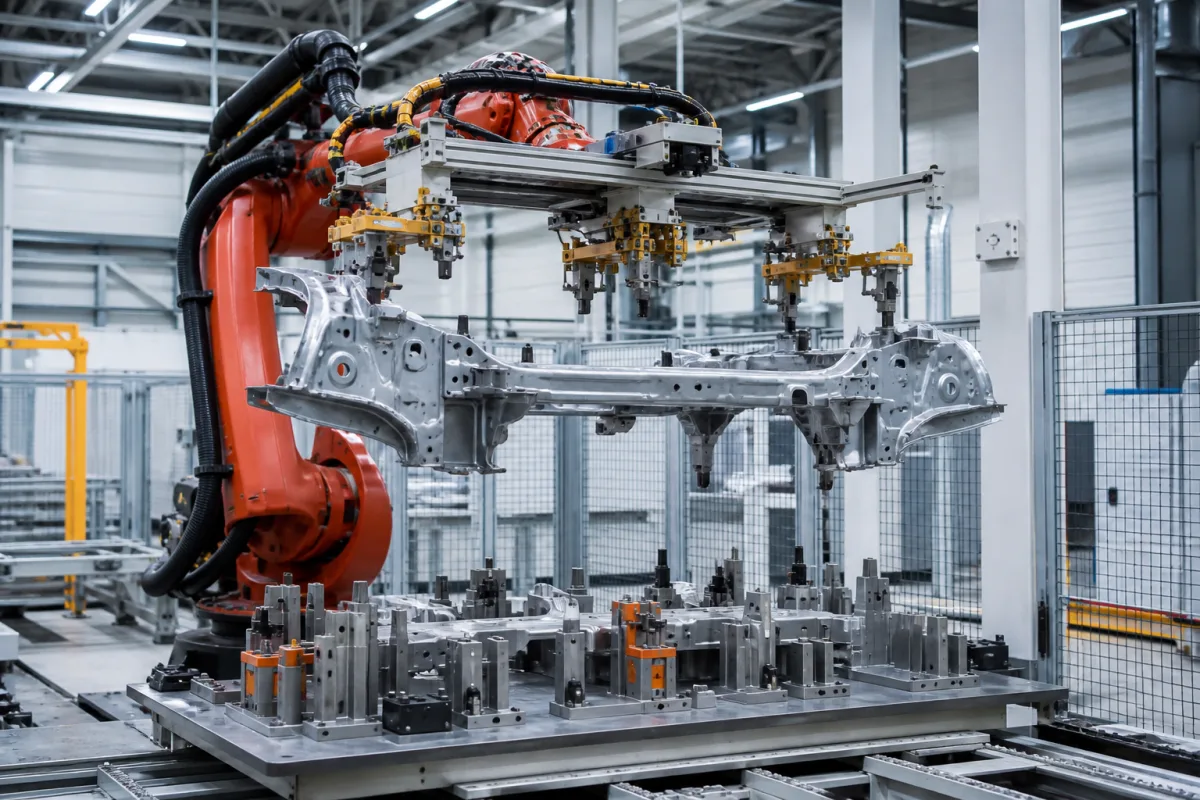
Frame positioning robot with a locating gripper: holding vehicle body sub-assemblies in position for welding instead of a fixed fixture
A handling robot that carries a body sub-assembly on a locating gripper and holds it in position for joining · a gripper frame whose geometry must survive collisions, a tool changer rated 660 lb (≈300 kg) with 0.0006 in repeatability, and vision and force feedback in place of fixed fixtures
In a positioning cell the robot is the fixture. It picks a frame member or sub-assembly with a gripper carrying locating pins and clamps, brings it to a defined position, and holds it while a second robot welds or joins it. Accuracy then depends on three links in series: the gripper's own geometry, the coupling between gripper and robot, and how the robot finds where the part actually is.
Handling robots that position vehicle frame members and body sub-assemblies for joining: the locating gripper (end-of-arm frame with reference pins, supports and clamps), the tool changer coupling it to the robot, and vision and force-sensing methods that let robots replace fixed fixtures. Robotic arc welding cells and gantries for trailer and semi-trailer frames are covered on the Trailer frame welding robot page; servo spot welding stations for aluminium bodies on the Robotic welding station for aluminium car bodies page; pallet-mounted floor-pan fixtures on the Pallet-mounted positioning fixture page.
CNFX editorial research · Sources checked October 13, 2026 · 3 sources
The gripper frame as a fixture: reference elements on a rebuildable aluminium structure instead of a welded one
Comau's patent for robot gripping equipment starts from the body shop: robots support body assemblies and sub-assemblies during welding and assembly, so the gripper needs a part connected to the robot and reference and positioning elements that put the workpiece in a precisely predetermined position, on a structure of rigidly defined geometry. [1]
It explains why welded steel gripper frames were a problem: after a collision the deformed structure cannot be returned to its original geometry, or certified as such, quickly. Its design builds the frame from extruded aluminium sections screwed together, with each reference element carried on a small lattice of round bars and interconnection blocks. Pairs of notches at equal intervals along each section act as an index, so a connection point is identified by counting seats from the end of the section, and a damaged module can be replaced and the geometry restored without rebuilding the whole gripper. [1]
Ask how the gripper's reference pins and supports are measured and certified, how a crashed module is replaced, and how the geometry is recorded so it can be restored.
02
The coupling between gripper and robot: a tool changer rated 660 lb with 0.0006 in repeatability
Where one robot changes between grippers, the tool changer sits between robot and gripper and adds its own load limits and repeatability. ATI lists its QC-210 for 200 kg-class robots with a suggested payload limit of 660 lb, a locking force of 7,000 lb at 80 psi (5.5 bar), static moment capacity of 24,000 lbf-in about X and Y and 20,000 lbf-in about Z, and positional repeatability of 0.0006 in in X, Y and Z. The master and tool plates weigh 11.6 lb and 5.85 lb, 17.4 lb coupled, and the plates must be within 0.0787 in of each other before locking at 87 psi (6 bar). [2]
QC-210 figure (ATI)
Listed value
Editorial metric conversion
Suggested payload limit
660 lb
≈299 kg
Locking force at 80 psi
7,000 lb
≈31.1 kN
Static moment, X and Y
24,000 lbf-in
≈2,710 N·m
Static moment, Z
20,000 lbf-in
≈2,260 N·m
Positional repeatability
0.0006 in
≈0.015 mm
Coupled weight
17.4 lb
≈7.9 kg
Add gripper, part and tool changer weights and their centre of gravity; check the total against the robot's payload diagram and the changer's moment ratings, not only its payload figure. [2]
03
Replacing fixed fixtures with vision and force feedback: two robots that locate and join frame components
Ford's patent on fixtureless assembly of a vehicle platform notes that rigid fixtures are used to align platform components, that in some applications more than one fixture is used for a single platform, and that they do not adapt to different platform sizes and shapes. Its system uses at least two robot arms, each with an end-effector and a force sensor, and a vision system of one or more multidimensional imaging devices that capture the assembly frames where components are to be located. [3]
The controller identifies assembly features in the images, converts them from vision to robot coordinates, calculates positional offsets from nominal with a component location model, which may be a trained model, and moves each arm to correct its component. The arms then join the components under force feedback, stopping if force exceeds a set point, and can hold the parts in position while a robotic joining system welds, bonds or fastens them. [3]
Ask which features the vision system measures, the offset correction range, the force limit during fit-up, and whether the positioning robot holds the part during welding.
04
What to send for a frame positioning robot and gripper
Paste it into your enquiry below or into an email to a maker, then replace every bracket.
Parts: [frame members or sub-assemblies; weight; size; locating holes and surfaces]
Gripper: [reference pins, supports, clamps; structure; crash recovery]
Coupling: [tool changer; payload; moment ratings; utilities through the changer]
Robot: [payload diagram at gripper centre of gravity; reach]
Guidance: [vision features; force sensing; offset range]
Joining: [weld, bond or fasten while held; second robot]
Explore company information and manufacturing capabilities, then discuss the scope of your project with a relevant supplier.
Share this page
Compiled and source-reviewed by the CNFX editorial team.
Each manufacturer above links to the page on that company's own website where the product is listed, with the date we checked it. How we source and review
· Page last updated 13 October 2026
Buyer questions
Why build robot grippers from screwed aluminium sections?
Comau's patent says welded gripper frames cannot be restored or certified quickly after a collision; indexed screwed sections let a damaged module be replaced and the geometry restored. [1]
How much can a tool changer between robot and gripper take?
ATI lists its QC-210 at 660 lb suggested payload, 24,000 lbf-in moment about X and Y and 0.0006 in repeatability. [2]
Can robots position frame parts without a fixture?
Ford's patented system uses two robot arms with force sensors and a vision system to find assembly features, correct offsets from nominal and join the components. [3]
Sources and what still needs a direct check
Sources checked 2026-10-13. Gripper structure comes from a Comau patent on the EPO server; tool changer ratings from ATI Industrial Automation's QC-210 page; fixtureless positioning from a Ford patent.