Industry-Verified Manufacturing Data (2026)

Trailer Frame Welding Robot

Based on aggregated insights from multiple verified factory profiles within the CNFX directory, the standard Trailer Frame Welding Robot used in the Manufacture of Trailers and Semitrailers sector typically supports operational capacities ranging from standard industrial configurations to heavy-duty production requirements.

Technical Definition & Core Assembly

A canonical Trailer Frame Welding Robot is characterized by the integration of Robotic Arm and Welding Power Source. In industrial production environments, manufacturers listed on CNFX commonly emphasize High-strength steel construction to support stable, high-cycle operation across diverse manufacturing scenarios.

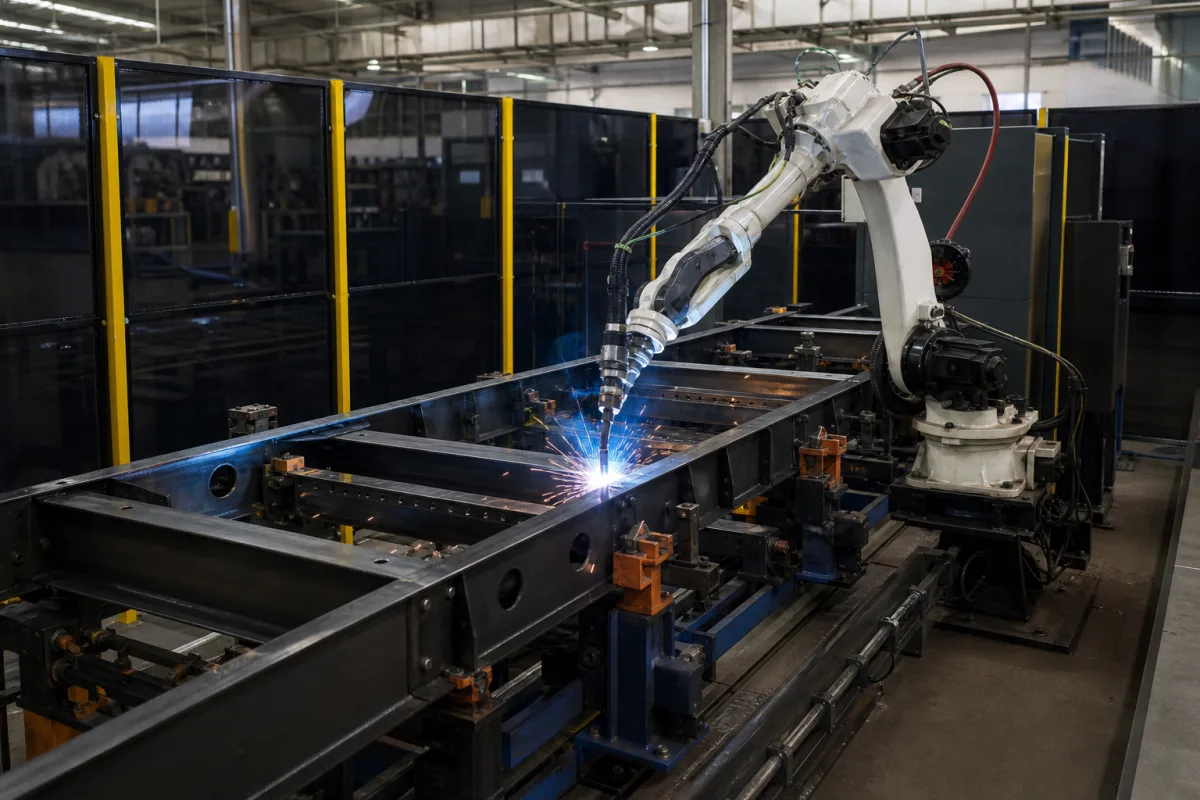
Industrial robotic system for automated welding of trailer and semitrailer structural frames
Product Specifications

Technical details and manufacturing context for Trailer Frame Welding Robot

Definition
A specialized industrial robotic welding system designed for fabricating the structural frames of trailers and semitrailers. This machine automates the welding of longitudinal beams, cross members, and reinforcement plates to create precise, consistent frame assemblies. It significantly reduces manual labor while improving weld quality and repeatability in trailer manufacturing operations. The system is engineered to handle the large dimensions and heavy components typical in trailer frame construction.
Working Principle
A multi-axis robotic arm with welding torch follows programmed paths to deposit weld material along joints between frame components, which are precisely positioned on a heavy-duty fixture table. The system uses arc welding processes with automated wire feed and shielding gas delivery.
Common Materials
High-strength steel, Aluminum alloy
Technical Parameters
  • Maximum working radius of robotic arm (meters) Per Request
  • Maximum weight the robot can manipulate while welding (kilograms) Per Request
Components / BOM
  • Robotic Arm
    Multi-axis manipulator that positions welding torch
    Material: Cast aluminum and steel
  • Welding Power Source
    Provides controlled electrical current for arc welding
    Material: Steel enclosure with copper windings
  • Positioning Fixture
    Holds trailer frame components in precise alignment during welding
    Material: Heavy-duty steel
  • Wire Feed System
    Automatically supplies welding wire to the torch
    Material: Aluminum housing with steel drive rollers
  • Control Cabinet
    Houses PLC and electronics for system operation
    Material: Powder-coated steel
Engineering Reasoning
0.8-1.2 MPa welding pressure, 150-250 A welding current, 18-22 V arc voltage
Welding pressure exceeds 1.5 MPa causing joint deformation, welding current exceeds 300 A causing electrode burn-through, arc voltage drops below 15 V causing incomplete fusion
Design Rationale: Exceeding yield strength of ASTM A36 steel (250 MPa) at weld joints, exceeding electrode melting point (3370°C for tungsten), insufficient heat input (Q=η*I*V*t) below 0.9 kJ/mm causing lack of fusion
Risk Mitigation (FMEA)
Trigger Servo motor encoder feedback loss due to EMI exceeding 85 dBμV/m at 100 MHz
Mode: Robot arm positional drift exceeding ±0.5 mm tolerance
Strategy: Shielded encoder cables with 360° grounding at both ends, ferrite chokes at 10 cm intervals
Trigger Welding wire feed roller wear reducing contact area below 70% of nominal
Mode: Wire feed inconsistency causing arc instability and porosity defects
Strategy: Hardened steel rollers with 60 HRC surface hardness, automatic wear compensation via laser displacement sensors

Industry Taxonomies & Aliases

Commonly used trade names and technical identifiers for Trailer Frame Welding Robot.

Industrial Ecosystem & Supply Chain DNA

Complementary Systems
Downstream Applications
Specialized Tooling

Application Fit & Sizing Matrix

Operational Limits
pressure: N/A (welding process, not fluid handling)
other spec: Max workpiece dimensions: 15m length × 3m width × 2m height, Welding speed: 0.3-1.5 m/min, Power supply: 380-480V AC, 3-phase, 50/60Hz
temperature: 5°C to 40°C (operating environment)
Media Compatibility
✓ Carbon steel frames ✓ High-strength low-alloy (HSLA) steel ✓ Aluminum alloy structures
Unsuitable: Explosive or highly flammable atmospheres (requires ATEX-rated equipment)
Sizing Data Required
  • Maximum frame dimensions (L×W×H)
  • Annual production volume (units/year)
  • Required welding processes (MIG, TIG, laser, etc.)

Reliability & Engineering Risk Analysis

Failure Mode & Root Cause
Weld Porosity
Cause: Contaminated welding wire or base metal, improper shielding gas flow, or moisture ingress leading to gas entrapment and weak welds.
Robot Arm Misalignment
Cause: Wear in harmonic drives or gearboxes, thermal expansion of components, or calibration drift from vibration over time.
Maintenance Indicators
  • Audible grinding or clicking noises from robot joints during movement
  • Visible weld spatter accumulation on torch nozzle or inconsistent bead appearance
Engineering Tips
  • Implement regular laser tracking calibration to compensate for positional drift and maintain weld path accuracy
  • Establish preventive replacement schedules for consumables (contact tips, nozzles, liners) based on arc hours rather than visual inspection alone

Compliance & Manufacturing Standards

Reference Standards
ISO 3834-2: Quality requirements for fusion welding of metallic materials ANSI/AWS D1.1/D1.1M: Structural Welding Code - Steel EN 15085-2: Railway applications - Welding of railway vehicles and components
Manufacturing Precision
  • Weld seam alignment: +/- 1.5mm
  • Frame squareness: 2mm per meter diagonal measurement
Quality Inspection
  • Ultrasonic Testing (UT) for weld integrity
  • Visual Inspection per AWS D1.1 acceptance criteria

Factories Producing Trailer Frame Welding Robot

Verified manufacturers with capability to produce this product in China

✓ 95% Supplier Capability Match Found

T Technical Director from Brazil Jan 22, 2026
★★★★★
"Testing the Trailer Frame Welding Robot now; the Welding Speed (mm/min) results are within 1% of the laboratory datasheet."
Technical Specifications Verified
P Project Engineer from Canada Jan 19, 2026
★★★★☆
"Impressive build quality. Especially the Welding Speed (mm/min) is very stable during long-term operation. (Delivery took slightly longer than expected, but technical support was excellent.)"
Technical Specifications Verified
S Sourcing Manager from United States Jan 16, 2026
★★★★★
"As a professional in the Manufacture of Trailers and Semitrailers sector, I confirm this Trailer Frame Welding Robot meets all ISO standards."
Technical Specifications Verified
Verification Protocol

“Feedback is collected from verified sourcing managers during RFQ (Request for Quote) and factory evaluation processes on CNFX. These reports represent historical performance data and technical audit summaries from our B2B manufacturing network.”

16 sourcing managers are analyzing this specification now. Last inquiry for Trailer Frame Welding Robot from Mexico (36m ago).

Frequently Asked Questions

What materials can this trailer frame welding robot handle?

This robotic system is designed for welding high-strength steel and aluminum alloy materials commonly used in trailer and semitrailer structural frames.

What is the maximum frame length this welding robot can accommodate?

The system supports trailer frames up to [specify meters] in length, with customizable positioning fixtures for various frame sizes.

What components are included in the BOM for this welding robot system?

The complete system includes a control cabinet, positioning fixture, robotic arm, welding power source, and wire feed system for automated trailer frame welding.

Can I contact factories directly on CNFX?

CNFX is an open directory, not a transaction platform. Each factory profile provides direct contact information and production details to help you initiate direct inquiries with Chinese suppliers.

Get Quote for Trailer Frame Welding Robot

Request technical pricing, lead times, or customized specifications for Trailer Frame Welding Robot directly from verified manufacturing units.

Your business information is encrypted and only shared with verified Trailer Frame Welding Robot suppliers.

Thank you! Your message has been sent. We'll respond within 1–3 business days.

Need to Manufacture Trailer Frame Welding Robot?

Connect with verified factories specializing in this product category

Add Your Factory Contact Us
Previous Product
Automated Trailer Assembly System
Last Product