Industry-Verified Manufacturing Data (2026)

Particulate Filter

Based on aggregated insights from multiple verified factory profiles within the CNFX directory, the standard Particulate Filter used in the Motor Vehicle Manufacturing sector typically supports operational capacities ranging from standard industrial configurations to heavy-duty production requirements.

Technical Definition & Core Assembly

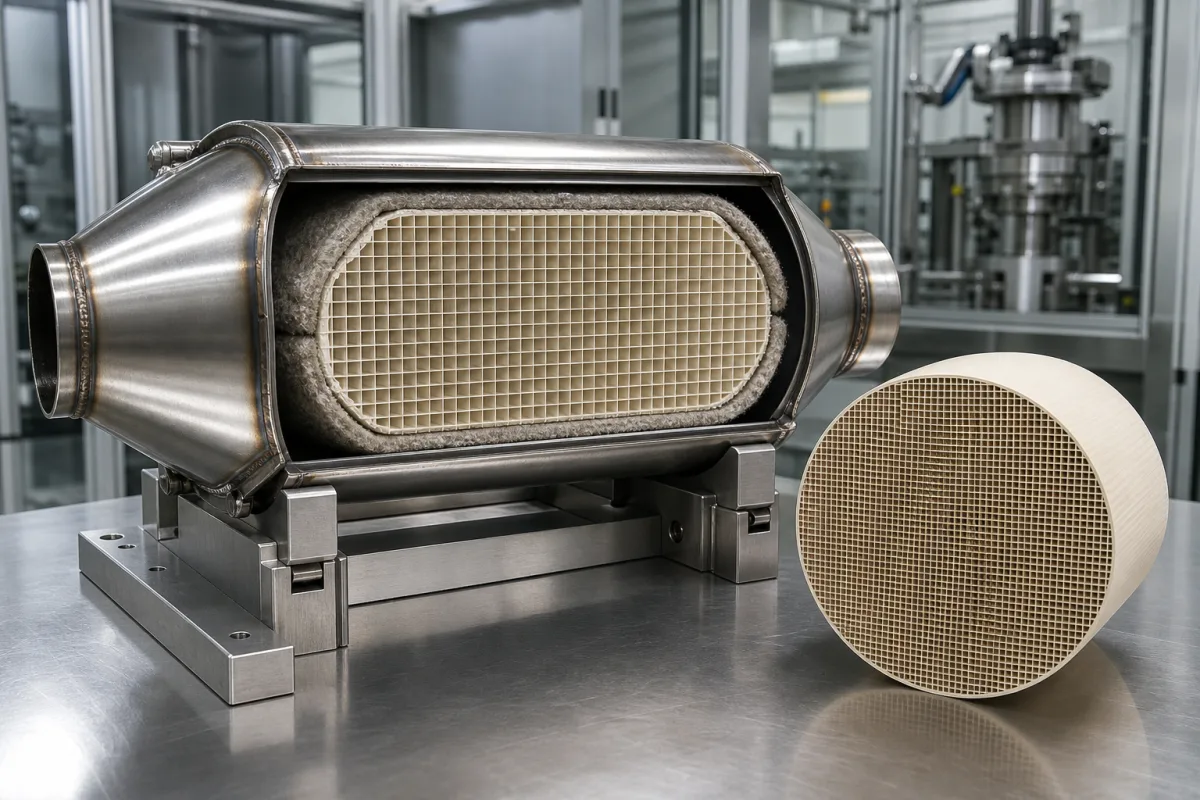
A canonical Particulate Filter is characterized by the integration of Filter Substrate and Catalytic Coating. In industrial production environments, manufacturers listed on CNFX commonly emphasize Silicon Carbide Ceramic construction to support stable, high-cycle operation across diverse manufacturing scenarios.

A filtration device that captures and removes particulate matter from exhaust gases.
Product Specifications

Technical details and manufacturing context for Particulate Filter

Definition
A particulate filter is a critical component within exhaust gas management systems, specifically designed to trap and remove solid particulate matter (PM) from engine or industrial process exhaust streams. It functions as a physical barrier that captures soot, ash, and other fine particles before the cleaned gas is released into the atmosphere, playing a vital role in reducing emissions and meeting environmental regulations.
Working Principle
Exhaust gas containing particulate matter is forced through a porous filter substrate, typically made of ceramic or sintered metal. The particles are physically trapped within the filter's porous walls or on its surface. For filters like Diesel Particulate Filters (DPFs), accumulated soot is periodically burned off through a process called regeneration to restore filtration efficiency.
Common Materials
Silicon Carbide Ceramic, Cordierite Ceramic, Sintered Metal
Technical Parameters
  • Filter diameter and length, defining the physical size and surface area for particulate capture. (mm) Customizable
Components / BOM
  • Filter Substrate
    The porous monolithic structure that physically traps particulate matter. It provides the surface area and pore structure for filtration.
    Material: Silicon Carbide or Cordierite Ceramic
  • Catalytic Coating
    A layer applied to the substrate to lower the ignition temperature of accumulated soot, facilitating regeneration. Often contains platinum or palladium.
    Material: Platinum Group Metals (PGM) on Alumina Washcoat
  • Canning / Housing
    The metal outer shell that contains and protects the fragile filter substrate, providing structural support and connection points to the exhaust system.
    Material: Stainless Steel
  • Inlet/Outlet Cones
    Tapered sections at the ends of the housing that guide exhaust gas flow into and out of the filter substrate smoothly, minimizing turbulence and pressure loss.
    Material: Stainless Steel
Engineering Reasoning
0-650°C, 0-2 bar differential pressure
Soot loading exceeding 8 g/L filter volume, thermal stress exceeding 1200°C for >30 seconds
Design Rationale: Thermal runaway from uncontrolled soot oxidation (exothermic reaction: C + O₂ → CO₂, ΔH = -393.5 kJ/mol) exceeding ceramic substrate melting point (1700°C for cordierite)
Risk Mitigation (FMEA)
Trigger Ash accumulation exceeding 40 g/L from lubricant additives (CaSO₄, Zn₃(PO₄)₂)
Mode: Backpressure increase to 250 mbar causing engine derating
Strategy: Ash-specific filter design with segmented channels and ultrasonic cleaning ports
Trigger Thermal shock from 200°C to 800°C in <60 seconds during regeneration
Mode: Radial cracking in silicon carbide substrate (CTE mismatch: 4.0×10⁻⁶/K vs 2.6×10⁻⁶/K)
Strategy: Graded porosity structure with 45-65% porosity gradient and controlled regeneration at 15°C/s ramp rate

Industry Taxonomies & Aliases

Commonly used trade names and technical identifiers for Particulate Filter.

Applied To / Applications

This component is essential for the following industrial systems and equipment:

Industrial Ecosystem & Supply Chain DNA

Complementary Systems
Downstream Applications
Specialized Tooling

Application Fit & Sizing Matrix

Operational Limits
pressure: 0 to 10 bar (g)
flow rate: Up to 5000 m³/h
temperature: -40°C to 400°C
slurry concentration: 0.1 to 30% solids by weight
Media Compatibility
✓ Stainless Steel 316L ✓ PTFE Membrane ✓ Ceramic Monolith
Unsuitable: High-chloride environments (>1000 ppm)
Sizing Data Required
  • Required filtration efficiency (particle size cutoff)
  • Maximum allowable pressure drop
  • Total exhaust gas flow rate

Reliability & Engineering Risk Analysis

Failure Mode & Root Cause
Filter Media Clogging
Cause: Accumulation of particulate matter beyond design capacity, often due to inadequate pre-filtration, excessive contaminant loading, or extended service intervals without monitoring differential pressure.
Structural Integrity Failure
Cause: Mechanical fatigue from cyclic pressure differentials, vibration-induced stress, or corrosion of housing/seals from chemical exposure or moisture ingress, leading to cracks or seal breaches.
Maintenance Indicators
  • Sustained high differential pressure across the filter (exceeding manufacturer's specified limit) indicating severe clogging or flow restriction.
  • Visible particulate bypass in downstream fluid or audible leaks/hissing from the filter housing, suggesting media rupture or seal failure.
Engineering Tips
  • Implement condition-based monitoring using real-time differential pressure sensors with automated alerts to schedule cleaning/replacement before critical clogging occurs.
  • Ensure proper system design with adequate pre-filtration (e.g., strainers) and maintain stable operating conditions (flow rates, temperatures) to reduce stress on filter media and housing.

Compliance & Manufacturing Standards

Reference Standards
ISO 16889:2008 - Hydraulic fluid power - Filters - Multi-pass method for evaluating filtration performance ANSI/ASHRAE 52.2-2017 - Method of Testing General Ventilation Air-Cleaning Devices for Removal Efficiency by Particle Size DIN 71460-1:2010 - Air filters for passenger compartments - Part 1: Test for particulate filtration
Manufacturing Precision
  • Frame dimensions: +/- 0.5 mm
  • Filter media pleat spacing: +/- 0.2 mm
Quality Inspection
  • Pressure drop test at rated flow
  • Particle counting efficiency test at specified particle sizes

Factories Producing Particulate Filter

Verified manufacturers with capability to produce this product in China

✓ 93% Supplier Capability Match Found

P Procurement Specialist from Germany Jan 27, 2026
★★★★★
"As a professional in the Motor Vehicle Manufacturing sector, I confirm this Particulate Filter meets all ISO standards."
Technical Specifications Verified
T Technical Director from Brazil Jan 24, 2026
★★★★★
"Standard OEM quality for Motor Vehicle Manufacturing applications. The Particulate Filter arrived with full certification."
Technical Specifications Verified
P Project Engineer from Canada Jan 21, 2026
★★★★★
"Great transparency on the Particulate Filter components. Essential for our Motor Vehicle Manufacturing supply chain."
Technical Specifications Verified
Verification Protocol

“Feedback is collected from verified sourcing managers during RFQ (Request for Quote) and factory evaluation processes on CNFX. These reports represent historical performance data and technical audit summaries from our B2B manufacturing network.”

12 sourcing managers are analyzing this specification now. Last inquiry for Particulate Filter from UAE (37m ago).

Supply Chain Compatible Machinery & Devices

Automotive Battery Management System

Electronic control system for monitoring and managing vehicle battery packs.

Explore Specs →
Automotive Wireless Power Transfer System

Wireless charging system for electric vehicles using electromagnetic induction.

Explore Specs →
Automotive Solid-State Battery Pack

High-energy-density solid-state battery system for electric vehicles

Explore Specs →
Automotive Active Grille Shutter System

Aerodynamic system with motorized shutters for vehicle thermal and efficiency management.

Explore Specs →

Frequently Asked Questions

What are the main differences between silicon carbide and cordierite ceramic filters?

Silicon carbide filters offer higher thermal conductivity and better thermal shock resistance, making them suitable for high-temperature applications. Cordierite filters are lighter and more cost-effective, with good filtration efficiency for standard operating conditions.

How does the catalytic coating enhance particulate filter performance?

The catalytic coating promotes oxidation of captured particulate matter at lower temperatures, enabling passive regeneration. This reduces soot accumulation, prevents filter clogging, and extends service intervals while maintaining optimal exhaust flow.

What maintenance is required for sintered metal particulate filters?

Sintered metal filters require periodic inspection for ash accumulation and potential thermal damage. They typically feature cleanable/reusable designs with regeneration cycles, but may need professional cleaning every 100,000-150,000 miles depending on operating conditions.

Can I contact factories directly on CNFX?

CNFX is an open directory, not a transaction platform. Each factory profile provides direct contact information and production details to help you initiate direct inquiries with Chinese suppliers.

Get Quote for Particulate Filter

Request technical pricing, lead times, or customized specifications for Particulate Filter directly from verified manufacturing units.

Your business information is encrypted and only shared with verified Particulate Filter suppliers.

Thank you! Your message has been sent. We'll respond within 1–3 business days.

Need to Manufacture Particulate Filter?

Connect with verified factories specializing in this product category

Add Your Factory Contact Us
Previous Product
Part Presentation Rack
Next Product
Pitman Arm (for recirculating-ball type) or Rack (for rack-and-pinion integration)