Machine safeguarding · safety distance from stopping time and resolution (OSHA and ISO 13855 formulas), Type 4 rating, pass-through hazards
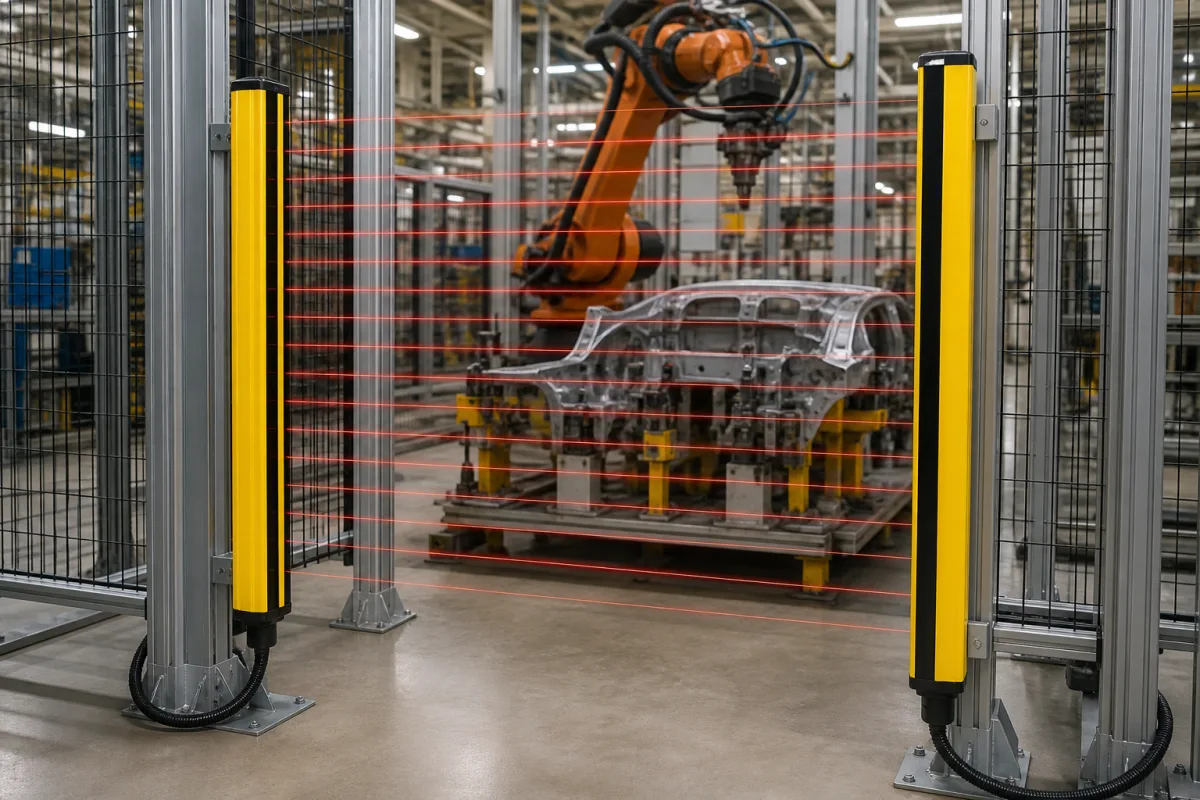
A safety light curtain is an emitter and receiver pair that projects a field of infrared beams across an opening; when a hand or body interrupts it, its safety outputs signal the machine to stop before the person can reach the hazard. Ask three things first: what resolution (smallest detected object) and protective height you need, what the machine's full stopping time is, and whether people can pass through the field and stand undetected inside the guarded area.
Type 4 (and Type 2) safety light curtains and light grids for point-of-operation, area and perimeter guarding on presses, robot cells and automated machinery, with their mounting and interface options. General-purpose photoelectric sensors, measuring light curtains and safety laser scanners are outside this page.
CNFX editorial research · Sources checked October 11, 2026 · 4 sources
Calculate the safety distance from stopping time and resolution
OSHA's mechanical power press rule (29 CFR 1910.217) requires the distance from a presence-sensing device's field to the point of operation to exceed Ds = 63 in/s × Ts, where Ts is the press stopping time. For presence-sensing device initiation (PSDI), it uses Ds = Hs × (Ts + Tp + Tr + 2Tm) + Dp, with hand speed Hs = 63 in/s (1.6 m/s), device and control response times, a brake-monitor allowance and a penetration depth factor, limits light curtain object sensitivity to 31.75 mm and forbids blanking. [1]
Banner's EZ-SCREEN LS manual gives the ISO 13855 form for European use: S = (K × T) + C, with K = 2000 mm/s for distances under 500 mm and 1600 mm/s above, T the total stopping time including the curtain's response, and C = 8 × (d − 14) mm for resolution d up to 40 mm (0, 72 and 208 mm for 14, 23 and 40 mm curtains). Its example, a 23 mm curtain with 0.3316 s total time, gives S = 1600 × 0.3316 + 72 = 603 mm. It advises adding at least 20% to a maker's stated stop time, taking the slower of two control channels, and mounting more than 100 mm from the hazard regardless of the calculation. [2]
Editorial calculation: a robot that stops in 0.200 s behind a curtain with 0.015 s response has T = 0.215 s. With a 14 mm curtain, S = 2000 × 0.215 + 0 = 430 mm. With a 40 mm curtain, 2000 × 0.215 + 208 = 638 mm exceeds 500 mm, so K = 1600 applies: 1600 × 0.215 + 208 = 552 mm. Stop and response times are assumed examples; use measured stopping times.
Give the supplier the machine and hazard, measured stopping time, opening width and height, required resolution (finger, hand, body), guarding type (point of operation, area, perimeter), muting or blanking needs, safety controller or relay interface, cable and connector, environment and IP rating.
02
Check the safety rating and pass-through hazards
Banner rates the EZ-SCREEN LS as Type 4 per IEC 61496-1/-2, Category 4 PL e per EN ISO 13849-1 and SIL 3 per IEC 61508, with resolutions of 14, 23 or 40 mm, response time depending on the number of beams, operation from −20 to +55 °C, and IP65/IP67 enclosures for 280–1820 mm lengths. [2]
The manual warns that a pass-through hazard arises where people can cross the curtain and stand inside the guarded area undetected, which can occur with as little as 75 mm between the field and the machine frame or fixed guarding. It recommends continuous sensing of people inside the area or a latched stop requiring a deliberate manual reset from a switch separate from the normal cycle start. [2] OSHA also requires guards on all areas of entry to the point of operation not protected by the presence-sensing device, and the device may not be used on machines with full-revolution clutches. [1]
03
General, wide-range, thin and cascade curtain series, and curtains sold with PLCs and HMIs
Listings include multiple series of safety light curtains (general purpose, wide range, thin and cascade versions) from a safety-sensor maker, and safety light curtains alongside photoelectric and proximity sensors, PLCs and HMIs from an automation supplier. Ask each for the Type, PL/SIL certificate, resolution, response time and test reports.
04
Measure the stopping time and add every response-time term
OSHA's Machine Guarding eTool for presses points out that the basic OSHA formula leaves out factors that must still be taken into account: total system response time, the minimum object sensitivity (MOS) of the presence-sensing device and the hand or object speed. For the ANSI B11.1 press standard it gives Ds = K × (Ts + Tc + Tr + Tbm) + Dpf, where K is the 63 inches/second hand speed constant, Ts the stop time measured at the final control element, Tc the control system response time, Tr the response time of the presence-sensing device and its interface, Tbm the extra time allowed for the brake monitor, and Dpf the added distance due to the penetration depth factor based on MOS. [3] It adds that if channel blanking is used, additional safety distance must be enforced based on the number of channels blanked. [3]
The eTool states that a portable or built-in stop-time measuring (STM) unit must be used to check the machine's stopping time, that the time measured during the hazardous portion of the cycle feeds the OSHA or ANSI formula, and that the same device can be used periodically to confirm the safety distance still matches the machine's current stopping ability. For the OSHA formula, Ts is measured at approximately 90° of crankshaft rotation; its safety distance chart pairs a Ts of .190 seconds with 12 in and a Ts of .571 seconds with 36 in. [3]
Editorial note: ask the light curtain supplier for Tr including any interface module, and the machine builder or controls integrator for Tc and Tbm, so that every term in the ANSI formula has a stated value before the mounting position is fixed. [3]
05
Read response time by length and synchronisation mode from the data sheet
KEYENCE's specification table for its GL-R series 14 mm (GL-RF) safety light curtains shows that the OSSD response time is not one number. With wire or optical channel-0 synchronisation the ON→OFF response is 6.9 ms for the 23-beam GL-R23F (240 mm total length) rising to 10.4 ms for the 55-beam GL-R55F (560 mm); with optical channel A or B it is 9.3 to 14.9 ms. Beam axis spacing is 10 mm, detecting distance 0.2 to 10 m, and the light source an 870 nm infrared LED. [4]
The same table lists Type 4 ESPE per IEC 61496-1, SIL 3 per IEC 61508, SIL CL3 per IEC 62061 and Category 4, PL e per EN ISO 13849-1:2015; two transistor OSSD outputs at up to 500 mA (350 mA at 50–55 °C); 24 VDC ±20% supply; IP65/IP67; −10 to +55 °C operation; and ambient light limits of 3,000 lux incandescent and 20,000 lux sunlight. Fitting a front protection cover on one unit shortens the operating distance by 0.5 m, and on both units by 1.0 m. [4]
Editorial calculation: in the ISO 13855 formula S = K × T + C as applied by Banner, [2] each millisecond of curtain response at K = 2,000 mm/s adds 2 mm. Moving from the 6.9 ms GL-R23F in channel 0 to the 14.9 ms GL-R55F in channel A or B adds 8.0 ms × 2 mm/ms = 16 mm of safety distance before machine stopping time is counted; with a 14 mm resolution C = 8 × (14 − 14) = 0 mm. [4]
Emitter, receiver, OSSD outputs with EDM, interface, brackets and fixed guards
The interface module or safety controller row bears on distance: its response time goes into T in S = K × T + C, as the 20 ms interface module does in Banner's worked example. [2]
Protective height, resolution, response time, range and enclosure for a curtain order
Every published value in this table comes from Banner's EZ-SCREEN LS manual except the 31.75 mm PSDI limit from OSHA; weight is the one field with no figure, since it depends on length. [2][1]
Field
What it means and published values
Ask the supplier for
Protective Height (mm)
Covered height of the field; example lengths 280–2380 mm. [2]
3 companies list this product among what they make. Company figures are quoted from each
company's own website; every card states where the relationship came from.
Explore company information and manufacturing capabilities, then discuss the scope of your project with a relevant supplier.
Share this page
Compiled and source-reviewed by the CNFX editorial team.
Each manufacturer above links to the page on that company's own website where the product is listed, with the date we checked it. How we source and review
· Page last updated 13 October 2026
Buyer questions
How far must a light curtain be from the hazard?
Far enough that the machine stops first: OSHA uses 63 in/s × stopping time for presses; ISO 13855 as applied by Banner uses S = K × T + C. [1][2]
What does resolution change?
Coarser resolution adds distance: C = 8 × (d − 14) mm, e.g. 72 mm for 23 mm and 208 mm for 40 mm curtains. [2]
What is a pass-through hazard?
Banner describes people crossing the curtain and standing undetected inside; it calls for continuous sensing or a latched stop with separate reset. [2]
How should press stopping time be measured for a light curtain safety distance?
OSHA's Machine Guarding eTool says a portable or built-in stop-time measuring unit must be used, and the same device can be used periodically to confirm the safety distance still matches the machine's stopping ability. [3]
Does a light curtain's response time depend on its length?
Yes in KEYENCE's GL-RF table: ON→OFF response rises from 6.9 ms for 23 beams to 10.4 ms for 55 beams in channel 0, and to 14.9 ms in optical channel A or B. [4]
Sources and what still needs a direct check
Sources checked 2026-10-11. OSHA 29 CFR 1910.217 is US regulation for mechanical power presses. Banner and KEYENCE are safety sensor makers; Banner's manual applies ANSI B11.19 and ISO 13855 to its own product, and KEYENCE's specification table gives response times by model. Use the standards that apply to your machine and market.