Editorial Technical Reference

Transmitter Unit

This page explains how Transmitter Unit is classified within Machinery and Equipment Manufacturing. Technical values and manufacturer relationships are research references; confirm the current specification and supplier evidence for each order.

Technical Definition & Core Assembly

The transmitter unit is the emitting component of a safety light curtain system that projects infrared light beams to create a protective detection field.
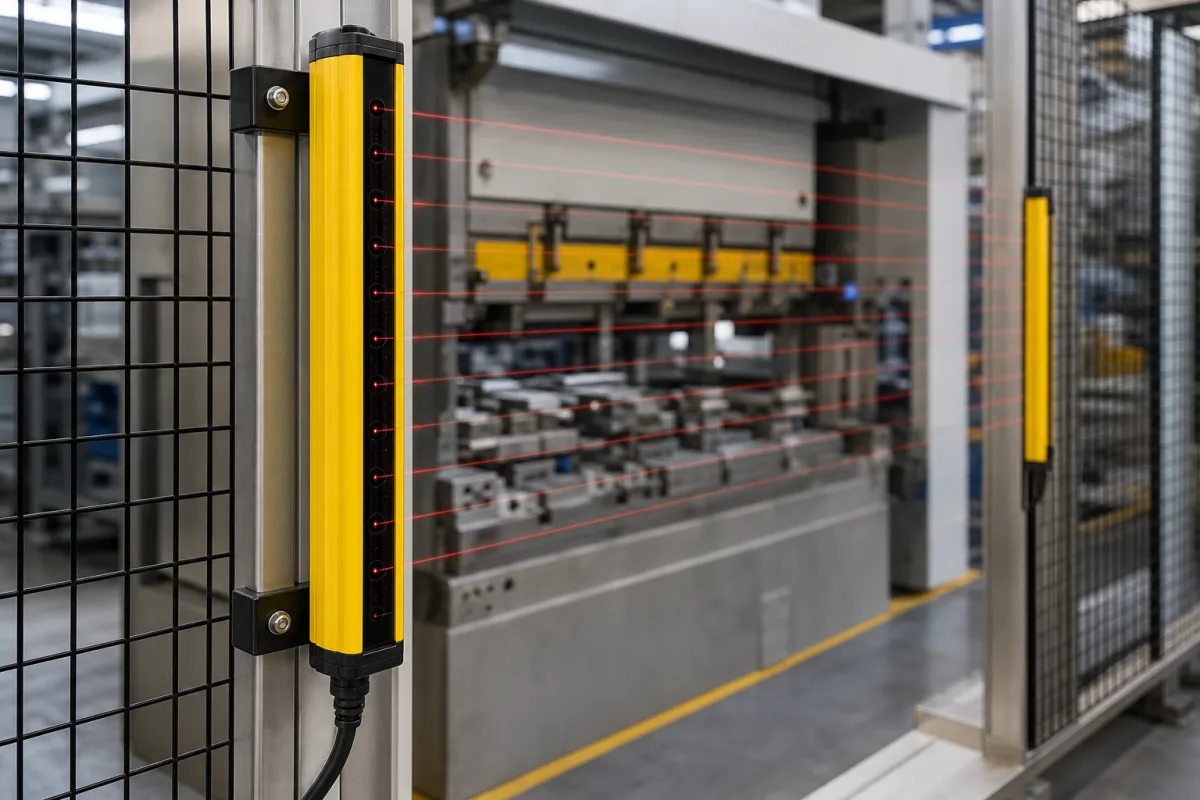
Representative product image. Confirm appearance and specifications with the manufacturer.

Product Specifications

Technical details and manufacturing context for Transmitter Unit

Definition
The transmitter unit is an active component within a safety light curtain system, designed to emit a series of parallel infrared light beams toward a corresponding receiver unit. These beams form a protective detection field across a hazardous area, such as a machine access point. When an object interrupts one or more beams, the system triggers a safety stop signal to prevent access to dangerous machinery. The transmitter unit typically contains LED arrays, optical lenses, control circuitry, and a housing engineered for industrial environments. It is part of a safety-related control system and must be selected and installed according to the specific application's risk assessment and applicable safety standards. The unit's performance characteristics, such as detection range, beam spacing, number of beams, protection height, response time, supply voltage, power consumption, operating temperature, storage temperature, enclosure rating, housing material, and weight, are provided as reference ranges in the directory. These values must be verified with the legal manufacturer or supplier for the exact model and application. The transmitter unit is not a standalone safety device; it must be used with a compatible receiver unit and safety logic to form a complete safety light curtain system. Proper alignment, mounting, and periodic testing are essential to maintain the safety function. The unit is designed for use in industrial settings and may be subject to national and international regulations. Always consult the manufacturer's documentation for installation, operation, and maintenance instructions.
Working Principle
The transmitter unit generates modulated infrared light pulses using an array of LEDs. These pulses are collimated by optical lenses to create parallel beams. The beams are transmitted across the protected area to the receiver unit. The modulation pattern allows the system to distinguish between ambient light and the safety light curtain signal, ensuring reliable operation in various lighting conditions. When an object interrupts the beams, the receiver detects the change and the system initiates a safety stop signal.
Common Materials
Aluminum alloy housing, Polycarbonate optical windows, Printed circuit board with electronic components
Technical Parameters
ParameterTypical rangeNotes & selection driver
Detection Range0.1–6 mMaximum range for reliable detectionIEC 61496
Beam Spacing10–40 mmDetermines minimum object size
Number of Beams4–128Depends on protection height
Protection Height100–1200 mmHeight of the detection field
Response Time5–30 msTime to output signal after beam interruptionIEC 61496
Supply Voltage24 ±10% V DCReverse polarity protected
Power Consumption2–10 WDepends on number of beams
Operating Temperature-10–55 °CNon-condensingIEC 61496
Storage Temperature-20–70 °CFor non-operating storage
Enclosure RatingIP54–IP65IP65 for washdown environmentsIEC 60529
Housing MaterialAluminumAnodized aluminum extrusion
Weight0.5–5 kgDepends on length

Ranges are indicative industry figures for RFQ preparation, not a supplier commitment. Confirm every value and standard with the legal manufacturer before ordering.

Components / BOM
  • LED Array
    Generates infrared light pulses for beam transmission
    Material: Semiconductor materials (GaAs, GaAlAs)
  • Optical Lens Assembly
    Collimates and directs light beams in parallel paths
    Material: Optical-grade polycarbonate or glass
  • Control Circuit Board
    Manages modulation, timing, and communication functions
    Material: FR-4 PCB with electronic components
  • Housing Part
    Protects internal components from environmental factors
    Material: Aluminum alloy with IP65/IP67 rating

Applied To / Applications

This component is essential for the following industrial systems and equipment:

Industrial Ecosystem & Supply Chain Structure

Complementary Systems
Downstream Applications
Specialized Tooling

Application Fit & Sizing Matrix

Operational Limits
pressure: Not applicable (ambient pressure only)
other spec: Protection rating: IP65/IP67, Response time: ≤20ms, Detection range: 0.2m to 20m
temperature: -10°C to +55°C
Media Compatibility
✓ Industrial machinery guarding ✓ Automated material handling systems ✓ Packaging equipment safety zones
Unsuitable: High-vibration environments with continuous displacement >0.5mm
Sizing Data Required
  • Required protective field height (mm)
  • Required protective field width (mm)
  • Required safety distance from hazard (mm)

Reliability & Engineering Risk Analysis

Failure Mode & Root Cause
Diaphragm fatigue cracking
Cause: Cyclic pressure fluctuations exceeding design limits, leading to material fatigue and eventual rupture
Electronic drift and calibration loss
Cause: Thermal cycling, moisture ingress, or component aging causing signal inaccuracies and measurement errors
Maintenance Indicators
  • Erratic or unstable output readings during normal operation
  • Visible corrosion, moisture accumulation, or physical damage on the transmitter housing
Engineering Tips
  • Install pulsation dampeners and ensure proper impulse line purging to minimize pressure cycling stress on the diaphragm
  • Implement regular calibration schedules with environmental compensation and maintain proper sealing integrity against moisture ingress

Indicative industry ranges for design and RFQ preparation. Confirm the exact figures and applicable standard with the manufacturer before specifying.

Compliance & Manufacturing Standards

Applicable Standards
CE Marking (EU Directive 2014/35/EU Low Voltage Directive) IEC 60079-0:2017 Explosive Atmospheres

Quoted from the published standard.

Manufacturing Precision
  • Housing Dimensional Tolerance: +/-0.05mm
  • Signal Output Accuracy: +/-0.1% of full scale
Quality Inspection
  • Environmental Stress Screening (ESS) Test
  • Calibration Verification against NIST-traceable standards

Manufacturers of Transmitter Unit

Manufacturer profiles associated with Transmitter Unit.

Sourcing Transmitter Unit from China?
Tell us your specification and target quantity — we will match it against manufacturer records and come back with the factories that fit.
Request manufacturers We manufacture this

Manufacturer listings support early research and capability understanding. They are not certification, ranking, or transaction guarantees.

Technical documentation
Request current drawings, revision history, and a signed specification sheet.
Manufacturing capability
Verify equipment lists, process limits, capacity, and representative production evidence.
Inspection readiness
Confirm test methods, calibrated equipment, sampling plans, and traceable reports.
Supplier transparency
Check the legal entity, factory address, ownership, certifications, and direct contacts.

CNFX does not score or rank suppliers. Buyers must verify all claims and documents with the legal manufacturer before ordering.

Supply Chain Compatible Machinery & Devices

Automated Powder Coating System

Integrated industrial system for applying dry powder coatings to metal substrates.

Explore Specs →
Centrifugal Pump Impeller

The centrifugal pump impeller is a critical rotating component that converts mechanical energy from the motor into kinetic energy in fluid systems.

Explore Specs →
High-Precision CNC Laser Cutting Machine

Computer-controlled industrial machine using focused laser beams to cut sheet metal with micron-level accuracy.

Explore Specs →
Industrial-Grade Hydraulic Cylinder Piston Rod

This industrial-grade piston rod is a precision-ground cylindrical component designed for use in hydraulic cylinders.

Explore Specs →

Frequently Asked Questions

What is the function of a transmitter unit in a safety light curtain?

The transmitter unit emits a series of parallel infrared light beams toward a receiver unit. These beams create a protective detection field. When an object interrupts one or more beams, the system triggers a safety stop signal to prevent access to hazardous machinery.

What are the typical parameters for a transmitter unit?

Typical parameters include detection range (0.1–6 m), beam spacing (10–40 mm), number of beams (4–128), protection height (100–1200 mm), response time (5–30 ms), supply voltage (24 V DC ±10%), power consumption (2–10 W), operating temperature (-10 to 55 °C), storage temperature (-20 to 70 °C), enclosure rating (IP54–IP65), housing material (aluminum), and weight (0.5–5 kg). These are reference ranges; verify with the manufacturer for the specific model.

How should I verify the suitability of a transmitter unit for my application?

You must perform a risk assessment and consult the legal manufacturer or supplier. Verify that the transmitter unit's detection range, protection height, response time, and other parameters meet your safety requirements. Also confirm compliance with applicable standards such as IEC 61496 and IEC 60529 for the specific model.

What maintenance is required for a transmitter unit?

Regularly clean the optical windows and check for damage. Ensure proper alignment with the receiver unit. Periodically test the safety function according to the manufacturer's instructions. If the unit fails to respond correctly, replace it or contact the manufacturer for service.

Data Basis

Editorial classification, named public sources where available, and source-reviewed manufacturer records.

Preliminary Technical Classification
This page supports structured research, RFQ preparation, and supplier evaluation. It does not replace buyer-led supplier qualification, standards review, or technical approval.
Buyer enquiry

Request manufacturing insight for Transmitter Unit

Ask for use case, specification boundaries, supplier type, and RFQ preparation information for this product.

Where it goes
Straight to the CNFX editorial desk, and to the manufacturer if this product is linked to a claimed profile. Nothing is broadcast to a supplier list.
Your details stay here
We do not sell or rent enquiry data, and we do not add you to a mailing list. Used only to answer this request.
No commission, no middleman
CNFX is a directory. We take no cut of any order and never negotiate on a supplier's behalf.
What we don't claim
A listing is not an endorsement. Qualify every supplier and verify every figure yourself before ordering.

Your business information is used only to process this request.

Thank you! Your message has been sent. We'll respond within 1–3 business days.
Sorry, we couldn't send your message. Please try again, or email us at contact@cnfx.com.

Need to Manufacture Transmitter Unit?

Compare manufacturer profiles with relevant product and process capability.

Previous Product
Z-axis Ram/Spindle
Last Product
Get QuotesChat