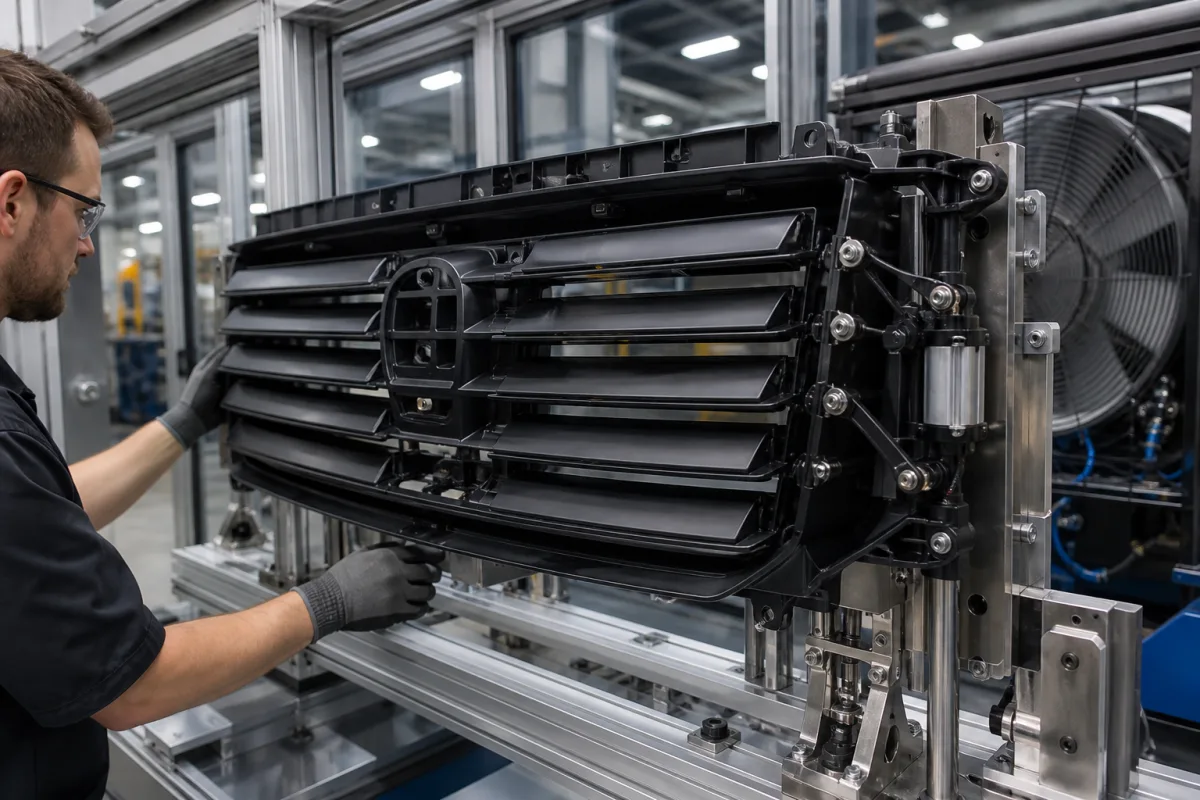
Grille shutter flap assembly: flap materials, flap-to-flap linkage and jam tolerance in the car's front end
The mechanical flap set of a car's grille shutter · drive flap in PA6 GF50 and followers in PA6 GF30, connecting rod and elastic claws, a PA6 GF35 bolster carrying four flap fields, and a bypass inlet for a second radiator
A grille shutter's actuator only turns one flap; the rest of the assembly decides whether every flap follows, whether one jammed flap stops them all, and whether the flaps and frame survive the front of the car. This page looks at that mechanical part: which flap carries the actuator torque and what it is moulded from, how the motion is passed from flap to flap, what happens when ice or dirt locks a flap, and how the flap set is built into the front-end carrier.
The mechanical shutter assembly of an automotive active grille shutter: flaps (vanes), pivot journals, connecting rods and levers, the frame or front-end carrier that holds them, and bypass openings beside the flap field. Actuators, control strategy, drag and CO₂ benefit and fail-safe opening logic are covered on the Automotive active grille shutters (AGS) page. HVAC and industrial dampers, including their blade types and leakage classes, are covered on the Airflow control dampers page.
CNFX editorial research · Sources checked October 12, 2026 · 4 sources
Drive flap in PA6 GF50, follower flaps in PA6 GF30: where the actuator torque goes
Valeo Systèmes Thermiques' European patent EP 3 649 000 B1 describes the conventional layout: a support frame carries the flaps, the actuator turns one drive flap through an angle in a range of, for example, 0 to 90°, and a connecting rod moving up and down turns the secondary flaps through the same rotation. Because the drive flap takes higher torsional loads, it is made in a stronger polyamide 6 with 50% glass fibre (PA6 GF50) and the secondary flaps in polyamide 6 with 30% glass fibre (PA6 GF30). [1]
The patent gives the reason for changing the layout: two flap grades need extra process steps and create an assembly risk if a GF30 flap is fitted between the actuator and the connecting rod. Its answer is a hollow journal into which a toothed lever from the actuator's rotary output is inserted, so the torque is spread through the journal and every flap can be the same shape and grade; one lever can pass through an actuator with outputs on both faces to drive two flaps at once. [1]
Editorial note: if a supplier quotes a flap set with two grades, ask how the assembly line prevents a follower flap being fitted in the drive position, and whether the drive flap is marked or keyed differently.
Ask for the flap and lever material grades, the rotation range from closed to open, and how actuator torque enters the flap set (drive flap, lever into the journal, or connecting rod).
02
When ice or dirt locks one flap: elastic claws that let the others keep opening
Batz S.Coop.'s patent EP 3 199 395 B1 points out the weakness of a rigidly linked flap set: if one flap jams through dirt or ice and cannot be decoupled from the transmitting part, the whole assembly is immobilised, and if that happens in the blocking position the engine may not get the cooling air it needs and can overheat. [2]
Its solution couples each flap to the transmitting part through its own elastic claw. The claw's path when moving from blocked to open coincides with its path of decoupling from the flap, and its path from open to blocked coincides with its path of re-coupling, so a jammed flap simply unclips while the others pivot open, and is picked up again on the closing stroke. [2] The patent also reviews other prior designs, including one that decouples the flaps from the transmitting part when an actuator failure is detected, and one in which the shutter section shares a component with an energy-absorbing crush section against the bumper beam. [2]
Editorial note: a claw that releases under load also sets a limit on how hard the actuator can break a flap free of ice; agree with the supplier whether the requirement is to break ice or to let the stuck flap release, and ask for the release force.
Specify the icing and dirt test the flap set must pass, the required behaviour of a jammed flap (release, or break free), and how the system confirms afterwards that every flap has re-engaged.
03
Flap fields moulded into the front-end carrier: a PA6 GF35 bolster with four shutter units
On the Ford Focus, the shutter is not a separate frame. PolyFormNEXT's report of Lanxess's development describes a bolster active grille shutter (BAGS): a front-end carrier, bolted to the side longitudinal beams, into which an actively controlled unit of four air-flap systems is integrated. It is moulded from a Durethan polyamide 6 with 35% short glass fibre, as a plastic-metal hybrid with metal inserts at the sides and in the upper chord, which also holds the bonnet lock. [3]
Lanxess chose polyamide 6 over polypropylene for its better heat resistance — needed, for example, when the cooling flaps are closed — and for stronger weld lines; direct screw connections into the plastic replaced metal inserts in places after comparative tests showed them more stable and durable than in polypropylene. [3] Ford, Röchling as system supplier and Lanxess worked together, and the carrier also has to hold the heavy cooling modules in place. [3]
The flap drive is crash-relevant because the slider that opens and closes the louvres sits on the front of the part. Ford specified that it break in a controlled way in a minor crash; behaviour at speeds up to around 10 km/h was simulated and checked in component tests. The upper chord may move only slightly at speed or on rough roads, otherwise the flaps could open, tilt or jump out of their mountings. [3]
Editorial note: in a bolster-integrated design, flap mounting stiffness, the bonnet lock and low-speed crash behaviour are one part; a separate shutter frame can be replaced alone after a parking knock, an integrated one cannot. Ask which repair the design assumes.
04
A bypass inlet beside the flaps for a hybrid-system radiator
Aisin Seiki's patent EP 2 574 484 B1 addresses vehicles with more than one heat exchanger behind the grille. In a hybrid vehicle the temperature of the electric power system, such as the inverter, can change suddenly, so the air reaching the hybrid-system radiator may fall short when the shutter is closed for drag or warm-up. [4]
The patented device keeps the shutter mechanism at the main air inlet but adds a bypass air inlet, arranged at the periphery of the shutter mechanism, that guides air around it to the specific heat exchanger whatever position the flaps are in. [4] The patent notes the trade-off: the bypass reduces part of the effect of controlling flow with the shutter, so the main inlet position is chosen with that in mind. [4]
Editorial note: on an electrified vehicle, list every heat exchanger behind the shutter (engine radiator, inverter or battery cooler, condenser) and its minimum airflow with the flaps closed before the flap field and any bypass are sized.
05
What to send for a grille shutter flap assembly
Paste it into your enquiry below or into an email to a maker, then replace every bracket.
Vehicle front end: [grille or bumper opening size; separate frame or integrated in the front-end carrier]
Flaps: [number; rotation range; material grade per flap and lever]
Drive: [how torque enters — drive flap, lever into journal, connecting rod]
Jam behaviour: [icing and dirt tests; release or break-free; re-engagement check]
Cooling: [heat exchangers behind the flaps; minimum airflow when closed; bypass]
Crash and repair: [low-speed impact behaviour; replaceable parts]
Explore company information and manufacturing capabilities, then discuss the scope of your project with a relevant supplier.
Share this page
Compiled and source-reviewed by the CNFX editorial team.
Each manufacturer above links to the page on that company's own website where the product is listed, with the date we checked it. How we source and review
· Page last updated 13 October 2026
Buyer questions
What are grille shutter flaps made of?
Valeo's patent names PA6 GF50 for the drive flap and PA6 GF30 for secondary flaps in the conventional layout; Lanxess's Ford Focus bolster that carries the flaps uses PA6 with 35% glass fibre. [1][3]
What happens if one shutter flap freezes?
In a rigidly linked set the whole assembly stops. Batz's patent couples each flap through an elastic claw so a jammed flap unclips and the others still open. [2]
Can the shutter be part of the front-end carrier?
Yes; the Ford Focus bolster integrates four air-flap units into a PA6 GF35 plastic-metal hybrid carrier, with a slider designed to break in a controlled way in crashes up to around 10 km/h. [3]
Why leave a bypass opening beside the shutter?
Aisin's patent adds a bypass so a hybrid-system radiator still receives air when the flaps are closed. [4]
Sources and what still needs a direct check
Sources checked 2026-10-12. Flap materials and the drive layout come from Valeo Systèmes Thermiques' patent (in French); jam release from Batz's patent; the bolster-integrated design from PolyFormNEXT's report of Lanxess's work on the Ford Focus part; the bypass inlet from Aisin Seiki's patent. Patents describe claimed designs, not a given production part.