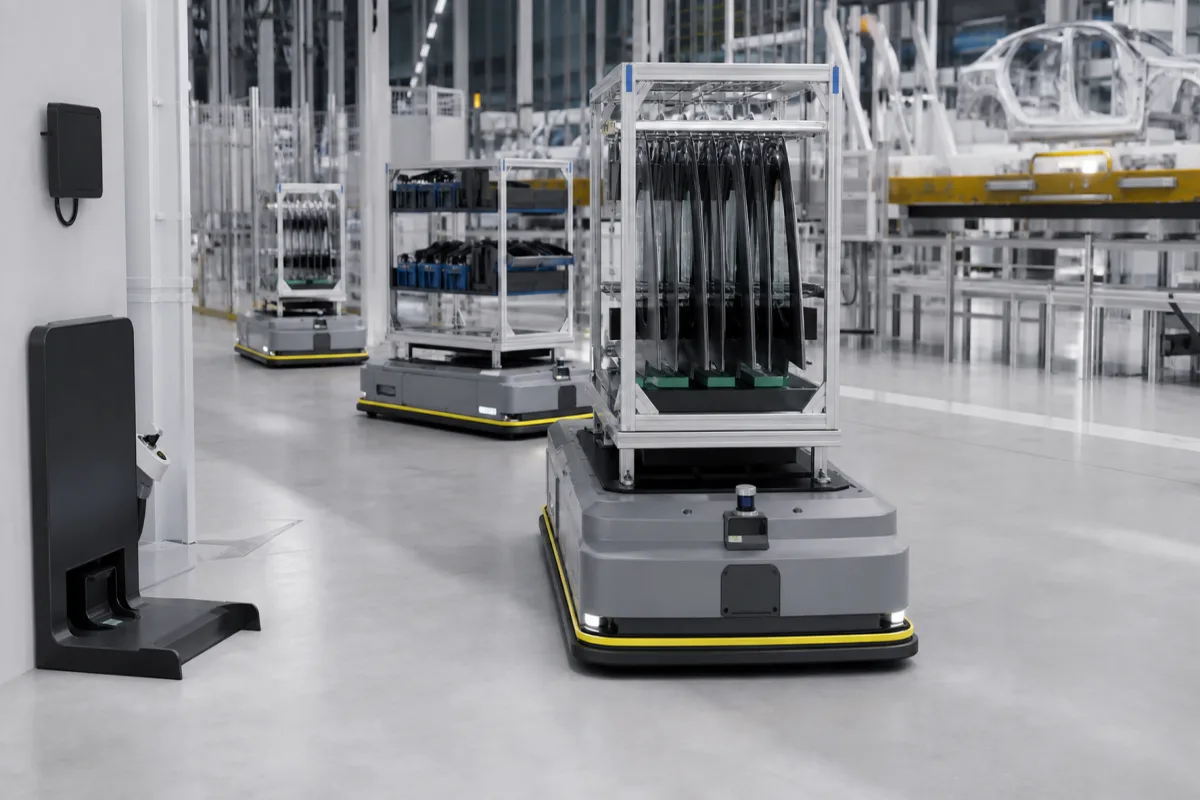
Automated guided vehicle (AGV) systems for vehicle assembly plants · Replacing fixed conveyors with synchronised AGVs, material delivery, navigation and docking accuracy, non-contact safety sensors and stop regions under ANSI/ITSDF B56.5, and how performance is tested
An automated guided vehicle system (AGVS) uses driverless vehicles under central control to move material in a plant: in vehicle assembly, AGVs can deliver parts and kits to the line or carry the vehicle itself from station to station in place of a fixed conveyor. Ask three things first: what loads, routes and takt the system must handle, how precisely the vehicles must navigate and dock, and how their safety sensors and stopping are specified and tested.
AGV and automated guided cart systems for manufacturing, especially vehicle assembly: vehicles, guidance, traffic control software, charging and safety systems, for line-side delivery or synchronised assembly carriers. Overhead and chain conveyors, manually driven industrial trucks, transfer robots (see transfer robot) and storage and retrieval cranes are outside this page except where compared.
CNFX editorial research · Sources checked October 12, 2026 · 4 sources
US patent 8,761,989 B1 (Method of material handling with automatic guided vehicles, 2014) explains that assembly lines conventionally use a chain, power-and-free or other conveyor installed permanently in the plant, which keeps workpieces evenly spaced and moving at a set speed, but, the patent says, is expensive to install, lacks flexibility for reconfiguration, can prevent access to the workpiece from all sides and stops workers crossing the path safely. AGVs move loads without an operator; the patent uses the term AGV to include smaller automatic guided carts (AGCs). Its system has AGVs travel in synchronisation along a line so normal manufacturing operations can be performed on the workpiece on the vehicle without a conventional conveyor. [1]
Editorial note: tell the supplier whether the AGVs will carry the vehicle or major assemblies through stations (synchronised with takt), or deliver parts and kits to the line, because load, speed control, positioning and charging strategy differ.
Give the supplier the plant layout and routes, loads (vehicle bodies, chassis, kits, racks) and their weights and sizes, takt time and stations, synchronised travel or point-to-point delivery, navigation method preference, docking and positioning accuracy needed at each station, fleet size, charging method and duty cycle, traffic control and integration with production control, floor condition, safety sensor and pedestrian rules, and the performance tests for acceptance.
02
Specify safety sensing and performance tests
A NIST paper on performance standards for autonomous vehicles (Bostelman, CEUR Workshop Proceedings 2015, author manuscript in PMC) states that AGV safety standards have minimal test methods for how manufacturers and users perform safety measurements, so results can differ across the industry. It notes that ANSI/ITSDF B56.5:2012 added language for an object suddenly appearing in the AGV's stop region, the area around the vehicle in which non-contact safety sensors detect obstacles and stop it: the manufacturer must show that when the AGV detects an object closer than its stopping distance it reduces its kinetic energy, but the standard does not say how to measure this. [2]
The paper describes test methods being developed under ASTM Committee F45 on driverless automatic guided industrial vehicles for navigation (commanded versus actual path), docking (stop point versus known facility points) and obstacle detection and avoidance using standard test pieces, with reconfigurable test apparatus for different AGV sizes and ground-truth measurement systems. [2]
One of those F45 methods is now published: ASTM F3244-21, Standard Test Method for Navigation: Defined Area (the active edition, replacing F3244-17). It evaluates an automatic, automated or autonomous-unmanned ground vehicle (A-UGV) traversing a defined space with limited clearance, using a set of generic 2D area shapes scaled to the vehicle. The test area can be rendered in three ways — physical boundaries, virtual boundaries or floor markings — and two kinds of impairment can be added: obstacles and communication impairments. It tests a single vehicle working from operator-supplied data and its own sensors, not a fleet controller, and does not cover picking up or dropping off a payload during navigation; any payload stays fixed as configured under Practice F3327, and environmental conditions are recorded under Practice F3218. Results must describe navigation capability in a statistically significant way. For safety it points to ANSI/ITSDF B56.5 and ISO 3691-4:2020. [3]
Editorial note: write the acceptance tests into the contract: docking repeatability at your stations, path deviation on your routes, and stopping behaviour with defined test pieces, measured by an agreed method.
03
Fill the vehicle line with published payload, speed and run-time figures
Mobile Industrial Robots (MiR) gives these quick facts for its "MiR1350" autonomous mobile robot: 1350 kg payload, 1.2 m/s max speed and a run time of 9 h 50 min. The page states that it is IP52 rated, "designed to withstand dust particles and waterdrops", and "Designed based on present safety standards - ISO3691-4 and with 13 TüV certified safety features". It lists the MiR family at 250kg, 600kg and 1350kg payload. [4]
MiR's page cites ISO 3691-4, while the NIST paper discusses ANSI/ITSDF B56.5:2012, which requires the manufacturer to show that an AGV detecting an object closer than its stopping distance reduces its kinetic energy, without saying how to measure it [2]. ASTM F3244-21 also cites ISO 3691-4:2020 [3]. For a line-side or assembly AGV, ask which of these standards the vehicle is declared to and request the stopping-distance test at the published maximum speed, loaded.
A run time quoted for one vehicle is not a shift plan. The patent on synchronised assembly AGVs describes vehicles travelling together along the line in place of a conveyor [1], so a fleet has to cover the full production time including charging. Ask for the run time at your load and route, the charging time, and how many vehicles the supplier adds to cover charging.
Editorial calculation: at 1.2 m/s a vehicle covers 72 m per minute; a 1350 kg payload at 1.2 m/s carries about 972 J of kinetic energy (½ × 1350 × 1.2²), before adding the vehicle's own mass, which the page does not state. [4]
Field on this page
MiR1350 (as published)
Ask the supplier for
Load Capacity (kg)
1350 kg payload
Rating with your load and its centre of gravity
Maximum Speed (m/s)
1.2 m/s max speed
Speed loaded, empty and in shared aisles
Run time
9 h 50 min
Run time on your route and duty cycle
Ingress Protection
IP52
Rating for your plant areas
Safety System
Based on ISO3691-4; 13 TüV certified safety features
Standard, edition, certificate and test report
Values are from MiR's MiR1350 product page; the full specification sheet was not reviewed. MiR describes the MiR1350 as an AMR (autonomous mobile robot).
Loads, routes and charging: AGV data for the supplier
Only payload, speed, IP rating and the test references have published values here; battery, charging and turning figures have to come from the supplier for your route.
Field
What it means and published values
Ask the supplier for
Load Capacity (kg)
Vehicle body, chassis or kit; e.g. 250, 600 or 1350 kg payload. [4]
Explore company information and manufacturing capabilities, then discuss the scope of your project with a relevant supplier.
Share this page
Compiled and source-reviewed by the CNFX editorial team.
Each manufacturer above links to the page on that company's own website where the product is listed, with the date we checked it. How we source and review
· Page last updated 13 October 2026
Buyer questions
Why use AGVs instead of a conveyor in vehicle assembly?
US 8,761,989 says fixed conveyors are costly to install, hard to reconfigure and block access, while synchronised AGVs carry work along the line. [1]
What does ANSI/ITSDF B56.5:2012 require when an object appears close to an AGV?
The vehicle must show a reduction in kinetic energy when it detects an object closer than its stopping distance (NIST paper). [2]
How is AGV performance tested?
NIST describes developing ASTM F45 test methods for navigation, docking and obstacle detection with standard test pieces. [2]
Which standard tests AGV navigation through a constrained area?
ASTM F3244-21 tests a single vehicle through a defined area marked by physical boundaries, virtual boundaries or floor markings, with optional obstacle and communication impairments. [3]
How heavy a load and how fast can a mobile robot for a factory move?
MiR lists its MiR1350 at 1350 kg payload, 1.2 m/s max speed and 9 h 50 min run time, rated IP52 and designed based on ISO 3691-4. Ask for the figures on your own load and route. [4]
Sources and what still needs a direct check
Sources checked 2026-10-12. The US patent (2014) describes its own AGV line system; the NIST paper (2015) is US government research on AGV performance standards. ASTM's published abstract and scope of F3244-21 describes one F45 navigation test method. The ANSI/ITSDF and ASTM standard texts themselves are not reproduced.