Industry-Verified Manufacturing Data (2026)

Vehicle Chassis

Based on aggregated insights from multiple verified factory profiles within the CNFX directory, the standard Vehicle Chassis used in the Motor Vehicle Manufacturing sector typically supports operational capacities ranging from standard industrial configurations to heavy-duty production requirements.

Technical Definition & Core Assembly

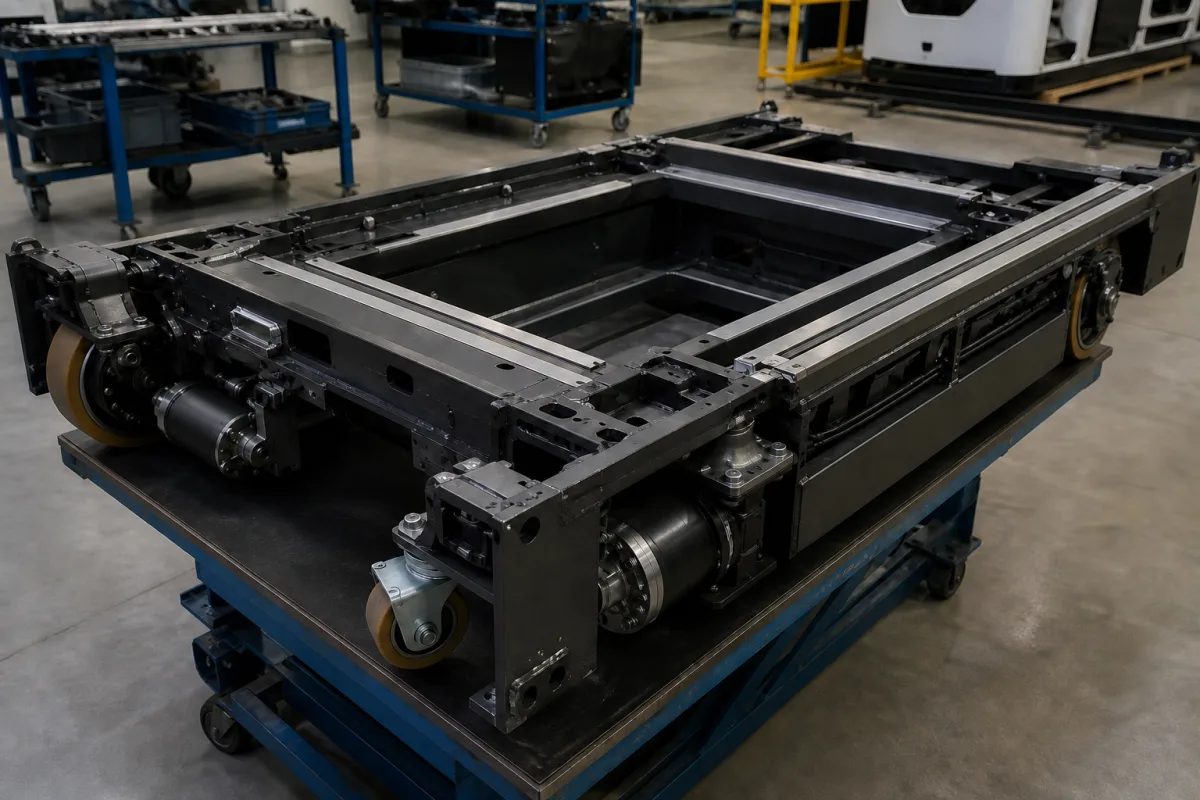
A canonical Vehicle Chassis is characterized by the integration of Main Longitudinal Beams and Cross Members. In industrial production environments, manufacturers listed on CNFX commonly emphasize High-strength steel construction to support stable, high-cycle operation across diverse manufacturing scenarios.

The structural framework that supports all other components of an Automated Guided Vehicle (AGV), providing rigidity, stability, and mounting points.
Product Specifications

Technical details and manufacturing context for Vehicle Chassis

Definition
In an Automated Guided Vehicle System, the Vehicle Chassis is the foundational structural component that forms the core frame of the AGV. It serves as the primary load-bearing element, supporting the drive system, control units, sensors, batteries, and any payload or tooling. Its design is critical for maintaining the vehicle's stability, ensuring proper weight distribution, and providing precise mounting surfaces for navigation and operational components. The chassis directly influences the AGV's maneuverability, durability, and overall performance within the material handling system.
Working Principle
The chassis functions as a rigid, engineered structure that transfers loads from all mounted components and the payload to the vehicle's wheels or tracks. It resists bending, torsion, and vibration forces encountered during movement, acceleration, deceleration, and lifting operations. Its geometry and material properties are designed to maintain dimensional integrity, ensuring that critical components like sensors and guidance systems remain in precise alignment for accurate navigation and operation.
Common Materials
High-strength steel, Aluminum alloy
Technical Parameters
  • Overall length, width, and height dimensions of the chassis frame, defining the AGV's footprint and internal space for components. (mm) Per Request
Components / BOM
  • Main Longitudinal Beams
    Primary load-bearing members running the length of the chassis, providing the main structural strength and defining the vehicle's length.
    Material: High-strength steel
  • Cross Members
    Structural beams connecting the longitudinal beams, providing lateral rigidity, preventing racking, and creating mounting platforms.
    Material: High-strength steel
  • Mounting Plates/Brackets
    Precisely located and machined surfaces or welded brackets for attaching drive units, control panels, sensor arrays, and battery packs.
    Material: Steel or aluminum
Engineering Reasoning
0-1500 MPa compressive stress, 0-300 MPa tensile stress, -40°C to 85°C temperature
Yield strength exceeded at 250 MPa tensile stress or 1500 MPa compressive stress, fatigue failure at 10^7 cycles at 100 MPa stress amplitude
Design Rationale: Plastic deformation due to von Mises yield criterion exceeding material yield strength, fatigue crack propagation from stress concentration at weld joints following Paris' law (da/dN = C(ΔK)^m)
Risk Mitigation (FMEA)
Trigger Corrosion-induced material thinning at 0.1 mm/year rate in chloride environment
Mode: Local buckling at load-bearing members under 5000 N compressive load
Strategy: Hot-dip galvanizing with 85 μm zinc coating, cathodic protection at -0.85 V vs. Cu/CuSO4
Trigger Resonant vibration at 15 Hz matching chassis natural frequency
Mode: Fatigue fracture at suspension mounting points after 2×10^6 cycles
Strategy: Finite element modal analysis with damping ratio >0.05, tuned mass dampers at critical nodes

Industry Taxonomies & Aliases

Commonly used trade names and technical identifiers for Vehicle Chassis.

Applied To / Applications

This component is essential for the following industrial systems and equipment:

Industrial Ecosystem & Supply Chain DNA

Complementary Systems
Downstream Applications
Specialized Tooling

Application Fit & Sizing Matrix

Operational Limits
pressure: N/A (structural component)
temperature: -20°C to +60°C
load capacity: Up to 5000 kg
operating humidity: 10% to 90% RH non-condensing
Media Compatibility
✓ Indoor warehouse environments ✓ Manufacturing floors with controlled conditions ✓ Clean room logistics operations
Unsuitable: Outdoor environments with direct weather exposure
Sizing Data Required
  • Maximum payload weight (kg)
  • AGV footprint dimensions (LxW in mm)
  • Required mounting point configurations

Reliability & Engineering Risk Analysis

Failure Mode & Root Cause
Corrosion fatigue cracking
Cause: Cyclic loading combined with environmental exposure (road salt, moisture) leading to stress corrosion cracking at weld joints and high-stress areas
Frame rail bending/twisting
Cause: Overloading beyond design limits, improper load distribution, or impact damage causing permanent deformation of structural members
Maintenance Indicators
  • Visible rust scaling or paint bubbling at structural joints and weld points
  • Unusual creaking, popping, or groaning sounds during vehicle articulation or load changes
Engineering Tips
  • Implement regular undercarriage cleaning and corrosion protection applications, especially after exposure to road salts or coastal environments
  • Establish and enforce strict load limit compliance with proper weight distribution, using load cells or scales for verification

Compliance & Manufacturing Standards

Reference Standards
ISO 26262:2018 - Road vehicles - Functional safety ANSI/SAE J429 - Mechanical and Material Requirements for Externally Threaded Fasteners DIN 70020 - Road vehicles; chassis; terms and definitions
Manufacturing Precision
  • Frame rail alignment: +/- 1.5mm over 1000mm length
  • Mounting hole positions: +/- 0.5mm from nominal position
Quality Inspection
  • Magnetic Particle Inspection for weld integrity
  • Coordinate Measuring Machine (CMM) verification of critical dimensions

Factories Producing Vehicle Chassis

Verified manufacturers with capability to produce this product in China

✓ 97% Supplier Capability Match Found

S Sourcing Manager from Canada Feb 21, 2026
★★★★★
"Testing the Vehicle Chassis now; the technical reliability results are within 1% of the laboratory datasheet."
Technical Specifications Verified
P Procurement Specialist from United States Feb 18, 2026
★★★★☆
"Impressive build quality. Especially the technical reliability is very stable during long-term operation. (Delivery took slightly longer than expected, but technical support was excellent.)"
Technical Specifications Verified
T Technical Director from United Arab Emirates Feb 15, 2026
★★★★★
"As a professional in the Motor Vehicle Manufacturing sector, I confirm this Vehicle Chassis meets all ISO standards."
Technical Specifications Verified
Verification Protocol

“Feedback is collected from verified sourcing managers during RFQ (Request for Quote) and factory evaluation processes on CNFX. These reports represent historical performance data and technical audit summaries from our B2B manufacturing network.”

17 sourcing managers are analyzing this specification now. Last inquiry for Vehicle Chassis from Mexico (27m ago).

Supply Chain Compatible Machinery & Devices

Automotive Solid-State Battery Pack

High-energy-density solid-state battery system for electric vehicles

Explore Specs →
Automotive Active Grille Shutter System

Aerodynamic system with motorized shutters for vehicle thermal and efficiency management.

Explore Specs →
Automotive Active Suspension Damping System

Electronically controlled suspension system for vehicle stability and comfort.

Explore Specs →
Ground Assembly Unit

A foundational structural component that provides stable mounting and alignment for equipment within an industrial system.

Explore Specs →

Frequently Asked Questions

What materials are best for an AGV chassis in motor vehicle manufacturing?

High-strength steel offers maximum durability and load capacity, while aluminum alloy provides a lighter weight alternative for improved energy efficiency in AGV operations.

How does the chassis design affect AGV stability and performance?

The chassis provides the structural framework that determines rigidity, weight distribution, and mounting precision, directly impacting AGV stability, payload capacity, and component integration.

What are the key components included in a typical AGV chassis BOM?

Standard BOM includes main longitudinal beams for primary structure, cross members for lateral reinforcement, and mounting plates/brackets for secure component attachment in motor vehicle manufacturing applications.

Can I contact factories directly on CNFX?

CNFX is an open directory, not a transaction platform. Each factory profile provides direct contact information and production details to help you initiate direct inquiries with Chinese suppliers.

Get Quote for Vehicle Chassis

Request technical pricing, lead times, or customized specifications for Vehicle Chassis directly from verified manufacturing units.

Your business information is encrypted and only shared with verified Vehicle Chassis suppliers.

Thank you! Your message has been sent. We'll respond within 1–3 business days.

Need to Manufacture Vehicle Chassis?

Connect with verified factories specializing in this product category

Add Your Factory Contact Us
Previous Product
Vehicle Assembly Unit
Next Product
Warning Indicator Lights