Industry-Verified Manufacturing Data (2026)

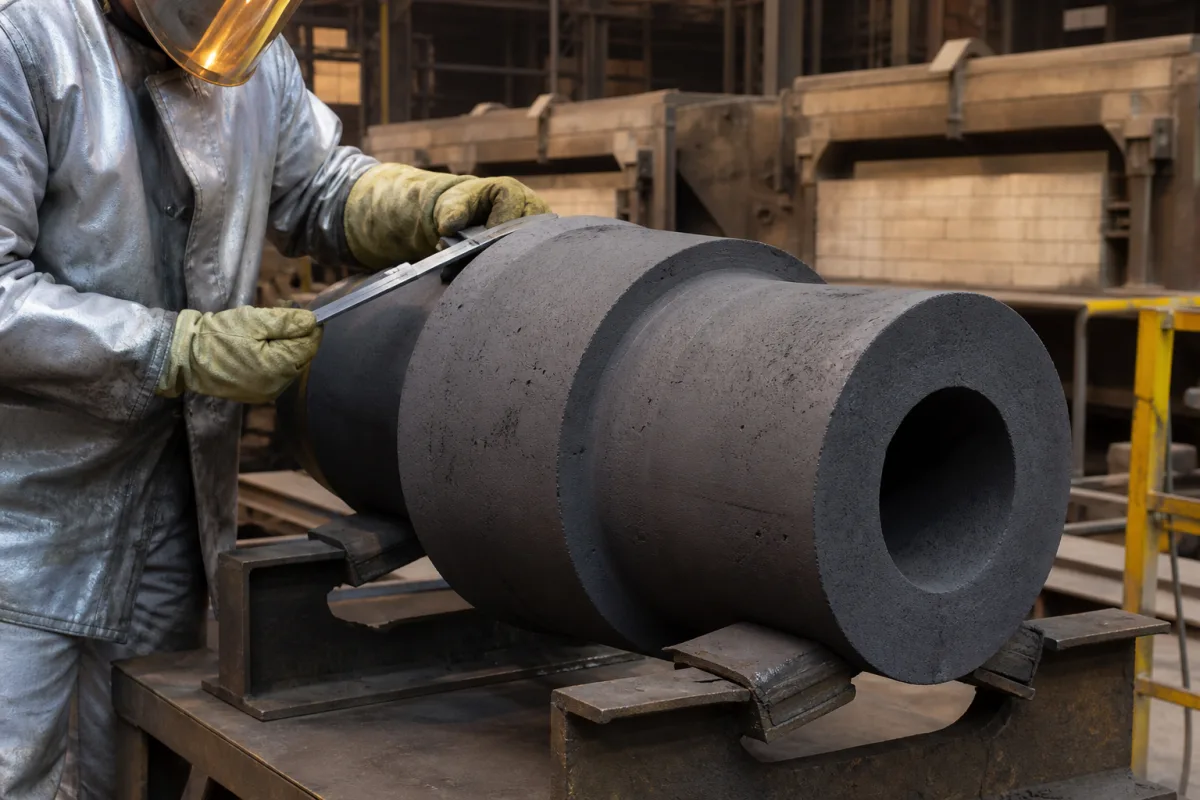
Refractory Nozzle Body

Based on aggregated insights from multiple verified factory profiles within the CNFX directory, the standard Refractory Nozzle Body used in the Basic Metal Manufacturing sector typically supports operational capacities ranging from standard industrial configurations to heavy-duty production requirements.

Technical Definition & Core Assembly

A canonical Refractory Nozzle Body is characterized by the integration of Flow Channel Lining and Thermal Insulation Layer. In industrial production environments, manufacturers listed on CNFX commonly emphasize Alumina-Silica Refractory construction to support stable, high-cycle operation across diverse manufacturing scenarios.

The main structural component of a heavy-duty molten aluminum pouring nozzle that withstands extreme temperatures and thermal shock.
Product Specifications

Technical details and manufacturing context for Refractory Nozzle Body

Definition
The refractory nozzle body is the core structural element of a heavy-duty molten aluminum pouring nozzle, designed to contain and direct the flow of molten aluminum at temperatures exceeding 700°C. It serves as the primary interface between the molten metal and the pouring system, maintaining structural integrity while resisting erosion, corrosion, and thermal stress during continuous casting or transfer operations.
Working Principle
The refractory nozzle body functions by providing a thermally stable, erosion-resistant channel for molten aluminum flow. Its refractory composition maintains dimensional stability at high temperatures, while its geometry controls flow rate and minimizes turbulence. The body absorbs and dissipates thermal energy without cracking or degrading, ensuring consistent pouring performance throughout the casting cycle.
Common Materials
Alumina-Silica Refractory, Zirconia-Enhanced Refractory, Silicon Carbide Refractory
Technical Parameters
  • Inner diameter of the flow channel, typically ranging from 20mm to 100mm depending on pouring capacity requirements (mm) Customizable
Components / BOM
  • Flow Channel Lining
    Direct contact surface for molten aluminum, providing erosion resistance
    Material: High-alumina refractory
  • Thermal Insulation Layer
    Reduces heat transfer to outer structures and minimizes thermal stress
    Material: Ceramic fiber composite
  • Mounting Flange
    Secures the nozzle body to the pouring system assembly
    Material: Stainless steel or refractory-coated steel
Engineering Reasoning
700-900°C continuous, 1200°C peak for 15 minutes
Thermal stress exceeds 150 MPa at 950°C with 300°C/min thermal gradient
Design Rationale: Thermal fatigue from cyclic heating/cooling causes microcrack propagation at grain boundaries where alumina-zirconia phase transformation occurs at 1173°C
Risk Mitigation (FMEA)
Trigger Aluminum infiltration into refractory pores at 750°C with 0.5 mm/s penetration rate
Mode: Structural spalling from 2.3% volume expansion of infiltrated material upon cooling
Strategy: Apply 50 μm silicon carbide coating with 3% porosity reduction via hot isostatic pressing
Trigger Thermal shock from 800°C to 200°C in 8 seconds during emergency stop
Mode: Radial cracking initiating at 0.8 mm from inner bore due to 85 MPa tensile stress
Strategy: Implement graded zirconia-alumina composition with 15% porosity gradient from inner to outer surface

Industry Taxonomies & Aliases

Commonly used trade names and technical identifiers for Refractory Nozzle Body.

Industrial Ecosystem & Supply Chain DNA

Complementary Systems
Downstream Applications
Specialized Tooling

Application Fit & Sizing Matrix

Operational Limits
pressure: Up to 2 bar (20 psi) static, 0.5 bar (7 psi) dynamic flow
flow rate: 0.5–15 L/min (aluminum), depending on nozzle bore
temperature: Up to 1800°C continuous, 2000°C peak
slurry concentration: Not applicable (designed for pure/molten metals)
thermal shock resistance: ΔT > 1000°C/min
Media Compatibility
✓ Molten aluminum alloys ✓ Molten magnesium alloys ✓ Molten zinc alloys
Unsuitable: Oxidizing atmospheres or molten ferrous metals (iron/steel) due to chemical attack and higher temperatures
Sizing Data Required
  • Required molten metal flow rate (L/min or kg/min)
  • Nozzle bore diameter (mm) or desired pour stream size
  • Connection interface dimensions (flange size, thread type, or custom fitting)

Reliability & Engineering Risk Analysis

Failure Mode & Root Cause
Thermal spalling
Cause: Rapid temperature fluctuations causing differential expansion and contraction, leading to cracking and material loss.
Chemical corrosion
Cause: Exposure to aggressive molten materials or gases that degrade refractory composition, reducing structural integrity.
Maintenance Indicators
  • Visible cracks or material loss on nozzle surface
  • Abnormal flow patterns or irregular discharge from nozzle
Engineering Tips
  • Implement controlled heating and cooling cycles to minimize thermal shock
  • Use refractory materials specifically engineered for the operating temperature and chemical environment

Compliance & Manufacturing Standards

Reference Standards
ASTM C862 - Standard Practice for Preparing Refractory Concrete Specimens by Casting ISO 1927-1:2012 - Monolithic (unshaped) refractory products - Part 1: Introduction and classification DIN EN 1402-1:2003 - Unshaped refractory products - Part 1: Introduction and classification
Manufacturing Precision
  • Bore diameter: +/-0.05 mm
  • Surface flatness: 0.15 mm across mating surfaces
Quality Inspection
  • Dimensional verification with coordinate measuring machine (CMM)
  • Non-destructive testing (NDT) - Ultrasonic testing for internal defects

Factories Producing Refractory Nozzle Body

Verified manufacturers with capability to produce this product in China

✓ 92% Supplier Capability Match Found

S Sourcing Manager from United States Feb 05, 2026
★★★★★
"Reliable performance in harsh Basic Metal Manufacturing environments. No issues with the Refractory Nozzle Body so far."
Technical Specifications Verified
P Procurement Specialist from United Arab Emirates Feb 02, 2026
★★★★☆
"Testing the Refractory Nozzle Body now; the technical reliability results are within 1% of the laboratory datasheet. (Delivery took slightly longer than expected, but technical support was excellent.)"
Technical Specifications Verified
T Technical Director from Australia Jan 30, 2026
★★★★★
"Impressive build quality. Especially the technical reliability is very stable during long-term operation."
Technical Specifications Verified
Verification Protocol

“Feedback is collected from verified sourcing managers during RFQ (Request for Quote) and factory evaluation processes on CNFX. These reports represent historical performance data and technical audit summaries from our B2B manufacturing network.”

17 sourcing managers are analyzing this specification now. Last inquiry for Refractory Nozzle Body from India (50m ago).

Supply Chain Compatible Machinery & Devices

Continuous Casting Machine

Industrial machine for solidifying molten metal into continuous billets/blooms/slabs.

Explore Specs →
Electromagnetic Induction Heater

Industrial heating device using electromagnetic induction for metal processing

Explore Specs →
Vacuum Induction Melting Furnace

Industrial furnace for melting metals under vacuum using electromagnetic induction

Explore Specs →
Electroslag Remelting Furnace

Secondary refining furnace for high-quality metal ingots

Explore Specs →

Frequently Asked Questions

What materials are used in refractory nozzle bodies for basic metal manufacturing?

Our refractory nozzle bodies are manufactured using premium materials including Alumina-Silica Refractory for general applications, Zirconia-Enhanced Refractory for superior thermal shock resistance, and Silicon Carbide Refractory for maximum durability in extreme conditions.

How does the refractory nozzle body withstand thermal shock during aluminum pouring?

The nozzle body features a multi-layer construction with a Thermal Insulation Layer that minimizes thermal gradients, combined with specialized refractory materials that expand and contract uniformly to prevent cracking under rapid temperature changes up to 1600°C.

What are the main components of the refractory nozzle body assembly?

The complete assembly includes the main Nozzle Body structure, Flow Channel Lining for smooth metal flow, Mounting Flange for secure installation, and Thermal Insulation Layer for temperature management - all designed for heavy-duty molten aluminum pouring operations.

Can I contact factories directly on CNFX?

CNFX is an open directory, not a transaction platform. Each factory profile provides direct contact information and production details to help you initiate direct inquiries with Chinese suppliers.

Get Quote for Refractory Nozzle Body

Request technical pricing, lead times, or customized specifications for Refractory Nozzle Body directly from verified manufacturing units.

Your business information is encrypted and only shared with verified Refractory Nozzle Body suppliers.

Thank you! Your message has been sent. We'll respond within 1–3 business days.

Need to Manufacture Refractory Nozzle Body?

Connect with verified factories specializing in this product category

Add Your Factory Contact Us
Previous Product
Refractory Lined Ladle
Next Product
Refractory Sleeve or Tip