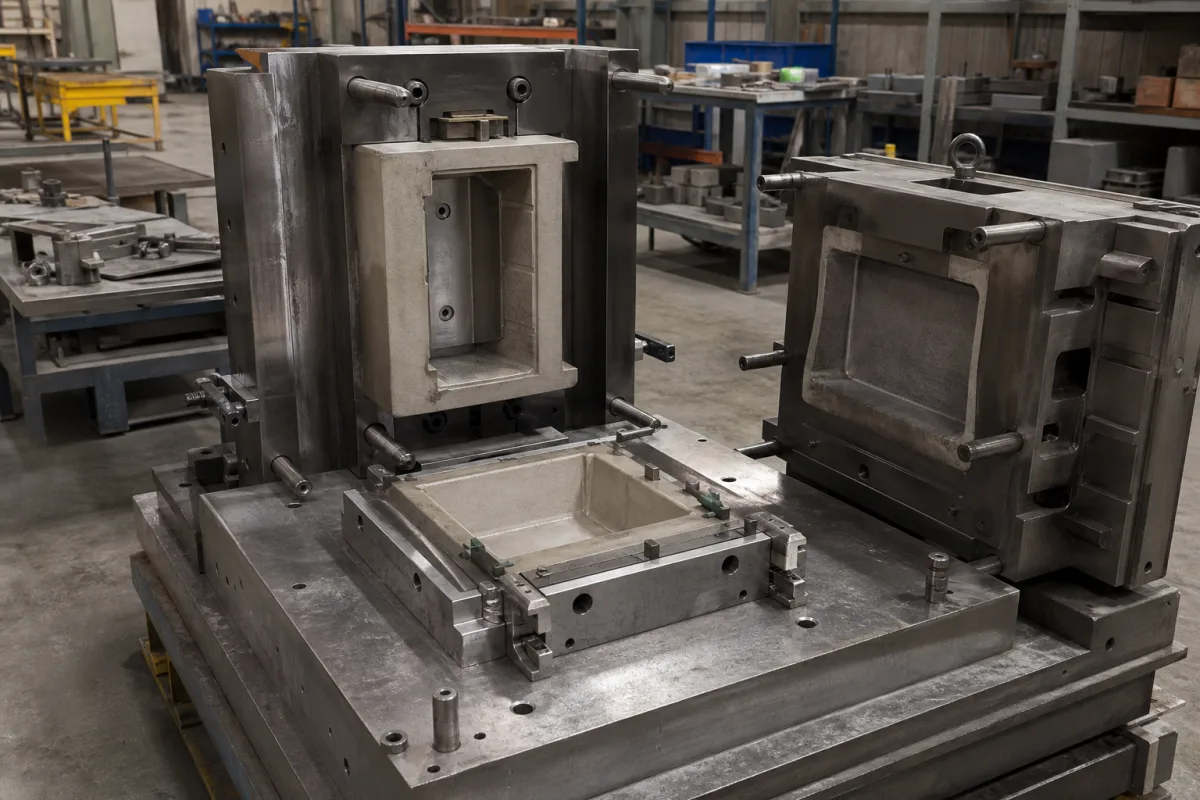
Mold assembly for plastic injection moulds: mould class, plate steels, guide pins and ejector set
Assembled plastic injection moulds · SPI mould class and cycle life, mould base and cavity plate steels, guide elements and ejector set
A mold assembly, in the sense used on this page, is a complete plastic injection mould as delivered by the mouldmaker: the mould base of clamp, cavity, backing and ejector set plates, the cavity and core inserts, guide pins and bushings that align the two halves, and the ejector system that pushes parts out. Buyers should check three things first: which mould class the expected number of cycles calls for, which steels are used for the cavity plates and for the structural plates, and how the mould is guided, ejected and tried before shipment.
Assembled plastic injection moulds and their mould bases, plates, guide elements, inserts and ejector sets. Moulds for hydraulic ceramic tile and slab presses (die boxes, punches, isostatic and floating-module systems) are covered on the Ceramic tile press page; injection moulding machines are covered on the Injection molding machine page. Die-casting moulds, continuous casting copper moulds and moulded parts are outside this page. Ejector pins, stepped pins and blades ordered as standard parts for the ejector set are on the Mould ejector pin page.
CNFX editorial research · Sources checked October 12, 2026 · 3 sources
Set the mould class from the cycles the mould must run
Plastikon's 2014 summary of the SPI mould classes rates Class 101 moulds for one million cycles or more, for extremely high production; Class 102 for less than a million, medium to high production; Class 103 for less than 500,000, medium production; Class 104 for less than 100,000 lifetime, low production; and Class 105 for 500 or less lifetime, prototype only. All of these are for machines of 400 ton or less. [1]
For machines of 400 ton or more the same summary uses the 400 series: Class 401 for 500,000 cycles or more, Class 402 not exceeding 500,000, Class 403 less than 100,000 and Class 404 for 500 or less lifetime. Plastikon describes Class 101 and 401 as the highest priced moulds made with only the highest quality materials, and Class 105 and 404 as built in the least expensive manner possible. [1]
Editorial calculation: a 4-cavity mould making 100,000 parts a year for 5 years runs 100,000 × 5 ÷ 4 = 125,000 cycles, which is above the Class 104 limit of 100,000 and within Class 103 (less than 500,000) for a press of 400 ton or less. Part volume, cavity count and years are assumed examples. [1]
Give the mouldmaker the part drawing and resin, annual volume and programme life, cavity count, the moulding machine (tonnage, platen size, tie-bar spacing, ejector pattern), the SPI class or cycle guarantee, steel preferences for cavity and structural plates, hot or cold runner, cooling and ejection requirements, and the trial and sample approval plan.
02
Choose steels for the cavity plates and the structural plates
Meusburger, a standard parts maker, explains that cold-work steels are suitable for temperatures up to approx. 200 °C and are preferably used in injection moulding, while hot-work steels suit approx. 400 °C, for example for zinc or aluminium die casting. It describes unalloyed tool steel 1.1730 as used mainly for unhardened components and for plates and frames for mould bases, and the alloyed, hardened and tempered 1.2312 as having a strength of 950–1100 N/mm² with the best machinability from its sulphur additive. [2]
Meusburger reports what its customers buy: about 40% of F 50 cavity plates in 1.2312 and about 25% in 1.1730, against about 85% of clamp plates and about 85% of ejector set plates in 1.1730. For corrosive plastics such as PVC or POM it points to 1.2085 with 16% chromium, and for through-hardened 1.2767 cavity plates it states that the tempering temperature after hardening must exceed the operating temperature by 50 °C to avoid warping. [2]
Uddeholm's Impax Supreme, an AISI P20 modified mould steel, is delivered hardened and tempered to 290–330 HB, so no hardening is needed before machining. Uddeholm lists 1020 N/mm² ultimate tensile strength at 20 °C on a 325 HB sample, flame or induction hardening to approx. 50 HRC, and gas nitriding at 525 °C for 20 hours to 650 HV1 at 0.30 mm case depth. [3]
Editorial calculation: with Uddeholm's density of 7,800 kg/m³, one 400 × 400 × 60 mm steel plate weighs 0.4 × 0.4 × 0.06 × 7,800 ≈ 75 kg; add the plates, inserts and components to estimate the assembled mould weight for handling and crane capacity. Plate size is an assumed example. [3]
03
Compare SPI mould classes
Plastikon's summary of the SPI classes for machines of 400 ton or less.
Class
Cycles and use stated
Ask about
101
One million or more; extremely high production. [1]
Cavity steel hardness; cycle guarantee.
102
Less than a million; medium to high production. [1]
Explore company information and manufacturing capabilities, then discuss the scope of your project with a relevant supplier.
Share this page
Compiled and source-reviewed by the CNFX editorial team.
Each manufacturer above links to the page on that company's own website where the product is listed, with the date we checked it. How we source and review
· Page last updated 13 October 2026
Buyer questions
What do SPI mould classes mean?
Plastikon's summary rates Class 101 for one million cycles or more, 102 for less than a million, 103 for less than 500,000, 104 for less than 100,000 and 105 for 500 or less, for machines of 400 ton or less. [1]
Which steel is used for mould base plates?
Meusburger reports about 85% of clamp plates and ejector set plates bought in unalloyed tool steel 1.1730, and lists 1.2312 at 950–1100 N/mm² for cavity plates. [2]
What hardness does prehardened P20-type mould steel have?
Uddeholm delivers Impax Supreme hardened and tempered to 290–330 HB. [3]
Sources and what still needs a direct check
Sources checked 2026-10-12. Plastikon is an injection moulder summarising the SPI mould classes; Meusburger is a mould standard parts maker; Uddeholm is a tool steel maker publishing its own datasheet.