Industry-Verified Manufacturing Data (2026)

Ejection System

Based on aggregated insights from multiple verified factory profiles within the CNFX directory, the standard Ejection System used in the Rubber and Plastic Product Manufacturing sector typically supports operational capacities ranging from standard industrial configurations to heavy-duty production requirements.

Technical Definition & Core Assembly

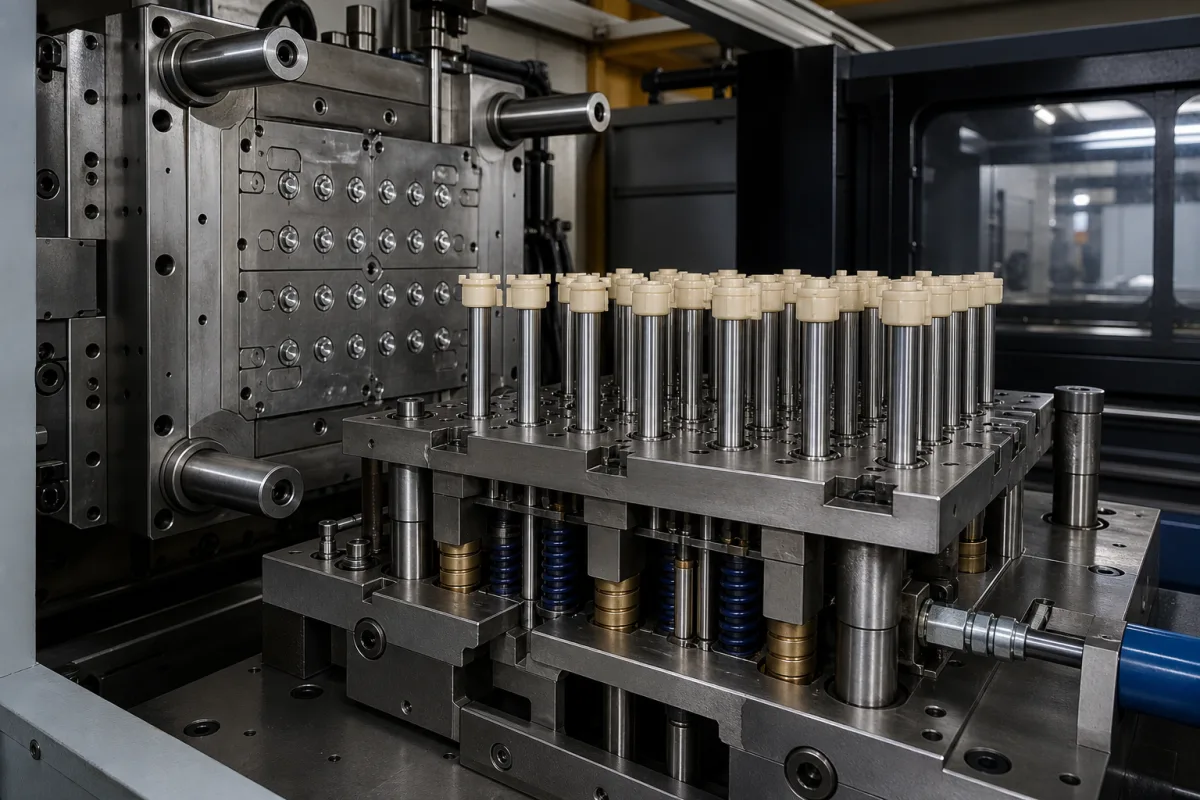
A canonical Ejection System is characterized by the integration of Ejector Pin and Ejector Plate. In industrial production environments, manufacturers listed on CNFX commonly emphasize Tool steel construction to support stable, high-cycle operation across diverse manufacturing scenarios.

A mechanism within injection molds that pushes finished plastic parts out of the mold cavity after cooling and solidification.
Product Specifications

Technical details and manufacturing context for Ejection System

Definition
The ejection system is a critical component of injection mold assemblies responsible for safely and efficiently removing molded plastic products from the mold. It operates after the cooling cycle when the plastic has solidified, using mechanical force to separate the part from the mold surfaces without causing damage to the product or the mold itself.
Working Principle
The system typically consists of ejector pins, plates, and return pins that are activated by the molding machine's hydraulic or mechanical ejection mechanism. When the mold opens, the ejection system advances forward, pushing the ejector pins against the molded part to dislodge it from the core or cavity. After ejection, the system retracts to its original position for the next molding cycle.
Common Materials
Tool steel, Hardened steel, Stainless steel
Technical Parameters
  • Ejector pin diameter and length specifications (mm) Customizable
Components / BOM
  • Ejector Pin
    Directly contacts and pushes the molded part out of the mold
    Material: Hardened tool steel
  • Ejector Plate
    Holds and aligns ejector pins, transfers ejection force from the machine
    Material: Steel
  • Return Pin
    Ensures ejector system retracts properly after ejection
    Material: Steel
  • Ejector Housing
    Encloses and supports the ejection mechanism components
    Material: Steel
Engineering Reasoning
5-25 MPa hydraulic pressure, 0.1-2.0 mm/s ejection velocity, 20-120°C operating temperature
Hydraulic pressure exceeding 30 MPa causes seal rupture, velocity below 0.05 mm/s results in part sticking, temperature above 150°C degrades lubricants
Design Rationale: Seal failure due to elastomer compression set exceeding 15% at 30 MPa, part adhesion from insufficient ejection force below 50 N/cm², lubricant viscosity breakdown at Arrhenius activation energy of 80 kJ/mol
Risk Mitigation (FMEA)
Trigger Hydraulic fluid contamination with 15 μm particles exceeding ISO 4406 18/16/13
Mode: Spool valve stiction causing 0.5 second delay in ejection timing
Strategy: Install 10 μm absolute filtration with differential pressure monitoring at 0.3 bar threshold
Trigger Misalignment of ejector pins exceeding 0.02 mm perpendicular tolerance
Mode: Asymmetric loading causing pin bending stress of 450 MPa exceeding yield strength
Strategy: Implement guided ejector plates with linear bearings maintaining 0.005 mm parallelism

Industry Taxonomies & Aliases

Commonly used trade names and technical identifiers for Ejection System.

Applied To / Applications

This component is essential for the following industrial systems and equipment:

Industrial Ecosystem & Supply Chain DNA

Complementary Systems
Downstream Applications
Specialized Tooling

Application Fit & Sizing Matrix

Operational Limits
pressure: Up to 200 bar (ejection force capacity)
other spec: Cycle time: 2-60 seconds, Stroke length: 5-300 mm, Actuation: Hydraulic/Pneumatic/Electric
temperature: Ambient to 150°C (mold operating temperature range)
Media Compatibility
✓ Thermoplastics (PP, ABS, PE) ✓ Thermosets (epoxy, phenolic) ✓ Elastomers (TPE, silicone)
Unsuitable: Abrasive-filled composites (e.g., glass fiber >40%)
Sizing Data Required
  • Part geometry and draft angle
  • Projected area and ejection force required
  • Mold plate thickness and available space

Reliability & Engineering Risk Analysis

Failure Mode & Root Cause
Hydraulic seal degradation
Cause: Contamination of hydraulic fluid with particulates leading to abrasive wear, or chemical incompatibility causing seal swelling/cracking
Pneumatic valve sticking/failure
Cause: Moisture accumulation in compressed air lines causing corrosion, or buildup of contaminants/oil residues on valve components
Maintenance Indicators
  • Inconsistent ejection timing or force (audible as irregular 'whoosh' or 'thud' sounds)
  • Visible hydraulic fluid leaks around cylinders or fittings, or excessive air exhaust mist
Engineering Tips
  • Implement strict fluid/air filtration maintenance: Use 10-micron filters for hydraulics and coalescing filters with automatic drains for pneumatics, with scheduled replacements
  • Establish predictive maintenance with vibration analysis on actuators and pressure transducers to monitor for early degradation before functional failure occurs

Compliance & Manufacturing Standards

Reference Standards
ISO 12100:2010 - Safety of machinery ANSI B11.19-2019 - Performance criteria for safeguarding DIN 8580:2003-09 - Manufacturing processes
Manufacturing Precision
  • Piston rod diameter: +/-0.01mm
  • Cylinder bore roundness: 0.005mm
Quality Inspection
  • Pressure decay leak test
  • Hardness verification test (Rockwell C scale)

Factories Producing Ejection System

Verified manufacturers with capability to produce this product in China

✓ 95% Supplier Capability Match Found

P Project Engineer from Brazil Jan 21, 2026
★★★★★
"Reliable performance in harsh Rubber and Plastic Product Manufacturing environments. No issues with the Ejection System so far."
Technical Specifications Verified
S Sourcing Manager from Canada Jan 18, 2026
★★★★★
"Testing the Ejection System now; the technical reliability results are within 1% of the laboratory datasheet."
Technical Specifications Verified
P Procurement Specialist from United States Jan 15, 2026
★★★★★
"Impressive build quality. Especially the technical reliability is very stable during long-term operation."
Technical Specifications Verified
Verification Protocol

“Feedback is collected from verified sourcing managers during RFQ (Request for Quote) and factory evaluation processes on CNFX. These reports represent historical performance data and technical audit summaries from our B2B manufacturing network.”

5 sourcing managers are analyzing this specification now. Last inquiry for Ejection System from Thailand (1h ago).

Supply Chain Compatible Machinery & Devices

Automotive Weatherstrip

Rubber sealing component for vehicle doors, windows, and trunks.

Explore Specs →
Industrial Conveyor Belt

A continuous loop of material used to transport goods in industrial settings.

Explore Specs →
Modular Injection Molded Plastic Pallet

Interlocking plastic pallet system for logistics and storage.

Explore Specs →
Multi-Layer Co-Extruded Barrier Film

Plastic film with multiple layers for superior barrier properties.

Explore Specs →

Frequently Asked Questions

What materials are used in your ejection systems for durability?

Our ejection systems are constructed from premium tool steel, hardened steel, and stainless steel to withstand high-pressure molding cycles and resist wear, ensuring long-term reliability in rubber and plastic manufacturing.

How does the ejection system prevent damage to finished plastic parts?

The system uses precisely aligned ejector pins and plates to apply even force, smoothly pushing parts out of the mold cavity after cooling without marks or deformation, maintaining part integrity.

Can the ejection system be customized for different mold designs?

Yes, we offer customizable configurations including ejector pins, plates, return pins, and housings to fit various mold cavities and part geometries in rubber and plastic product manufacturing.

Can I contact factories directly on CNFX?

CNFX is an open directory, not a transaction platform. Each factory profile provides direct contact information and production details to help you initiate direct inquiries with Chinese suppliers.

Get Quote for Ejection System

Request technical pricing, lead times, or customized specifications for Ejection System directly from verified manufacturing units.

Your business information is encrypted and only shared with verified Ejection System suppliers.

Thank you! Your message has been sent. We'll respond within 1–3 business days.

Need to Manufacture Ejection System?

Connect with verified factories specializing in this product category

Add Your Factory Contact Us
Previous Product
Drain Valve
Next Product
Extruder Barrel